The message from Vance Industries arrived at 8:17 AM.
By 8:45, Elara’s bio-wallet had already begun to misbehave.
It started small. Her apartment door, which had opened for her ten thousand times without hesitation, took an extra three seconds to authenticate. The green checkmark flickered—once, twice—before stabilizing. She told herself it was nothing. A glitch. The system was overloaded after the Soul-Scraping attacks.
But when she tried to buy coffee from the kiosk on her way to meet Cipher, the payment pad rejected her.
UNABLE TO VERIFY IDENTITY. PLEASE TRY AGAIN.
The vendor, a tired-looking woman with her own fading glow, gave Elara an apologetic shrug. “System’s been acting up all morning. Try touching it slower?”
Elara pressed her palm to the pad again, holding it there for a full five seconds. The pad hummed, beeped, and finally—reluctantly—accepted.
VERIFICATION PARTIAL. TRANSACTION APPROVED WITH RESTRICTIONS.
Restrictions. She didn’t even know that was possible.
She took her coffee and walked faster.
Cipher was waiting for her at the transit station, but he wasn’t alone.
Three other people stood in the maintenance bay, huddled around a portable heater that glowed orange in the dim light. They were all ages—a woman in her forties with tired eyes, a man in his thirties with a nervous twitch, a teenager about Elara’s age who kept rubbing his fingertips as if trying to summon a glow that wouldn’t come.
Their hands were dark. All of them.
“Elara,” Cipher said, his voice careful, “these are some friends of mine. People I’ve been helping.”
The woman stepped forward. She had kind eyes and the kind of wrinkles that came from smiling too much in a world that didn’t smile back. “I’m Sara,” she said. “You’re the Original everyone’s talking about.”
“I don’t think anyone’s talking about me.”
“They are now.” Sara’s smile was thin. “The girl who looked into the system and got her wallet suspended. You’re a legend in the tunnels.”
“Suspended, not terminated,” Cipher corrected. “She still has 22 hours before they pull the plug completely.”
The teenager snorted. “22 hours until they fork her, you mean. Might as well be a death sentence.”
Cipher shot him a look. “This is Dez. He’s fifteen. He’s also wrong about pretty much everything, so don’t listen to him.”
“I’m not wrong,” Dez muttered. “Once they fork you, you’re done. The old you doesn’t exist anymore.”
Elara felt a chill that had nothing to do with the cold tunnel. “That’s what I want to understand. What does forking actually mean?”
Sara gestured to a cracked plastic chair near the heater. “Sit down. I’ll tell you.”
Sara had been a teacher before the fork. Elementary school, third grade. She’d had a bio-wallet since the mandate—registered at twenty-three, when the system became mandatory for all public employees. Her verification score had never dropped below 995.
Then someone Soul-Scraped her.
“It was a year ago,” she said, staring at her dark fingertips. “I woke up and my wallet was gone. Not suspended—gone. The verification nodes didn’t recognize me anymore. My apartment door wouldn’t open. My school ID wouldn’t scan. Even my coffee maker wouldn’t turn on because it couldn’t confirm I was me.”
“Did they catch the hackers?” Elara asked.
“No. They never do. But Vance Industries offered me a solution. A ‘clean fork.’ They said they could give me a new wallet, a new identity, a fresh start. All I had to do was sign a waiver.”
“A waiver for what?”
Sara’s jaw tightened. “Acknowledging that my old identity was ‘irrecoverably compromised’ and that the new identity would be legally distinct from the original. That I would have no claim to any assets, relationships, or records associated with my previous self.”
Elara stared at her. “They made you give up your entire life?”
“They made me agree that my old life wasn’t mine anymore. The new me—the forked me—would be a different person in the eyes of the law. Same body, same memories, same face. But legally? A stranger.”
“But that’s insane. You’re still you.”
Sara held up her dark hands. “Am I? My cells don’t think so. My old bio-wallet is still out there, nullified but not erased. My body still responds to the old key. I can’t open my own front door because my hand doesn’t match the lock anymore. I can’t access my own bank account because my signature doesn’t match the file. I am, for all practical purposes, a ghost wearing my own face.”
Elara felt sick. “Why did you agree to the fork?”
“Because the alternative was worse. Without a bio-wallet, I couldn’t work, couldn’t travel, couldn’t even see a doctor. The fork gave me a way to exist in the system again. A diminished existence, but existence.” She paused. “My husband didn’t come with me. The fork changed my legal identity, which meant our marriage certificate no longer applied. He had to choose between staying with a stranger or leaving. He left.”
The room was silent except for the hum of the heater.
Cipher spoke quietly. “Sara is one of the lucky ones. She still has her memories, her personality, her sense of self. Some forking victims—especially the ones with neural damage—wake up as blank slates. New people trapped in old bodies.”
Elara thought of Maya. The vacant eyes. The dark fingertips. The scheduled fork in three days.
“Maya is going to be forked,” she said. “The doctors told me. They’re going to replace her.”
“They’re going to kill her,” Dez said bluntly. “And put a copy in her place. That’s what forking is. Identity death.”
Cipher didn’t contradict him.
The next two hours were a tour of the underground.
Cipher led Elara through the maintenance tunnels beneath the city, introducing her to the people who lived there. Ghosts, they called themselves—unregistered, unforked, or simply forgotten. Some had rejected the bio-wallet system on principle. Others had been pushed out by Soul-Scraping and refused the fork. A few were runaways, children born off-grid like Cipher, who had never known the glow.
Every one of them had a story. Every story was worse than the last.
A woman named Priya had been forked three times—each time because her wallet was “compromised” by a system she didn’t understand. Each fork had stripped away more of her memory, more of her identity. She now carried a notebook everywhere, writing down who she was every morning so she wouldn’t forget.
A man named Marcus had refused the fork after his Soul-Scraping. He lived entirely without verification now, surviving on cash and barter, unable to enter most buildings or access any public service. “I’d rather be a ghost than a copy,” he said. “At least I know I’m real.”
A girl named Lin, no older than twelve, had been born without a bio-wallet because her parents were political dissidents. She had never seen her own fingertips glow. She didn’t understand why everyone else’s did.
“This is what the system creates,” Cipher said as they walked. “Not security. Not convenience. Refugees. People who couldn’t keep up with the verification demands and got left behind.”
“But it wasn’t supposed to be like this,” Elara said. “Dr. Vance created bio-wallets to end fraud. To give everyone a secure identity.”
“Did he? Or did he create a system where identity is a commodity, and he controls the supply?”
Elara didn’t have an answer.
Her bio-wallet chimed again at noon.
She had stopped looking at the messages. They were all the same—demands that she report to a verification node, warnings that her suspension was imminent, threats of legal action if she continued to “evade identity confirmation.”
But this message was different.
It wasn’t from the automated system. It was personal, encrypted, and marked with a signature she recognized.
DR. ARTHUR VANCE. CEO, VANCE INDUSTRIES.
Cipher leaned over her shoulder as she opened it. His breath caught.
The message was short.
Elara,
I know who you are. I know what you’ve been investigating. I know about the boy you’re with.
I’m not angry. I’m impressed. You have the same fire I had at your age—the same refusal to accept things as they are. That fire built this company. It can also destroy it.
I’m offering you a way out. Come to my facility. Submit to a clean fork. We will burn your current wallet—all its compromised data, all its dangerous associations—and give you a new one. Pristine. Untraceable. Free.
You can walk away from all of this. No consequences. No record. Just a new self, ready to live whatever life you choose.
In return, you stop asking questions. You forget about The Echo. You disappear from the underground and never go back.
You have 12 hours to decide.
—AV
Elara read the message three times. Then she read it again.
“He wants me to become a fork,” she said. “Like Sara. Like Priya. A legal stranger to my own life.”
“He wants you to stop being a threat,” Cipher said. “A fork would erase your investigation. Your credentials. Your access. You’d be starting over from zero, with no memory of what you’ve learned.”
“He said I’d keep my memories.”
“He says a lot of things. Do you trust him?”
She looked at Sara, who couldn’t open her own door. At Priya, who had to write down her own name every morning. At Marcus, who would rather be a ghost than a copy.
“No,” she said. “I don’t trust him at all.”
She spent the afternoon thinking.
The offer was tempting—she couldn’t deny it. A clean fork meant safety. A new identity, untouched by the investigation, unmarked by the company’s suspicions. She could go back to school. See her friends. Live a normal life.
But what kind of normal life would it be? A life where every door opened only because Dr. Vance allowed it. A life where her identity was borrowed, not owned. A life where she had looked into the abyss and chosen to look away.
She thought about Maya. About the scheduled fork in three days. About the way Maya’s eyes had flickered when Elara said her name—a flicker of recognition, buried under the damage.
Maya was still in there. Fighting. Trying to come back.
If Elara accepted the fork, she would be abandoning her to the same fate.
She thought about The Echo. The checksum of the human genome, hidden in every bio-wallet. A message from someone who had wanted the system to remember what it was built on.
If she accepted the fork, would The Echo follow her? Or would it be erased, scrubbed away by the new identity?
She thought about Cipher. The ghost with no glow, fighting a war no one else would fight.
If she accepted the fork, she would become his enemy. Not because he would hate her, but because she would be part of the system again. A collaborator. A tool.
She made her decision at 6:47 PM, with five hours left on the clock.
She opened the reply channel and typed three words:
I refuse.
She hit send before she could change her mind.
The consequences were immediate.
Her apartment door stopped recognizing her at 7:02 PM. She stood in the hallway, pressing her palm to the scanner, watching the red light blink again and again.
IDENTITY NOT FOUND. PLEASE CONTACT VERIFICATION SERVICES.
She had to wait for a neighbor to let her in. The neighbor—a middle-aged man she’d never spoken to—gave her a suspicious look but held the door. His own fingertips glowed bright and steady.
Inside her apartment, the systems were failing one by one. The lights wouldn’t respond to her presence. The shower wouldn’t start. The window shades were stuck halfway, letting in the cold evening air.
She sat on her bed in the dim light, watching her bio-wallet glow flicker. It was dimmer now. Fading. Like a battery running out of charge.
Her phone buzzed. A message from Cipher.
Status?
They’re cutting me off, she typed back. Door won’t open. Lights won’t work. My own apartment doesn’t know me anymore.
They’re forking you. Slowly. Making your old self fail until you have no choice but to accept the new one.
I know.
What are you going to do?
She looked around her room—the room that had known her since birth, that had responded to her every need, that was now as indifferent to her as a stranger on the street.
I’m going to fight, she typed. I’m not going to let them replace me.
How?
She thought about Sara’s dark hands. About Priya’s notebook. About Marcus choosing to be a ghost.
Then she thought about something else. Something Kaelen had mentioned, in the research databases. A fringe group of bio-anarchists who had built a different way—a way to verify identity without central nodes, without corporate permission.
Cipher, she typed, what do you know about Cellular Consensus?
The pause was long. When the reply came, it was just three words:
How do you know that name?
The research databases. Kaelen’s work. She mentioned it.
Another pause. Then:
Cellular Consensus is real. I thought it was a myth, but… there’s a commune. Deep in the forest, outside the city. They’ve been building peer-to-peer verification for years. No central nodes. No corporate control. Just people verifying each other.
Can we find them?
Maybe. But it’ll take days. And you don’t have days. Your wallet will be fully suspended by morning.
Then I don’t need a wallet.
Elara—
I don’t need their permission to be me. I never did.
She put down the phone and stared at her dimming fingertips.
The glow was almost gone now. In a few hours, she would be a ghost—unverified, unrecognized, invisible to the system that had defined her entire existence.
But she would still be herself.
She would still have her memories, her anger, her determination.
She would still have Cipher.
And somewhere out there, in a hidden commune in the forest, there were people who had already solved the problem. People who had built a way to verify identity without asking permission.
She just had to get to them before the system erased her completely.
At midnight, Elara packed a bag.
She took clothes, food, her open-source sequencer, and the chip containing The Echo’s diagnostic data. She left behind everything that required verification—her school ID, her payment cards, her apartment key that no longer worked anyway.
She slipped out of her apartment through a window, climbing down the fire escape to the alley below.
Cipher was waiting for her in the shadows.
“Last chance,” he said. “Once we leave the city, you can’t come back. Not as the same person. The system won’t let you.”
“I know.”
“Your friends won’t recognize you. Your school won’t admit you. Your medical records won’t exist.”
“I know.”
“You’ll be a ghost. Like me.”
Elara looked at her hands. The glow was gone. Completely gone. Her fingertips looked like Cipher’s—just skin and bone and blood.
“Then I’ll be a ghost,” she said. “But I’ll be myself.”
Cipher nodded slowly. He extended his hand—the same hand he had offered earlier, the one with no glow.
She took it.
They walked into the darkness together, leaving behind the city of glowing fingertips and green checkmarks and borrowed identities.
Behind them, Elara’s apartment stood dark and silent, waiting for a person who no longer existed.
Ahead of them, the forest waited. And the commune. And the answer to a question that had been hiding in every bio-wallet from the beginning.
Elara didn’t look back.
Table of contents:
Introduction
Chapter 1: The Key Under Your Skin
Chapter 2: A Theft of Self
Chapter 3: The Zero-Knowledge Biopsy
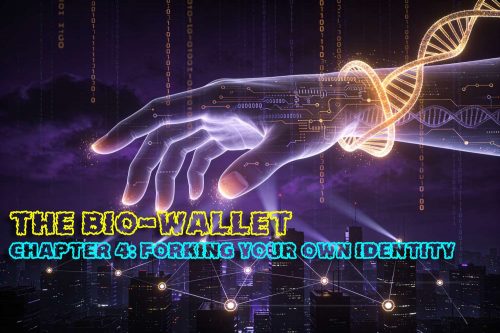
Chapter 4: Forking Your Own Identity
Chapter 5: The Sybil Organ Farm <<<<<< NEXT
Chapter 6: Cellular Consensus
Chapter 7: Burning the Old Flesh
Chapter 8: A Soul’s Provenance
Chapter 9: The Decentralized Self
Chapter 10: More Than a Hash
