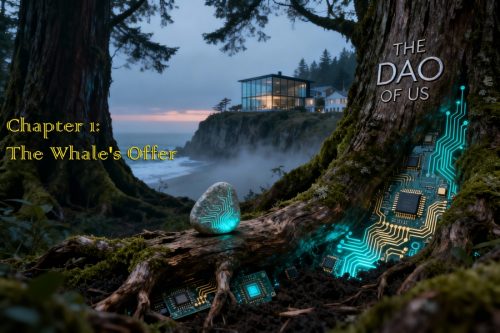
The salt-sting in the air wasn’t just from the ocean anymore. It was the taste of rust on abandoned playground swings, of concrete dust from the shuttered cannery, and of a slow, quiet decay that had settled over the coastal town of Arcadia like a damp fog. For Sam Tanaka, seventeen and feeling twice as old, it was the taste of futility.
He stood on the cracked concrete steps of the Arcadia Community Hall, staring at the notice hammered into the patchy lawn. The sun, weak and pale behind a sheet of high cloud, glinted off the slick plastic sign: ‘FUTURE SITE OF CORVUS ENERGY SERVER FARM – SALE PENDING.’ It was planted where the old wooden sign for “Seabreeze Park” had been, before the town couldn’t afford to fix the splintered benches or the broken sprinklers.
Sam’s hands were buried deep in the pockets of his faded hoodie. He’d been the one, six months ago, to organize the petition to save the park. He’d gotten 287 signatures, which was nearly every adult in town. It hadn’t mattered. The corporate lawyers had sharper pens.
“They’re just waiting for us to die off so it’s easier to scoop up the pieces,” muttered Old Man Finchley, leaning on his cane beside Sam. His voice was a dry rattle of pebbles. “Or for the next storm to finish the job.”
Sam didn’t answer. He was looking past the sign, past the chain-link fence that now surrounded the patch of grass and the single, stubborn pine tree, to where the grey Pacific churned against the crumbling sea wall. His town was a patient in hospice, and everyone was just arguing over the music for the funeral.
“Meeting’s starting, Sam,” said a softer voice. His younger sister, Maya, appeared at his elbow, her dark hair pulled into a messy bun. At thirteen, she carried the town’s anxiety differently than Sam did—not as a weight, but as a constant, buzzing curiosity. “Ms. Flores says they’re already yelling about the dredging machine.”
Sam sighed, the sound swallowed by the vast, indifferent sky. “Okay. Let’s go mediate.”
The hall was a cacophony of despair disguised as debate. The wooden floorboards creaked under the feet of about a hundred of Arcadia’s remaining souls. At the front, the three remaining members of the town council looked like sailors clinging to wreckage.
“—the last dredger we can afford to rent breaks down in two weeks!” bellowed Hal Perkins, his face the color of cooked lobster. He represented the fishing families, what was left of them. “If those channels silt up, my boat—every boat—sits in the mud. We need the funds now!”
“And what good is a boat if our kids can’t read a manual to fix it?” fired back Mrs. Chen from the library board. The library had been reduced to three days a week. “The library roof is leaking onto the history section! We need emergency repairs before the winter rains!”
“History won’t feed us, Li!” Hal shot back.
Sam made his way down the side aisle, offering weak smiles and nods. He was the unofficial peacekeeper, the teen who’d learned that listening was sometimes more powerful than talking. He’d fetched groceries for elders during the last flood, helped re-tar roofs, organized a tutoring co-op for the younger kids using the library’s last working terminals. He was good at band-aids. But the patient was hemorrhaging.
He took his usual spot on a folding chair near the front, Maya slipping in beside him. For an hour, he listened. The dredger. The roof. The failing power grid on the west end. The need for a new water filter for the elementary school. Every plea was valid. Every solution cost money they didn’t have. The council’s emergency fund was a joke, and the state had long ago written Arcadia off as not worth saving.
The atmosphere thickened with a shared, suffocating hopelessness. Arguments dissolved into weary silence. This was the ritual. They met, they fought, they acknowledged the abyss, and they went home.
Just as the council head, a weary woman named Barbara, was about to adjourn with a promise to “look into grants,” the double doors at the back of the hall swung open.
A man stood silhouetted against the grey daylight. He was tall, dressed in a charcoal coat that looked both expensive and strangely out of place, like it had never been touched by sea spray. His hair was silver, swept back from a sharp, intelligent face. He carried no briefcase, only a slender, matte-black device in one hand.
All heads turned. Strangers were rare in Arcadia.
“Forgive the intrusion,” the man said. His voice was calm, smooth, and carried to every corner of the hall without needing to be raised. It was the voice of someone accustomed to being heard. “My name is Alistair Corvus. I believe I have a proposal that might be of interest.”
He walked down the center aisle with a predator’s grace. The townspeople shrank back, not out of fear, but out of a instinctive recognition of a different species. This was not one of them.
“Mr. Corvus,” Barbara said, her councilwoman voice straining for authority. “We’re in the middle of a town meeting. If you’re from the Corvus Energy buyout committee, your lawyers have our contact—”
“I am not here as a buyer,” Corvus interrupted, a faint, polite smile on his lips. He reached the front and turned to face them. His eyes, a cool, assessing grey, scanned the room. They lingered for a moment on Sam, on his attentive posture, then moved on. “I am here as a… patron. An investor in potential.”
A scoff came from the back. “We’re not a charity case!”
“No,” Corvus agreed, his smile unwavering. “Charity is transactional. It creates dependency. I am proposing something far more radical.” He held up the black device. A tap of his finger, and a large, crisp holographic display shimmered to life above the council table. People gasped. Maya leaned forward, enthralled.
The display showed a simple, elegant diagram. A circle labeled “Arcadia Treasury.” Lines radiated out from it to dozens of smaller circles, each labeled “Citizen.”
“Arcadia is dying of a failure of imagination and of tools,” Corvus stated bluntly. “Your systems are centralized, slow, and prone to corruption or collapse. You are at the mercy of distant corporations and indifferent governments.” He paused, letting the painful truth settle. “What if you could be at the mercy of no one but yourselves?”
He tapped again. The diagram animated. Tokens, glowing like blue diamonds, flowed from the treasury to each citizen. “I am prepared to make an irrevocable grant of digital currency to this town. A substantial sum. It will be placed into a secure, transparent, shared account—a Decentralized Autonomous Organization. A DAO.”
The words meant nothing to most in the room. Sam frowned, his mind racing. He’d read about blockchain, crypto—mostly in the context of scams and wild speculation.
“Every citizen over sixteen,” Corvus continued, “would receive one equal, non-transferable membership token in this ‘Arcadia DAO.’ One person, one vote. Not a vote for a representative who might break promises, but a direct vote on how your shared treasury is spent. Do you fund the dredger?” A token icon flew from the citizen circles to a proposal labeled ‘Dredger.’ It glowed green as it reached a majority. “The library roof?” Another flow of tokens. “A new solar grid? A community-owned fishery? You decide. Not a council. Not a mayor. You. Collectively. The code that runs the DAO ensures every transaction is public, verifiable, and unstoppable once a vote passes. No more begging. No more waiting. Sovereignty, in real-time.”
The silence in the hall was absolute. It was the silence of a drowning man being offered a spaceship. It was too strange, too vast to comprehend.
“What’s the catch?” The question, flat and skeptical, came from Sam. He hadn’t meant to speak, but it was out. All eyes, including Corvus’s cool grey ones, shifted to him.
“The catch, young man, is the experiment itself,” Corvus said, his gaze locking onto Sam’s. “I am a student of human nature and of systems. Can a dispersed group, armed with the right tool, govern itself more effectively than a hierarchy? Can you overcome short-term self-interest for long-term communal good? The catch is the work. The debate. The responsibility. The treasury is a tool. I am curious to see what you will build with it.”
“Why us?” someone shouted.
“Because you have everything to lose, and therefore, everything to gain,” Corvus replied. “And because your town, isolated and overlooked, is a perfect… laboratory. A clean slate.”
The word ‘laboratory’ sent a chill down Sam’s spine. But then he looked around. He saw Hal Perkins, his anger replaced by a desperate, calculating hope. He saw Mrs. Chen’s eyes alight with the vision of a restored library. He saw Old Man Finchley looking less like a monument to decay and more like a person with a future.
“How… how much?” Barbara asked, her voice hushed.
Corvus named a figure. The gasp was collective. It was more money than the town had seen in fifty years. It was lifeline money. It was miracle money.
A torrent of questions erupted. Corvus handled them with unflappable patience. The tokens were free, non-tradeable, solely for voting. The treasury was held in a public “smart contract” anyone could audit but no one could alter alone. Votes would happen on a simple app. He would provide the initial tech framework and education.
As the meeting dissolved into a buzzing hive of excited clusters, Corvus made his way through the crowd toward the exit. He stopped beside Sam and Maya.
“You asked the core question,” he said to Sam. “That is a useful skill.” From his coat pocket, he produced two small, physical objects. They looked like polished stone chips, embedded with a faint, circuit-like glow. He handed one to Sam and one to Maya. “A tangible reminder. Your genesis tokens. The digital ones will be in your app wallets tomorrow.”
Maya turned the cool token over in her palm. “It’s pretty,” she said.
“It is power,” Corvus corrected gently. “Use it wisely.” He looked at Sam again. “They will need translators. People who can bridge the old world and the new. I suspect you may be one of them.”
Then he was gone, the doors swinging shut behind him, leaving the hall buzzing with a frenetic, fragile energy Sam hadn’t felt in years. It was hope.
Later, in the small, cluttered living room of their home overlooking the restless sea, Sam sat at the table, the token glowing softly under the dim light. He’d downloaded the sleek, simple “Arcadia DAO” app. His balance said 1.0 ARC. The proposal board was empty, waiting.
Maya sat on the sagging couch, still studying her token. “Sam?” she asked, her voice small in the quiet.
“Yeah?”
“What happens,” she asked, looking up with her clear, earnest eyes, “if we push the wrong button?”
Sam stared at the holographic interface on his screen, so clean, so promising. He thought of the furious debates in the hall, of Hal’s desperation and Mrs. Chen’s passion, of Mr. Corvus’s cool, evaluating gaze. A laboratory.
He looked back at his sister, the one person he was truly trying to save this town for. He had no answer. The taste of the sea air through the open window was still there, but now it was mixed with the electric, metallic scent of a future unknown. The Whale had offered them the ocean. Now they had to learn how to swim—or decide if they were just being fed to something bigger, lurking in the depths.
Table of contents:
Introduction
Chapter 1: The Whale’s Offer
Chapter 2: Genesis of the Arcadia DAO
Chapter 3: Proposal #001: Save the Old-Growth Net
Chapter 4: The Sybil Attack
Chapter 5: Liquid Democracy
Chapter 6: Rug Pull Threat
Chapter 7: Forking the Future
Chapter 8: The IRL Bridge
Chapter 9: Consensus in the Chaos
Chapter 10: From DAO to Home
NEXT >>> Chapter 2: Genesis of the Arcadia DAO
