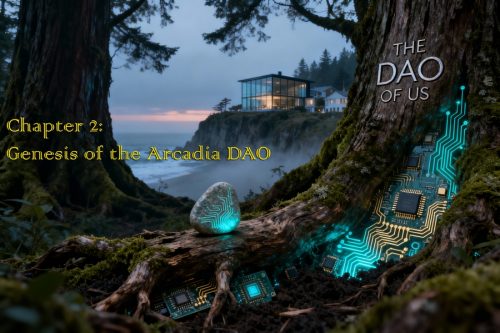
The hope that had filled the community hall curdled into anxiety within forty-eight hours.
The “Arcadia DAO” app sat on nearly every phone in town, a sleek icon of a wave encircling a pine tree. People had their 1.0 ARC token. They could see the treasury balance—a number so absurdly large it seemed like a typo—and a stark, empty list labeled “Live Proposals.” And nothing happened.
Confusion was the first product. A line formed outside the tiny town library, now open extra hours, as Mrs. Chen tried to explain “digital wallets” and “gas fees” using a whiteboard covered in frantic diagrams. Hal Perkins nearly threw his phone into the bay after failing three times to “sign” a test transaction with his password. The council was paralyzed, waiting for direction that didn’t come. Mr. Corvus was gone, leaving only a single, automated email address for “technical inquiries.”
The grand experiment in self-sovereignty was failing at the first hurdle: user interface.
Sam felt the pressure like a physical weight. He’d become the default point of contact, not by election, but by default. He was the one who’d asked the question. He had the Whale’s attention. Elders stopped him on the street, their faces etched with worry. “Sam, how do I vote for the dredger? My son set up this app, but I don’t dare touch it.” The desperate hope he’d seen was turning back into the old, familiar despair, now tinged with a new layer of technological impotence.
They needed a builder. Not a politician, not a community mediator, but a coder. Someone who spoke the language of this new world. Sam knew exactly who he needed, and the thought filled him with a profound sense of dread.
Jinx didn’t live in a house; she occupied a territory. It was the rusted shell of a former weather station perched on the northern bluffs, where the town’s wifi signal was a whisper and the wind screamed like a banshee. Satellite dishes, some salvaged, some bizarrely modified, bristled from the roof like metallic fungi. This was the workshop of Arcadia’s ghost—a sixteen-year-old hacker most people knew only from rumor and the occasional, inexplicable blip in the municipal power grid.
Sam’s bike tires crunched over a carpet of electronic debris as he approached. The door was a slab of reinforced ship’s hull, ajar. He knocked on the cold metal.
“Go away. I’m not buying, selling, or saving anyone’s soul today.” The voice from inside was sharp, layered with static from a dozen speakers.
“It’s Sam Tanaka. From the town.”
A pause. “Even worse. The negotiator. Did the council send you to ask me to pay for electricity?”
Sam pushed the door open. The interior was a cathedral of chaos. Server racks hummed in the corner, their LED lights casting a blue glow on walls papered with schematics, anarchist symbols, and faded maps of the internet’s physical backbone. In the center, surrounded by a nest of cables and three mismatched monitors, sat Jinx. She was small, swimmer-lean, with hair dyed the color of oxidized copper and cut in a jagged, self-administered style. She didn’t look up, her fingers flying across four different keyboards.
“We need your help,” Sam said, stepping inside, careful not to trip on a bundle of fiber-optic cable.
“Not interested in your municipal bankruptcy,” Jinx said, her eyes glued to a scrolling waterfall of code. “You people had your chance to build something resilient. You chose to trust corporations and governments. Enjoy the consequences.”
“This is different.” Sam pulled out his phone, opened the DAO app, and placed it on the edge of her desk. “It’s a DAO. Corvus funded it. The town controls the treasury.”
For the first time, Jinx’s fingers stilled. She swiveled in her chair, snatched the phone, and her dark, kohl-rimmed eyes scanned the screen with predatory speed. She scoffed, a short, sharp sound. “A curated UI wallet front-ending a Gnosis Safe multisig. Basic quadratic voting template. Probably an OpenZeppelin governance contract.” She tossed the phone back to him as if it were contaminated. “It’s a puppet show. The Whale holds the admin keys. He can freeze it, alter it, or rug-pull it whenever he gets bored. You’re not sovereign; you’re lab rats in a prettier cage.”
Sam’s heart sank. But her skepticism was informed. She understood the machinery. “Corvus said no admin controls. The code is law.”
Jinx barked a laugh. “And you believed him? Code is only law if you can read it, audit it, and enforce it. Can you? Can any of them?” She jerked a thumb toward the town below.
“No,” Sam admitted, the frustration boiling over. “But I can read faces. I can read desperation. Hal Perkins’s boat is his life. Mrs. Chen’s library is the town’s memory. They’re going to lose both. This…” he pointed at the phone, “is the only tool anyone’s ever given us that isn’t attached to a choke-chain. Maybe it’s flawed. Maybe it’s an experiment. But it’s something. And right now, it’s failing because no one knows how to use it.”
He took a breath, his mediator’s calm reasserting itself. “You could fix that. You could build the real thing. One with no choke-points. Where the code actually is the law.”
Jinx studied him, her head tilted like a curious bird of prey. The hum of the servers filled the silence. “Why would I waste my cycles saving a community that’s spent my whole life ignoring me? Or worse, blaming me for every brownout?”
“Because you’d get to build it right,” Sam said, latching onto the only thread he sensed in her. Not compassion, but craftsmanship. Ideology. “You could prove your point. That radical decentralization works. That people don’t need kings or councils or… or Whales. You could build the cage so that no one, not even you, has the key.”
A light flickered in Jinx’s eyes—not kindness, but the fierce joy of a supreme challenge. The pure, technical and philosophical puzzle of it. To build a perfect, trustless system.
“Zero admin keys,” she stated, her voice flat.
“Zero admin keys,” Sam agreed.
“No backdoors. No overrides. The contract is immutable once deployed.”
“Immutable.”
“And I don’t take orders from you, or the council, or anyone. I architect the system according to first principles. You handle the… mammal interface.”
“The what?”
“The people, Sam. You handle the people.”
Sam extended his hand. “Deal.”
She looked at his hand as if it were a biological hazard, then turned back to her keyboard. “Go away. I need to read Corvus’s contract line-by-line and then burn it down. I’ll send you a prototype in 72 hours. Tell your people to stop clicking on ‘test vote’ buttons. They’re wasting gas.”
The next three days were a blur of two parallel worlds grinding into alignment. Sam became the bridge.
Jinx worked in a furious, silent storm of creation. Cryptic, jargon-filled messages would arrive at 3 AM: “Implementing conviction voting to prevent flash loans. UI needs a delegate visualization.” Sam would decouple the core need—“People need to see how voting power builds up over time if they stay committed to an idea”—and then spend the day in the library or the diner, sketching interface ideas on napkins, gathering feedback.
Maya became an unwitting but invaluable beta-tester. She’d sit with Sam’s tablet, tapping through Jinx’s crude prototypes. “Why is the ‘yes’ button grey?” she’d ask. Or, “What does ‘delegate my voting power’ mean? Like giving someone my lunch money to buy for me?” Her simple, human-centric questions were a compass in the technical wilderness. Sam would relay them to Jinx, who would initially respond with exasperated screeds about “agency” and “sovereign individualism,” then, hours later, send a revised build with a clearer tooltip or a more intuitive flow.
They clashed constantly. Sam wanted real names attached to proposals for accountability. Jinx demanded total pseudonymity to prevent coercion. They compromised with a system of self-chosen, persistent “handles” that were cryptographically tied to a real identity only in a way that could be revealed in case of serious fraud—a concept Jinx loathed as a “backdoor” and Sam saw as a necessary “emergency brake.”
Sam wanted a clear, structured proposal process with categories. Jinx wanted a free-form, meme-filled forum where ideas could emerge organically. They settled on a hybrid: a formal proposal tracker, linked to a bustling, anonymous town square forum she called “The Agora.”
Through it all, they built. Sam saw past Jinx’s abrasive, misanthropic shell to the terrifying clarity of her intellect. She wasn’t building a tool for Arcadia; she was building a Platonic ideal of a governance machine, and Arcadia happened to be the first organism to inhabit it. Her obsession with perfect, unstoppable code was the flip side of her utter disdain for imperfect, unreliable people.
Finally, the day came. The “Arcadia DAO – True” app propagated to phones. It was leaner, meaner, and far more powerful. The treasury from Corvus’s original contract had been, with a breathtaking series of transactions Sam only half-understood, “forked” into Jinx’s new, audited, and truly decentralized structure. Corvus’s original, sleek app went dark. The new one bore Jinx’s aesthetic: functional, a little brutalist, but profoundly transparent. A link next to the treasury balance read: [AUDIT SMART CONTRACT].
The launch party was in the community hall, but the nervous energy was different this time. Jinx stood in the corner, a scowl on her face, arms crossed as if defending herself from the crowd’s optimism. Sam stood at the front with a terminal linked to a large screen.
“This is it,” Sam said, his voice calm but amplified. “The old contract is void. Our funds are now held here.” He pointed to a long, alphanumeric address on the screen. “No one can touch them without a successful vote from us. Not me, not Jinx, not Mr. Corvus. The rules are locked. Now… we rule.”
He took a deep breath. “Our first proposal. Ms. Flores, would you like to do the honors?”
The elderly woman, whose ancient fishing net had finally given out last week, shuffled forward. With Sam’s gentle guidance, she navigated to the proposal screen on a tablet. Her gnarled finger hovered, then tapped. She typed slowly: “Proposal #001: Replace my shrimp net. Cost: 120 ARC.”
She hit submit. A transaction hash appeared on the big screen. The proposal was now live. A 24-hour voting period began.
People stared at their phones. Hal Perkins, with a grunt of triumph, clicked “Yes.” Mrs. Chen smiled and did the same. One by one, blue “Yes” tokens cascaded into the proposal’s vote tally on the main screen. No “No” votes appeared. In fifteen minutes, it passed with 100% approval. A minute later, a notification popped up on Ms. Flores’s phone: “Proposal #001 Executed. 120 ARC transferred to verified vendor ‘Arcadian Marine Supply.’ Delivery scheduled.”
A spontaneous cheer erupted. Ms. Flores hugged her tablet, tears in her eyes. It worked. A community need had been identified, ratified, and funded in under an hour, without petitions, without council meetings, without begging.
Sam felt a surge of elation. He looked over at Jinx. She wasn’t smiling, but the hard set of her jaw had softened slightly. She gave a single, slow nod. The machine worked.
Later, as the celebratory mood simmered, Maya tugged on Sam’s sleeve. She was frowning at her phone, navigating the “Agora” forum. It was already filling with jokes, memes about the vote, and a new, anonymous post proposing a community barbecue.
“Sam,” Maya whispered, pointing to the forum’s rules. “It says here anyone can say anything, and no one knows who they are. What’s to stop someone from being really mean?”
Before Sam could answer, Jinx’s voice cut in from behind them. She’d overheard. “Nothing. That’s the point. Truth doesn’t need a name tag. Forced identity is a tool of control.” She said it like a sacred creed.
Sam looked from Jinx’s fierce, idealistic face to Maya’s worried one. He thought of the fragile, hard-won civility of the town hall. “What if truth gets drowned out by noise?” he asked quietly. “Or by lies?”
Jinx shrugged, a gesture of supreme faith in her system. “Then the community is flawed. The code is pure. The Agora is a mirror. Maybe you won’t like what you see.”
She turned and walked back into the night, toward her lighthouse of servers on the bluff. Sam watched her go, the euphoria of the successful vote cooling. They had built a perfect, unstoppable engine of democracy. But as he looked at the glowing, anonymous chatter already blooming on the forum—a mix of celebration, silly jokes, and one already-cynical post asking “who Flores is sleeping with to get a free net?”—he wondered if they had just removed the guardrails from a very steep road. The genesis was complete. The experiment was now truly, terrifyingly, in their own hands.
Table of contents:
Introduction
Chapter 1: The Whale’s Offer
Chapter 2: Genesis of the Arcadia DAO
Chapter 3: Proposal #001: Save the Old-Growth Net
Chapter 4: The Sybil Attack
Chapter 5: Liquid Democracy
Chapter 6: Rug Pull Threat
Chapter 7: Forking the Future
Chapter 8: The IRL Bridge
Chapter 9: Consensus in the Chaos
Chapter 10: From DAO to Home
NEXT >>> Chapter 3: Proposal #001: Save the Old-Growth Net
PREVIOUS <<< Chapter 1: The Whale’s Offer
