For two weeks, the Arcadia DAO ran on the gentle, reassuring fuel of small-scale consensus. Proposal #002 funded new textbooks for the school. Proposal #003 paid for a month of diesel for the community generator. Each vote passed with overwhelming, feel-good majorities. The app’s notification ping became a sound of progress, a digital heartbeat for the town. People began to joke about “DAO-ing” things. “We should DAO a repaint of the lighthouse,” someone would say in the diner. It felt like a game they were all winning.
Sam allowed himself to hope. He spent his days helping people navigate the platform, explaining how to delegate votes, and basking in the simple, tangible good it was doing. Jinx remained in her aerie, monitoring the blockchain’s immutable ledger with the intensity of a hawk, but the system was running smoothly. The machine was working.
Then, Proposal #004 was submitted. It was titled simply: “Preserve the Old-Growth Net.”
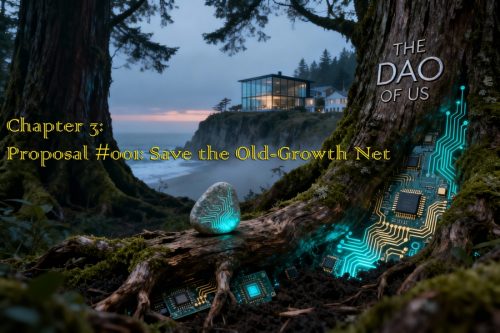
It was authored by a user named @GreenAnchor. The proposal was stark in its elegance. It requested the allocation of 65% of the remaining treasury to purchase, in perpetuity, the 200-acre tract of ancient forest on the northern ridge—the last old-growth ecosystem in the region. It included plans for a conservation trust, minimal eco-trails, and a clause that the land could never be sold or developed. The “Net” was more than trees; it was a complex, living web of life, a rain-catcher for the watershed, and the town’s crumbling spiritual backbone.
The town’s response was immediate and visceral. A wave of “Yes” votes flooded in within the first hour. Comments in the Agora forum were celebratory. “Our heritage!” “For our grandchildren!” “The lungs of Arcadia!”
But the celebration was short-lived. Three hours later, a counter-proposal appeared: “Proposal #005: Arcadia Sovereign Server Farm Initiative.”
Its author was @SteelTide. This proposal was a masterpiece of pragmatic, hard-edged argument. It requested 70% of the treasury to purchase the same plot of land, clear it (with sustainable timber being sold to offset costs), and build a state-of-the-art, community-owned data server farm powered by offshore wind. It projected long-term revenue, high-tech jobs for the youth, and “economic sovereignty through infrastructure, not sentiment.”
A cold silence fell over the digital town square. Then, the war began.
It started rationally. @GreenAnchor posted links to ecological studies on old-growth carbon sequestration and watershed protection. @SteelTide countered with economic models showing the server farm’s revenue potentially funding not just the dredger and the library, but universal basic income for the town within five years.
Then, the anonymity Jinx had baked into the Agora began to show its fangs.
@TrueArcadian wrote: “Only a selfish purist would choose a bunch of rotting trees over their neighbor’s job. Some of us have families to feed.”
@Rootkeeper fired back: “Only a short-sighted profiteer would sell our soul for a server rack. Your ‘jobs’ will last until the next tech crash. The Net has stood for a thousand years.”
The debate spilled out of the app. At the docks, Hal Perkins, who had voted for the server farm, got into a shouting match with young Liam’s father, a park ranger who was @GreenAnchor’s most vocal supporter. The diner split into two camps. Old friendships strained under the weight of the binary choice: Past or Future? Heart or Head?
Sam watched, his mediator’s instincts screaming in alarm. He tried to post neutral, clarifying questions on the proposals. His posts were drowned in the tide of rhetoric. He called Jinx.
“This is getting toxic,” he said, standing on the bluffs outside her station, the wind whipping his words away.
“It’s debate,” Jinx’s voice crackled from a speaker. “It’s messy. That’s the point. The system is handling it.”
“The system is amplifying it!” Sam shot back. “No one has to stand by their words! They can be as cruel as they want behind a handle!”
“If a truth is only spoken when attached to a name, is it really a principle, or just reputation management?” she retorted. “Let the ideas fight. The best one will win.”
But Sam wasn’t so sure. The “best” idea was fracturing his community. He saw it at home. Maya had been quiet for days. She spent hours in the forest, taking pictures of ferns and banana slugs. She’d come home smelling of damp earth and pine, her face set in a worried frown.
One evening, she finally spoke. “Liam isn’t coming to school,” she said, pushing her dinner around her plate.
“Is he sick?” Sam asked.
“No. His dad voted for the forest. Liam’s best friend, Cody, his dad voted for the server farm. Cody told Liam his family was lazy and living in the past. They got in a fight. Now they’re not talking.” She looked up, her eyes bright with confusion. “It’s just trees and computers. Why are people being so mean?”
Because it’s not about trees or computers, Sam thought with a sinking heart. It’s about fear. Fear of being left behind, and fear of losing what little is left. The DAO had given them a voice, but it had also given their fears a megaphone.
The vote tallies seesawed dramatically. One hour, the Forest led by 20 votes. The next, the Server Farm would surge ahead. It was clear the town was almost perfectly divided. The gentle consensus of the early days was a distant memory.
Jinx, monitoring the blockchain, noticed something odd. The voting patterns weren’t just shifting; they were lumping. Small clusters of wallets would delegate their voting power to @SteelTide all at once, then another cluster to @GreenAnchor. It was as if factions were forming, with unofficial leaders emerging from the anonymous fog. She found it fascinating—a natural emergence of digital tribalism.
On the final day of the voting period, the tension was a live wire. The proposals were within five votes of each other. The entire town seemed to be holding its breath, phones in hand, refreshing the app.
Sam stood in the community hall, now a neutral ground, watching the vote tally update on the large screen. The physical space was silent, but the digital Agora was a roaring, scrolling battleground of final, desperate arguments and accusations.
@SteelTide posted: “Last chance to save your town from becoming a museum. Vote for the future.”
@GreenAnchor responded: “The future is built on a healthy foundation, not a digital graveyard. Save the Net.”
With two hours to go, the Server Farm proposal pulled ahead by three votes. A groan went up from half the room. Sam felt sick.
Then, it happened.
The tally for the Server Farm proposal began to climb. Not by ones or twos, but in jumps of five, then ten. 320… 335… 350… 400…
The line on the graph shot upwards vertically. The Forest proposal’s votes froze.
Silence in the hall turned to bewildered murmurs, then to uproar.
“What’s happening?” someone yelled.
“It’s cheating!”
“Who are these votes?”
Sam stared, his blood running cold. The Server Farm votes were now at 450, far exceeding the total number of genesis tokens ever distributed. He fumbled for his phone and called Jinx.
Before he could speak, her voice came through, sharp and electrified with a perverse kind of awe. “It’s a Sybil Attack.”
“A what?”
“Someone,” she said, the sound of furious typing in the background, “has just created hundreds, maybe thousands, of fake identities. They’ve spun up bot wallets, each with a voting token, and they’re all voting in sync.” Her voice held no panic, only a intense analytical fervor. “It’s a flaw in the one-token-one-person assumption. A classic attack vector. I didn’t think… I didn’t think they’d have the resources or the know-how.”
“Can you stop it?” Sam demanded, his heart hammering.
“No,” she said, flatly. “The votes are valid. The signatures check out. The code is working perfectly. It’s the social layer that’s been compromised. The system is under attack from a ghost army.”
On the big screen, the voting period ended. “Proposal #005: Arcadia Sovereign Server Farm Initiative – PASSED” flashed in stark, triumphant letters.
The hall erupted in chaos. Those who had voted for the server farm looked around, their victory hollow, tainted by the obvious fraud. Those who had voted for the forest were white with rage and betrayal.
Sam sank into a chair, the noise washing over him. He looked at the screen, at the illegitimate, impossible result now permanently etched into the blockchain. He wasn’t thinking about code flaws or attack vectors. He was thinking of Liam and Cody, of Hal’s desperate face, of Maya’s confusion.
Jinx’s words echoed in his head: “The system is handling it.”
But the town wasn’t. The perfect, trustless machine had been gamed. And in the shimmering, unforgiving ledger of the Arcadia DAO, the lie was now the law. The Old-Growth Net was condemned, not by the will of the people, but by the silent, soulless click of a thousand puppets. The experiment had just gotten its first taste of poison.
Table of contents:
Introduction
Chapter 1: The Whale’s Offer
Chapter 2: Genesis of the Arcadia DAO
Chapter 3: Proposal #001: Save the Old-Growth Net
Chapter 4: The Sybil Attack
Chapter 5: Liquid Democracy
Chapter 6: Rug Pull Threat
Chapter 7: Forking the Future
Chapter 8: The IRL Bridge
Chapter 9: Consensus in the Chaos
Chapter 10: From DAO to Home
NEXT >>> Chapter 4: The Sybil Attack
PREVIOUS <<< Chapter 2: Genesis of the Arcadia DAO
