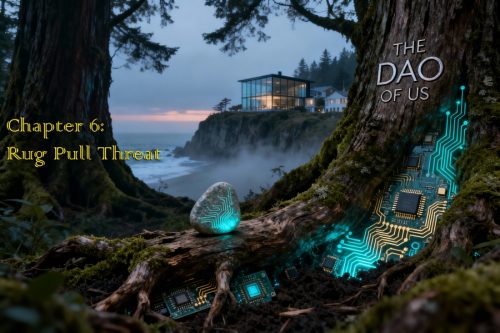
The victory was quiet, but profound. The Arcadia DAO didn’t become a utopia overnight—it became functional. It became theirs. The liquid democracy model was like a muscle the town had never known it possessed; it was awkward at first, prone to spasms of over-delegation or indecision, but with each passing week, it grew stronger.
Proposals flowed through the new system like water finding its level. Funds were allocated to repair the sea wall, with Old Man Finchley stewarding a clear majority. A community composting initiative passed, its steward a quiet gardener named Rosa who had patiently explained the soil science on the Agora. The debate was present, but it was productive debate. The anonymous bile had largely drained away, replaced by accountable, if passionate, discussion between known entities. The Sybil Attack wasn’t forgotten, but it was fossilized—a lesson embedded in their new, more resilient code.
Sam allowed himself, for the first time in years, to breathe. He spent less time firefighting and more time participating. He delegated his “infrastructure” vote to a retired civil engineer and his “arts” vote to Mrs. Chen. He kept his own vote on community matters, reveling in the simple act of considered choice. He watched Maya thrive, delegating her “environment” token to Liam’s father and her “education” token to a sharp-witted high school senior. She was growing up inside this system, learning a new literacy of consent and trust.
Jinx remained in her library-citadel, a less volatile but more solemn presence. The weight of the hundreds of delegation tokens she held on protocol security was a crown she never wanted but wore with grim responsibility. She published transparent, weekly audits of the smart contracts. She ran educational threads explaining attack vectors. She had become, to her own horror, a trusted institution. Sam saw the conflict in her—the anarchist forced to become a guardian—but he also saw a new, steely pride in her work. She was no longer just building for herself.
It was in this fragile, hopeful equilibrium that Mr. Corvus returned.
His message was a model of polite brevity, delivered to both Sam and Jinx’s official steward addresses: “Requesting a review of the Arcadia DAO’s trajectory. My waterfront property, tomorrow, 10 AM. Tea will be served.”
The invitation felt like a cold stone dropped into the warm pond of their progress. Sam’s earlier suspicions about the Sybil Attack being Corvus’s work had never been proven, and the urgency of building liquid democracy had pushed it aside. Now, the Whale was back, and his timing felt deliberate.
The “waterfront property” was a stark, modern glass structure perched on the southern cliffs, the only building in town that seemed to repel salt and weather. It was a monument to observation, not belonging.
They were ushered in by a silent assistant. The interior was all cool whites, bleached woods, and breathtaking, sterile views of the tumultuous sea. Corvus stood by a floor-to-ceiling window, looking every bit the part of a benevolent, distant god.
“Sam, Jinx,” he said, turning with a smile that didn’t reach his eyes. “Thank you for coming. Please, sit. Your progress has been… fascinating to observe.”
He served tea himself, the ritual precise and unsettling. “The Sybil incident was a valuable stress test. And your response—liquid democracy—was genuinely innovative. A clever patch on the human problem.” He took a sip. “However, it has steered the experiment in a direction I did not anticipate.”
Sam’s guard went up. “The direction of the community’s will,” he said carefully.
“The direction of preservation over progress,” Corvus corrected gently. “Sentiment over viability. You’ve created a very efficient system for maintaining the status quo. The Old-Growth Net, the sea wall, the library roof… these are all worthy, but他们是维护, not creation. They are expenses, not investments.”
Jinx’s eyes narrowed. “The community decides what constitutes value. That was the premise.”
“The premise,” Corvus said, setting his cup down with a soft click, “was self-governance within a framework of sustainable viability. My initial grant was not an endowment for a museum. It was seed capital for a new economic organism. An organism that, according to my metrics, is trending toward stagnation.”
He walked to a sleek terminal and tapped a key. A holographic display materialized, showing graphs of the DAO’s treasury outflows. “Your burn rate on preservation and maintenance is 84%. Your proposals for generative, revenue-creating projects? Less than 10%. You are consuming your seed capital. You are, in economic terms, dying.”
“We’re healing,” Sam countered, his voice tight. “We’re fixing the foundations that were left to rot.”
“And what will you do when the treasury is empty?” Corvus asked, his grey eyes locking onto Sam’s. “Return to begging? The experiment will be recorded as a failure. A charming, democratic failure.”
“What do you want?” Jinx asked, her voice flat and dangerous.
Corvus smiled. “A course correction. I want you to leverage your impressive new system to pass a proposal for genuine growth. The server farm concept was… crude. But the principle stands. I have drawn up plans for a modular, eco-sensitive data co-op, with guaranteed offtake agreements from a green tech firm I’m affiliated with. It would provide steady, decentralized income for the DAO in perpetuity.”
He slid two tablets across the polished table. The plans were detailed, beautiful, and invasive. They still required the Old-Growth Net land.
“You’re asking us to undo the biggest decision we’ve ever made,” Sam said, disbelief washing over him.
“I am asking you to make a mature decision,” Corvus said. “Pass this proposal. Demonstrate that your democracy can make hard choices for long-term survival. Do this, and my support continues. My… observations… will be most favorable.”
“And if we don’t?” Jinx whispered.
Corvus’s polite façade evaporated. It didn’t crack; it simply vanished, replaced by an expression of chilling, analytical coldness. “Then the experiment concludes. And I withdraw my capital.”
Sam barked a laugh, a dry, hopeless sound. “You can’t. The treasury is in the smart contract. It’s immutable. It belongs to the DAO.”
“Ah,” Corvus said, and the sound was a door slamming shut. “That is the cornerstone of your misunderstanding.”
He picked up a different tablet, called up a block explorer, and navigated to the very first, original contract—the one he had provided, the one Jinx had forked away from. He zoomed in on a densely packed section of code, a function tucked away amongst boilerplate that Jinx, in her furious audit, had categorized as a standard ‘emergency pause’ feature—rarely used and usually controlled by a multi-signature wallet.
“You forked the treasury,” Corvus said, his finger hovering over a single, cryptographic address listed as the controller of that function. “But you were in such a hurry to escape my original cage, you didn’t realize this particular lock was welded to the capital itself, not the cage. This clause is tied to the token mint. It’s a ‘Founder’s Governance Token.’ A single key.”
Jinx was already on her feet, her face bloodless. She stared at the code, her lips moving silently as she parsed it. Sam watched the horror dawn in her eyes—not anger, but the devastating horror of a master architect who has missed a single, critical fissure in the foundation.
“It’s a rug pull clause,” Jinx breathed, the term sounding obscene in the pristine room.
“A safety mechanism,” Corvus corrected. “A failsafe if the experiment threatened the principal. Which, in my assessment, it now does. This token grants me the unilateral right to withdraw the entire treasury balance, minus a small… facilitator’s fee.” He looked at them, a predator who has finally shown his teeth. “You have forty-eight hours to pass the data co-op proposal. If you do not, I will execute the withdrawal. The Arcadia DAO will be an empty shell. Your town will be exactly where it was, only poorer in spirit.”
The walk back into town was a silent, nightmare trek. The sun was too bright, the sounds of life too cheerful. Sam felt hollowed out, the hopeful scaffolding of the last few months crumbling to dust inside him. They had been tenants all along, building beautiful additions on a house whose deed they never held.
Back in the library server room, Jinx finally exploded. Not at Corvus, but at herself. She hurled a empty energy drink can against the wall, a sharp, aluminum crack.
“I read it! I audited it! It was hidden in plain sight! A fucking ‘pauseWithdrawal’ function with a single-point controller! I assumed it was a dead function! He owns us!” Her voice broke, raw with a shame Sam had never heard in her. “My perfect, trustless system… it was built on a poisoned well. I failed.”
“We both failed,” Sam said, his voice dull. “I was so busy looking at the people, I forgot to fear the one who brought the table.”
They sat in the ruins of their hope.
“What do we do?” Sam asked. “We can’t pass his proposal. The town won’t do it. Not after everything. It would break the DAO more surely than emptying it.”
“If we tell them,” Jinx said, staring at a blinking server light, “it will be a panic. A run. People will try to spend the treasury down before he can pull it, which will just create chaos and prove his point about our immaturity.”
“So we lie? We coerce the vote?” Sam shook his head. “That’s what he’s doing. Then we become him.”
The silence stretched, filled only by the hum of machines running a beautiful, pointless simulation of sovereignty.
Then, Jinx looked up. The fury and shame in her eyes had been refined into something else: a cold, radical clarity. It was the look she’d had when she first proposed forking from Corvus’s original contract.
“What if,” she said, her voice barely a whisper, “we don’t play his game?”
Sam stared at her. “What other game is there?”
“We took his treasury once,” she said, a dangerous spark in her eyes. “We forked it into my new contract. But we left his original chain, his original… trap… behind.”
“Right. And he just showed us the trap is still attached to the money.”
“So we do it again,” Jinx said, leaning forward. “But this time, we don’t just fork the treasury. We have to fork everything. The entire state. The token holdings, the delegation graph, the proposal history. We copy it all onto a brand new chain, a chain where his Founder’s Token doesn’t exist because it was never minted there. We leave him holding his singular, powerful key… to an empty room.”
Sam’s mind reeled. “Is that even possible?”
“It’s called a hard fork with a state migration. It’s the nuclear option. It’s what you do when a community is fundamentally at odds with its rulers. It’s the ultimate expression of consensus.” Her excitement was building, technical and revolutionary. “But it only works if everyone—or nearly everyone—agrees to move. If only half of us go, the treasury splits, both communities are crippled, and Corvus still drains the old one. It requires… unanimous belief.”
Sam looked out the library window at the town. He saw Hal mending a net, Mrs. Chen arranging books on a cart, Maya laughing with friends. He saw the fragile, hard-won trust, the web of delegated votes, the muscle of their new democracy.
Could they ask them to take a leap of faith that massive? To abandon the very blockchain they’d just learned to trust, based on a threat most of them wouldn’t understand?
Jinx’s whisper hung in the air, a ghost of a possibility. We don’t play his game.
The rug had been pulled, revealing the abyss beneath. Now they had to decide if they had enough faith in each other to build a new floor, in mid-air, before they fell.
Table of contents:
Introduction
Chapter 1: The Whale’s Offer
Chapter 2: Genesis of the Arcadia DAO
Chapter 3: Proposal #001: Save the Old-Growth Net
Chapter 4: The Sybil Attack
Chapter 5: Liquid Democracy
Chapter 6: Rug Pull Threat
Chapter 7: Forking the Future
Chapter 8: The IRL Bridge
Chapter 9: Consensus in the Chaos
Chapter 10: From DAO to Home
NEXT >>> Chapter 7: Forking the Future
PREVIOUS <<< Chapter 5: Liquid Democracy
