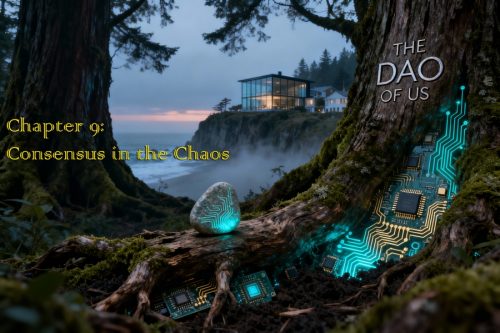
The storm didn’t care about blockchains. It didn’t care about forks, or sovereignty, or the beautiful, terrifying leap of faith they had just taken. The storm was physics, raw and unchecked. As the last digital “Yes” vote settled onto the pristine, new ledger of Arcadia Prime, ratifying it as their home, the wind outside the community hall screamed like a thing in pain, and the world went from dark to black.
The power was out for good. The glow of phones that had guided their migration was now the only light in a sea of ink. The triumphant silence following the vote shattered into a new, more primal chaos.
“The west road’s gone!” a voice yelled from the doorway, barely audible over the gale. “Telephone pole came down, took out the Petersons’ carport!”
“Generator at the clinic is flooding!” another voice, this one from a crackling walkie-talkie.
“We need sandbags at the lower dock! The water’s coming up over the sea wall!”
The abstract, digital crisis was over. The immediate, physical one was just beginning. For a disorienting second, Sam stood frozen on the stage, the architect of a new digital world, utterly useless in the face of a collapsing physical one. The old reflexes of their decaying town kicked in—people shouted into the dark, plans collided, a sense of helpless overwhelm began to rise like the floodwaters.
Then, a single, bright ping cut through the noise. Not from one phone, but from dozens. A notification from the Arcadia Prime DAO app.
EMERGENCY PROPOSAL #1 (AUTO-GENERATED):
Title: Delegate Emergency Authority for Storm Response.
Proposer: System (Crisis Protocol).
Summary: Activates liquid democracy crisis mode. Designate stewards for: 1) Medical/Rescue, 2) Infrastructure/Safety, 3) Shelter/Logistics. Stewards gain temporary power to allocate emergency funds from Community Crisis Sub-Wallet without standard voting delay. Authority expires in 24 hrs.
[VOTE YES/NO/DELEGATE]
Jinx. She’d built a failsafe for the failsafe. A protocol buried in the new constitution, triggered by a combination of meteorological data feeds and a 90%+ consensus event. The system was anticipating their needs.
In the dark hall, people stared at their glowing screens. This was familiar. This was their tool. The panic didn’t recede, but it was channeled.
“Doc Harlow!” someone shouted. “You’re medical! Steward!”
The elderly doctor, his face pale in the phone-light, fumbled with his app. A tag by his name, #Medicine, began to glow. Delegation tokens from across the hall started flowing to him instantly. He was no longer just a retired doctor; he was the community’s appointed medic, with the digital mandate and treasury access to commandeer supplies, fuel for ambulances, whatever he needed.
“Hal! You know the boats and the docks! Infrastructure!”
Hal Perkins, still holding Old Man Finchley’s phone, saw his own #Marine_Safety tag illuminate. Tokens surged to him. His authority was now formal, backed by the communal will.
Mrs. Chen’s #Community_Organizing tag lit up. She became the steward for shelter and logistics, directing people to safe buildings, organizing food distribution from the diner’s failing freezer.
It wasn’t perfect. It wasn’t instant. But it was order emerging from the chaos, built on the web of trust they had just used to save themselves. The DAO was no longer just governing; it was coordinating. It was the central nervous system of a town under attack, and the signals were firing along paths of established trust.
Sam’s role transformed. He became a runner, a physical node. He didn’t need a stewardship tag; his was #Bridge. He relayed information from the digital front to the physical one. He sprinted through the lashing rain to tell a team with chainsaws that their labor was now tokenized and funded, the payment guaranteed on the chain. He carried messages from Doc Harlow at the makeshift clinic to families huddled in the library, assuring them the doctor had the authority and funds to get more medicine when the roads cleared.
He found Jinx not in the library, but in the town’s old radio shack, the only place with a hardline and a backup generator. She had wired her terminal into the town’s ancient PA system and was a furious conductor of data.
“I’m not a steward,” she said without looking up as Sam entered, dripping wet. Her screen was a mosaic of the DAO interface, weather radar, and a map of the town with digital pins glowing. “I’m the… operator. The protocol is running, but it needs data. The bridge between sensor and action.” She pointed to a chat window where Doc Harlow was messaging: “Need 4x insulin refrigerated transport from county hospital. Estimate 800 ARC for private medevac.”
Jinx highlighted the request. “I verify it’s from his stewarded address, confirm the treasury has the funds in the crisis wallet, and execute.” She hit a key. A transaction hash scrolled by. “Funds released to pre-vetted medical courier service. Their GPS is now linked. ETA 53 minutes.”
She was doing it. She was using her power, her central position, not for control, but for facilitation. Her face was grim, soaked with sweat, but lit with a purpose Sam had never seen. She was part of the community’s immune response.
The storm raged for hours. The DAO hummed. Proposals for specific needs—“Purchase 20 emergency blankets from General Store,” “Contract with Bob’s Tree Service to clear Fallen Oak on Ridge Road”—flashed and were ratified in minutes, their funding flowing instantly because the stewards delegated for those specific tasks had the community’s trust.
Maya and Liam, armed with waterproof tablets, became roving reporters, updating damage maps on the shared Agora, turning it into a real-time crisis board. A pin for a flooded basement, a pin for a tree on a roof, a pin for an elderly person needing evacuation. The community could see itself, its wounds and its resources, in real-time.
As the first grey light of dawn bled through the retreating clouds, the worst had passed. The town was battered—roofs torn, roads scoured, the docks a mess of splintered wood—but it was intact. And it had never been more connected.
Exhausted, soaked, and shivering, people began to trickle back into the community hall, now a designated warming center. They came not just as victims, but as participants. They had done something. They had not waited for rescue; they had organized it, funded it, and executed it through the strange, powerful tool they had built and then fought to keep.
Sam stood with Jinx at the front, looking out at the tired, muddy, resilient faces. The app on his screen buzzed one last time. The 24-hour emergency authority was expiring. A final proposal auto-generated.
PROPOSAL #2: OFFICIAL RATIFICATION OF ARCADIA PRIME & COMMUNITY CHARTER.
This vote formally adopts the forked chain as our permanent, sovereign ledger and ratifies the attached charter, which includes the Crisis Response Protocol and bans any form of centralized override or founder key.
[VOTE YES/NO/DELEGATE]
There was no debate. There was only the shared, bone-deep experience of the last 24 hours. The liquid democracy system, still active, showed a beautiful, unanimous flow. Delegation tokens streamed not just to the logical stewards, but back to individuals. People were reclaiming their direct voice for this foundational act.
One by one, in the grey morning light, the “Yes” votes appeared. Not from fake Sybils, not from coerced wallets, but from a doctor who had saved lives with decentralized funds, from a fisherman who had coordinated boat-rescues with tokenized authority, from a librarian who had turned a shelter into a hub of warmth and information, from a teenager who had trusted her brother and clicked first.
The vote reached 100%. Unanimous. A perfect, hard-won consensus.
On Jinx’s terminal, a final, poetic message appeared. It was from the address of the old, empty treasury on the original chain—the one Corvus had successfully rug-pulled. A transaction note, attached to the withdrawal of the last ghost token:
“Observation: The experiment concluded prematurely. The vessel was emptied. Yet, curiously, the organism appears not only to have survived but to have reproduced. A fascinating, if unprofitable, anomaly. -A. Corvus.”
He had won his petty, financial victory. He had taken his toys from a sandbox he thought was his. He hadn’t realized the children had learned to build castles from the sand itself, and from the trust between their hands.
Jinx looked at the message, then at the exhausted, victorious community in the hall. She closed the terminal with a definitive snap.
“The anomaly,” she said, her voice quiet but clear in the hushed room, “is thriving.”
Outside, the storm was gone. The sun broke through the ragged clouds, illuminating the battered but standing town, and the ancient, unbroken canopy of the Old-Growth Net on the ridge above. The chaos had been met with consensus. The future, for the first time, was truly theirs to build.
Table of contents:
Introduction
Chapter 1: The Whale’s Offer
Chapter 2: Genesis of the Arcadia DAO
Chapter 3: Proposal #001: Save the Old-Growth Net
Chapter 4: The Sybil Attack
Chapter 5: Liquid Democracy
Chapter 6: Rug Pull Threat
Chapter 7: Forking the Future
Chapter 8: The IRL Bridge
Chapter 9: Consensus in the Chaos
Chapter 10: From DAO to Home
NEXT >>> Chapter 10: From DAO to Home
PREVIOUS <<< Chapter 8: The IRL Bridge
