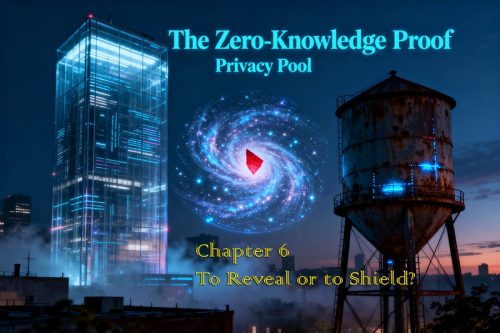
Relief was a fleeting currency. The confirmation that the antifungals had been dispensed bought Ravvi a few minutes of silence, a temporary stay of execution. But on the holoscreen, his sister’s labored breathing continued to saw through the static, a grim metronome counting down to the next crisis. And in the center of the water tower, the crimson shard of data—the blood trace transaction—still pulsed within the holographic galaxy, a silent, ticking bomb.
“A bandage,” Zed repeated Lena’s words, his voice flat. He’d just manually pushed through an exemption, a tiny crack in his own foundational principle of automated, blind trust. The guilt of the action warred with the necessity. “We exposed a vulnerability. Not in the code. In us. In our willingness to bend.”
Lena, pacing the narrow space between server racks, shook her head. “We made a human judgment. Your system can’t do that. It can only process binary proofs. ‘Is this on the stolen ledger? Yes/No.’ It can’t weigh ‘medical emergency’ against ‘investigative priority.’” She stopped, facing him. “That’s the flaw, Zed. Not in the cryptography, but in the philosophy. You built a world without judges. But sometimes, we need judgment.”
“And who gets to be the judge?” Zed shot back, the fire returning. “You? Maro? The same power that wants to shine a light into every dark corner? You call it judgment, I call it a backdoor. Today it’s for medicine. Tomorrow it’s for ‘national security.’ The next day, it’s for silencing an activist. The moment you introduce discretion, you introduce corruption. The system must be trustless!”
“It must also be just!” Lena’s voice echoed off the steel walls. “Right now, it’s providing a shield for a criminal. Your perfect, trustless system is being used to launder the payment for a crime that’s starving thousands. Where’s the justice in that? Is your ideology worth Ravvi’s sister’s life? Worth a thousand Ravvis in that camp?”
They were back on the fault line, but the ground had shifted. They were no longer defender and attacker. They were two architects standing in the ruins of their own paradigms, each holding a piece of the solution, and a piece of the problem.
Zed looked away, his gaze falling on the swirling anonymity set. “The system protects the innocent by blending them together. To find the guilty, you would have to unblend them all. You’d sacrifice every shield to find one sword. Is that justice?”
“No,” Lena admitted, the word pulled from her. “It’s not.” She leaned on the console, the glow of the data painting her face in shades of blue and red. “So we need something impossible. A targeted extraction. A way for the system to… to diagnose its own illness without killing the patient.”
A wet, hacking cough from the open comm channel froze them both. On screen, Ravvi was holding a cloth to his sister’s mouth, his own shoulders shaking with silent sobs. The sound was awful, a physical thing in the sterile digital air.
“The crowd…” Ravvi mumbled, his voice thick with despair, not looking at the camera. “You said we were safe in the crowd. But the sickness is in here with us. Can’t… can’t the crowd smell it? Can’t it push the sickness out?”
Zed and Lena locked eyes. A metaphorical plea from a dying girl’s bedside, yet it hung in the air with the weight of a revelation.
Can’t the crowd smell it?
“An internal audit…” Zed whispered, the concept forming like a crystal in his mind. “Not by us. Not by the Panopticon. By the system itself.”
Lena straightened up. “Explain.”
He began pacing, thoughts tumbling out. “The pool is a closed environment. The rules are math. We write a new piece of math—a tiny, focused judge algorithm. We give it one piece of evidence: the forensic signature of the blood trace. We then introduce the judge into the pool’s secure processing layer.”
Lena’s auditor mind followed, leaping ahead. “It doesn’t see all the data. It’s only allowed to examine… the encrypted packets one by one?”
“No! That would require decryption, exposure,” Zed said, his eyes alight with the technical challenge. “It performs a ZKP on the ZKP! It asks, for each transaction: ‘Does the encrypted data inside this packet match this specific forensic signature?’ It’s not looking at content. It’s looking for a single, specific lock that fits one key. The key is the blood trace. The lock is the transaction’s unique format.”
“A one-to-one match,” Lena breathed. “And if it finds the lock that fits…”
“If it finds a match,” Zed said, his voice growing solemn, “the judge algorithm has a single, pre-programmed output. It generates a decryption key for that transaction only and sends it to a specified authority token.” He pointed to Lena’s wrist device, her Panopticon identity key. “One key. One lock. Revealed only to you. If no match is found after checking every packet, the judge algorithm self-destructs, leaving no trace and revealing nothing.”
The elegance of it was staggering. It was a surgical strike. It used the system’s own principles—privacy, proof, and automation—to police itself. No human discretion after the fact. The judge’s parameters were set in stone before it was deployed: look for this signature, reveal to this authority. Period.
“It’s a warrant,” Lena said, awe in her voice. “But a warrant written in code, executed by logic. Not a battering ram, but a locksmith who only makes one key.”
“Exactly,” Zed said, but his excitement was already cooling, tempered by fear. “But it’s still a vulnerability. It’s a rule that says ‘under this specific, extreme condition, a transaction can be exposed.’ Once that principle exists in the code…”
“…it can be audited,” Lena finished, seeing his fear. “The code would have to be open-source. Every line visible to the world. So everyone can see the judge is blind, deaf, and dumb except for that one task. Any attempt to widen its scope, to change the signature it looks for, would be instantly detectable. It’s not a backdoor. It’s a… a glass door. Everyone can see it, and see that it’s only opened under one condition.”
The moral and technical landscape was reforming before them. They weren’t finding a middle ground; they were discovering a new dimension.
Ravvi’s voice, weak but clear, cut through their brainstorming. “You… you can do that? You can make the system check itself?” He’d been listening, a spark of desperate hope replacing the hollow terror in his eyes.
“We can try,” Zed said, the weight of it settling on him. He was no longer just a guardian of secrets. He would have to become an architect of accountable privacy. The thought was terrifying.
“But we’d need authorization,” Lena said, the practical hurdles surfacing. “I’d have to get Maro and the Oversight Board to approve an audit based on a theoretical, automated process. They’ll want the master key. They’ll want the whole pool.”
“Then we don’t ask,” Zed said, a stubborn set to his jaw. “We build it. We show them it works. We prove that privacy and accountability can co-exist with math, not just with force.”
Lena stared at him. He was asking her to subvert her chain of command, to build a tool outside the law to ultimately serve it. It was reckless. It was everything she was trained against.
She looked at Ravvi’s sister on the screen, each breath a struggle. She looked at the crimson shard in the hologram, representing a crime that continued to inflict suffering. The old methods were too blunt. The old war between privacy and transparency had only casualties.
“We call it the ‘Ultimate Audit,’” she said finally, the decision solidifying in her core. “And we make every line of code public. For the world. For Ravvi. So everyone can see we’re not building a weapon. We’re building… a conscience.”
Zed nodded, a silent pact forged in the humming dark. He turned to his main console, his hands hovering over the keyboard. The first line of code blinked on the screen, a simple declaration of intent.
// JUDGE PROTOCOL v1.0: SINGLE-ISSUE PROBATIVE SEARCH// OBJECTIVE: LOCATE TRANSACTION MATCHING SIGNATURE [BLOOD_TRACE_ALPHA]// UPON MATCH: OUTPUT DECRYPTION KEY TO AUTHORITY_TOKEN [KOVAC_PANOPTICON_7]// UPON NON-MATCH: SELF-TERMINATE AND PURGE.// ALL CODE FOLLOWS ZKP STANDARD ZK-SNARK. NO DATA RETENTION. NO SECONDARY OUTPUTS.
He typed the final, monumental clause:
// THIS PROTOCOL AND ALL EXECUTIONS ARE PUBLICLY AUDITABLE. TRUST, VERIFIED.
The work began. The hacker and the auditor, side by side, started building a new kind of justice—one that could prove guilt without sacrificing innocence, a system that could, at last, smell the sickness in the crowd.
Table of contents:
Introduction
Chapter 1: The Privacy Pool
Chapter 2: The Data Leviathan
Chapter 3: zk-SNARKs and Suspicions
Chapter 4: The Anonymity Set
Chapter 5: A Trace of Blood
Chapter 6: To Reveal or to Shield?
Chapter 7: The Ultimate Audit <<<<<< NEXT
Chapter 8: Trustless, But Not Heartless
Chapter 9: Proof of Personhood
Chapter 10: Verified, Not Exposed
