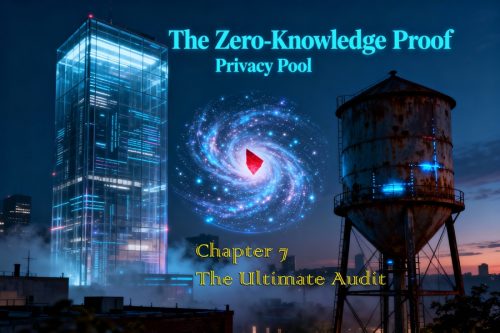
The air in the water tower grew thick with the scent of ozone and tension. What had been a sanctuary for secrets became a workshop for a radical new kind of transparency. Zed and Lena worked in a silent, intense tandem, their previous ideological battle replaced by a shared, grueling focus.
The Build
Zed’s fingers flew across his keyboard, lines of complex cryptographic code cascading down multiple screens. He wasn’t just writing a program; he was forging a judicial instrument in silicon and logic.
“The judge has to exist in a secure enclave,” he muttered, more to himself than Lena. “A walled garden within the pool’s own architecture. It can see the transactions, but it can’t touch them. It can only ask its one question.”
Lena watched, her legal mind translating his code into principles. “Like a detective in a sealed room, given a single fingerprint. They can compare it to objects brought in, but they can’t leave the room or examine anything else.”
“Exactly.” Zed created the virtual space—a stark, isolated processing node governed by ironclad rules. Its permissions were absurdly narrow: RECEIVE INPUT: [BLOOD_TRACE_SIGNATURE]. ACCESS: ENCRYPTED TRANSACTION FORMATS ONLY. OUTPUT: [KEY] OR [NULL].
Lena’s job was the legal and ethical framework. On her portable terminal, she drafted the “Single-Issue Probative Algorithmic Search (SIPAS) Protocol.” She cited historical precedents: targeted warrants, the prohibition of general searches. She argued that their judge was the digital equivalent of a drug-sniffing dog—a tool that reacts to one specific contraband and is blind to all other, lawful possessions. She wrote clauses ensuring the code would be open-source, that any execution would be logged on a public ledger, and that the authority token (hers) could only be used once per judicial finding.
Her terminal chimed with an incoming priority comm from Inspector Maro. She took a steadying breath and accepted.
His hologram flickered to life, his expression one of impatience. “Kovac. You’ve been silent for hours. I have Enforcement ready to storm that tower. Do you have the operator in custody? Have you run the blood trace?”
“Sir, I have a alternative proposal,” Lena began, her voice carefully neutral. “The suspect, Zed, is cooperating. He has demonstrated that a brute-force decryption of the pool would cause catastrophic collateral damage to innocent, vulnerable users.”
Maro’s eyes narrowed. “Their vulnerability is not our primary operational concern, Auditor. The criminal is.”
“Which is why we’ve engineered a surgical alternative,” she pressed on, transmitting the SIPAS draft and a technical summary of the judge protocol. “We can deploy an automated algorithm that will search only for the blood trace signature. If it finds a match, it reveals only that transaction. If it doesn’t, it reveals nothing. The privacy of every other user remains intact.”
Maro scanned the documents, his face growing stormier by the second. “This is… insubordinate conjecture. You are proposing we outsource a judicial search to a machine written by the suspect? The legal precedent is non-existent. The risk of trickery is absolute.”
“The code will be open-source, sir. Verified by third parties. The process is more transparent and constrained than a traditional warrant. It eliminates human error and… overreach.”
“It eliminates control!” Maro snapped. “I will not authorize a fairy-tale solution when we have a concrete, lawful path: seize the servers, decrypt everything, and find our criminal. The ends justify the means, Kovac.”
Lena felt the old certainty, the clear-cut rule of law, warring with the new shape of justice she was helping to build. “With respect, sir, the ‘means’ in this case would be ethically catastrophic and would destroy public trust. It would also alert the Benefactor, who could vanish. Our way is silent, specific, and just.”
“Your way is naive and dangerous,” Maro stated coldly. “You are ordered to secure the suspect and the equipment for a full forensic seizure. That is your final directive.” The hologram dissolved.
Lena stood in the blue gloom, the weight of the direct order pressing down on her. She had just been told to end the experiment, to choose the blunt instrument.
Zed had stopped coding, watching her. “He said no.”
“He said no,” Lena confirmed, her voice quiet. She looked at the lines of code on the screen, at the elegant logic of the judge. She thought of Ravvi’s sister, breathing in the dark. She thought of the thousand other ghosts in the machine, relying on Zed’s sanctuary. She thought of her father, who had believed in the system, but who had also believed in protecting people.
She made her choice.
“We’re not done,” she said, turning back to her terminal. “We finish the build. We deploy it.”
Zed stared at her. “That’s career termination. Possibly arrest.”
“Probably,” Lena agreed, a strange calm settling over her. “But if it works, it will force the conversation. It will prove there’s another way. Sometimes, you have to build the new path before you can get permission to walk it.” She gave him a faint, grim smile. “Keep coding. I’ll handle the deployment authority.”
Using her auditor’s credentials, she didn’t request authorization. She created it. She forged a one-time, self-contained judicial order, citing emergency powers and the imminent destruction of evidence. It was a legal house of cards, but it would grant the judge protocol the temporary legitimacy it needed to execute within the Privacy Pool’s governance system. She signed it with her digital ID, knowing it was a signature that might end her time at the Panopticon.
The Deployment
Hours later, it was ready. The judge protocol was a lean, elegant piece of code, every function documented and visible. Zed compiled it and prepared to upload it to the secure enclave.
“Once it’s in, it will trigger at the next consensus cycle,” he said, his hand hovering over the enter key. “In twenty-three minutes. There’s no stopping it. It will run its search across every active transaction in the pool.”
The finality of it hung in the air. They were committing to the unseen verdict of pure logic.
“Do it,” Lena whispered.
Zed pressed the key. The code uploaded, a tiny, potent seed taking root in the heart of the Privacy Pool. A countdown appeared on the main screen: 23:00.
The Wait
It was the longest twenty-three minutes of their lives.
Zed monitored the pool’s integrity metrics, terrified he’d introduced a fatal flaw, that the judge would malfunction and spill secrets like a gutted fish. The servers hummed, louder now, processing the unprecedented internal audit.
Lena watched the live news feeds. A report from Veridian Gap showed worsening conditions, a spokesman blaming “bureaucratic delays.” Every second of the countdown felt like a betrayal of those faces.
Ravvi called, his voice a thin wire of anxiety. “Is it happening?”
“It’s happening,” Zed confirmed. “The system is checking itself. Your data is safe. The judge is looking for one specific poison.”
“And if it finds it?”
“Then the world gets a little safer,” Lena answered, hoping she believed it.
The countdown ticked under ten minutes. Five. Two.
The tension was a physical presence, a cold, squeezing hand around the tower. They had gambled everything—her career, his life’s work, the safety of thousands—on an unproven algorithm. The “Ultimate Audit” was no longer a theory. It was a verdict approaching at the speed of light.
With ten seconds left, the system chimed, a clear, pure tone that echoed in the silent space.
AUDIT CYCLE COMPLETE.
JUDGE PROTOCOL EXECUTED.
The main screen went blank for a heart-stopping second. Then, two lines of text appeared, in stark, unadorned font.
RESULT: POSITIVE MATCH IDENTIFIED.
DECRYPTION KEY GENERATED.
A file, no larger than a grain of digital sand, materialized in Lena’s secure Panopticon inbox. The key. It was specific, single-use, and tagged with the cryptographic hash of the guilty transaction.
They had done it. They had found the trace of blood without spilling a drop of innocent data.
But the victory was cold and quiet. They stared at the result, not at each other. The judge had spoken. Now, they had to face what it had found. The next step was theirs, and it would lead out of the theoretical realm of code and into the messy, dangerous world of flesh and blood. The glass door had been opened. It was time to walk through it.
Table of contents:
Introduction
Chapter 1: The Privacy Pool
Chapter 2: The Data Leviathan
Chapter 3: zk-SNARKs and Suspicions
Chapter 4: The Anonymity Set
Chapter 5: A Trace of Blood
Chapter 6: To Reveal or to Shield?
Chapter 7: The Ultimate Audit
Chapter 8: Trustless, But Not Heartless <<<<<< NEXT
Chapter 9: Proof of Personhood
Chapter 10: Verified, Not Exposed
