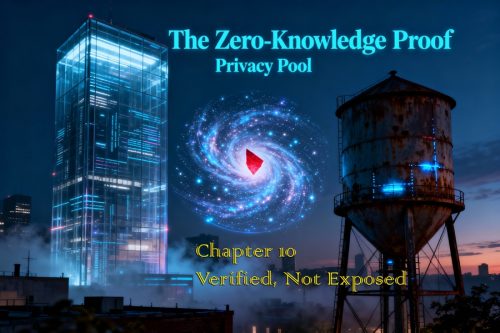
The vote was not a thunderclap, but a tide. It rolled through the council chamber, measure by measure, clause by clause. The “Zed-Kovac Framework,” as the press had dubbed it, was not adopted wholesale. It was dissected, debated, amended, and fortified. Hardliners on both sides forced concessions that made Zed wince and Lena bristle, but the core architecture held.
The Single-Issue Probative Algorithmic Search (SIPAS) Protocol was ratified into the city’s legal code, but with chains of adamant. Its use required a double-key system: a judicial warrant from a newly formed Cryptographic Oversight Court and a concurrent authorization from a citizen privacy panel. The list of “single issues” it could search for was brutally narrow: violent crimes, grand fraud, terrorism. It could never be used for political speech, dissent, or immigration status. Every line of any deployed Judge algorithm had to be published on a public ledger before execution. And a new office was created to audit the auditors: the Algorithmic Transparency Bureau.
Six months later, the city hadn’t become a utopia, but it had found a new equilibrium.
Zed’s new workspace was not in a water tower. It was a clean, bright lab in the University District’s Cooperative Tech Hub, funded by a city grant. The humming here was quieter, the air warmer. On his main screen, he wasn’t monitoring a privacy pool, but modeling a disease outbreak.
“See,” he explained to a small holographic cluster of epidemiologists, “by using a zero-knowledge proof protocol, individuals can submit their location history data to the model. The model can prove it’s calculating exposure vectors and hotspots without ever storing or seeing any individual’s raw movements. We get public health intelligence. They keep their private trails. It’s a proof of proximity, not a map of persons.”
He zoomed in on a flickering, anonymized map. A cluster of infection risk glowed orange over a market square, but no dots representing people were visible. “The system verifies the danger. It doesn’t expose the endangered.”
As the holograms nodded and began discussing integration, Zed leaned back. The work was good. It used his skills for creation, not just concealment. He still ran a version of the Privacy Pool, but it was now a licensed, regulated piece of civic infrastructure—a “Privacy Utility.” It had fewer users from the extreme fringe, but more from the mainstream: patients, journalists, ordinary people who simply believed their data was theirs. The crowd was smaller, but it didn’t have to hide. It was a sanctuary, not a bunker.
Across the city, in an office that had clear, smart-glass walls which could turn opaque at a voice command, Lena Kovac reviewed a log. She wore no Panopticon grey. Her title was Director of Algorithmic Oversight, Division 7. Her badge was a simple, clear hexagon.
On her screen was the audit trail of the first sanctioned SIPAS execution—a hunt for a ransomware network. She traced the path: the dual warrant approvals, the publication of the Judge’s code (which she and a team of independent cryptographers had vetted), the execution log showing the scan of a dark-data pool, the single positive match, the generation of one key. The criminal’s data was unmasked. The rest of the pool remained a blur of static. The entire process was appended as a case study to the public ledger.
A soft chime announced a visitor. Inspector Maro stood at her door, his posture still rigid, but his expression unreadable. She gestured; the door slid open.
“Director,” he said, the title still seeming strange on his tongue.
“Inspector. What can I do for you?”
He entered, not sitting. “The ransomware takedown. Clean. Efficient.” He paused. “No collateral damage complaints. No privacy petitions. The… process worked as advertised.”
Lena waited. This wasn’t a social call.
“I opposed you,” Maro stated. “Vehemently. I believed you were undermining the very foundation of order.”
“I know.”
“I may have… misjudged the nature of the foundation.” The admission seemed physically difficult. “The old methods were becoming ineffective. And… brutish.” He met her eyes. “The Vance arrest. The way you did it. It was clean. It was just. It respected the innocent. That is the mission.”
Lena nodded slowly. “That was always the mission, sir. We just needed better tools.”
Maro gave a curt, almost imperceptible nod. “Keep your tools sharp, Director.” He turned and left.
Lena exhaled. The victory was quiet, but it was real. The light could be focused. It could disinfect, not just dazzle.
On the edge of the city, in a small, clean apartment in a community housing bloc, a family sat down to dinner. The windows had real curtains, drawn against the evening. The smells were of spices unfamiliar to the city’s central districts.
Ravvi placed a bowl of stew before his sister, whose cheeks were now full, her eyes bright. She was sketching on a cheap tablet, drawing fantastical birds. Their mother hummed as she set out bread.
A notification glowed softly on the wall panel: a reminder for a mandatory health check-up. A month ago, this would have sparked panic. Now, Ravvi simply tapped it. A prompt appeared: “Verify residency and insurance status for appointment.”
He didn’t input his ID number. Instead, he selected an option: “Privacy Utility Verification.” He authenticated with a fingerprint and a random, personal mnemonic known only to him. His terminal communicated silently with the city’s systems.
A moment later, a green checkmark appeared. “Status Verified. Appointment Confirmed. No further data required.”
The system had asked: “Is this person a legal resident with valid health insurance?”
The Privacy Utility, using the family’s anonymized credentials, had provided a zero-knowledge proof: “Yes.”
They were verified. They were not exposed. They were persons, with a right to care, and a right to secrets. They ate their dinner in the warm, quiet safety of their own unobserved lives.
The rooftop garden was a neutral space, a thin strip of greenery between the soaring towers of commerce and the dense, vibrant blocks of the Green Sector. It was where the city’s two tectonic plates—the old transparency and the new privacy—grifted against each other.
Zed and Lena met there, as they sometimes did. It wasn’t friendship, not exactly. It was a necessary dialogue, a continuing audit of their own creation.
Lena looked out over the cityscape. She saw the Panopticon, a glowing diamond. She saw the scattered, unassuming locations of the licensed Privacy Utilities. She saw the dark patches where no data flowed at all, by choice or by poverty. “It’s messy,” she said, echoing her words from months ago in a different context.
Zed stood beside her, holding a steaming cup of tea. He followed her gaze. He saw the same things, but in his mind, he saw the layers of encryption, the flows of proofs, the silent, verifiable handshakes happening in the dark. “It’s alive,” he said. “And it’s free. That’s enough.”
He pointed his chin toward a news ticker crawling along a distant building. It announced the successful containment of the outbreak he’d modeled, with a record-low data collection complaint statistic. Further down, it noted the conviction of the ransomware operator, secured via the SIPAS protocol.
“You can’t un-invent the truth,” Zed said softly. “And you can’t un-invent the right to hide it. All you can do is build systems that respect both. Systems that can prove a thing is true, without forcing the thing to be seen.”
Lena smiled, a real, tired, satisfied smile. “Verified, not exposed.”
“Verified, not exposed,” Zed agreed.
Below them, the city pulsed—a symphony of light and shadow, of shouted truths and cherished secrets, of watchful eyes and private hearts. It was not perfect. It was not simple. It was a permanent, uneasy negotiation.
But for the first time, the negotiation had rules. It had a proof. It had a protocol for peace.
They stood in the gathering dusk, two architects of the great, fragile balance, watching their world turn, and trusting—not blindly, but with verification—that it would hold.
Table of contents:
Introduction
Chapter 1: The Privacy Pool
Chapter 2: The Data Leviathan
Chapter 3: zk-SNARKs and Suspicions
Chapter 4: The Anonymity Set
Chapter 5: A Trace of Blood
Chapter 6: To Reveal or to Shield?
Chapter 7: The Ultimate Audit
Chapter 8: Trustless, But Not Heartless
Chapter 9: Proof of Personhood
Chapter 10: Verified, Not Exposed
