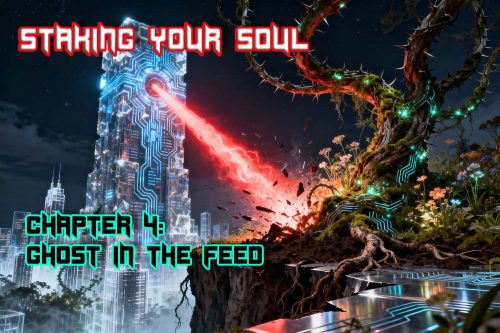
The silence was the first shock. It wasn’t an absence of sound, but an absence of layer. For years, Lena’s reality had been a symphony conducted by Veritas: the gentle ping of validations, the whisper of data streams, the subconscious hum of her own metrics tracking in the background. Now, there was only the wind through the pines around her grandmother’s cottage, the crunch of gravel under her shoes, and the ragged sound of her own breathing. It was deafening.
The cottage was a fossil. A small, boxy structure of real wood and brick at the end of a overgrown lane, it had been exempted from the city’s Smart-Grid due to her grandmother’s stubbornness and later, her passing. No beacon welcomed her. No security system queried her identity. The key was under a ceramic frog by the door, just as it had always been.
Inside smelled of dust, pine sap, and forgotten stillness. Moonlight filtered through dusty windows, illuminating furniture draped in yellowed sheets. Lena dropped her bag on the floor, the thump absurdly loud in the emptiness. She didn’t turn on the lights. She stood in the middle of the living room, wrapped in a quiet so complete it felt like pressure on her skin.
Her hand flew to her temple out of habit, seeking the neural link that wasn’t there. A phantom itch. She needed to post. She needed to tell someone she was here, that she was safe, to frame this exile as a “digital detox” narrative. The urge was a physical craving, a synaptic pathway firing into a void. She gasped, doubling over, clutching her head. It wasn’t grief. It was withdrawal.
For three days, she moved through the cottage like its ghost. She ate stale crackers from the pantry. She drank water that tasted of minerals from the well. She slept for sixteen hours at a stretch, her dreams a chaotic montage of crumbling numbers and Sloane’s smiling face. When awake, she was paralyzed by a terrifying question: What did she do now? Her entire life had been a series of objectives with clear, stake-based rewards. Now there was no objective. No reward. No score.
On the fourth morning, a sound ripped through the silence—not a digital chime, but a persistent, physical knocking on the front door.
Her heart hammered against her ribs. Her parents? The authorities? She crept to a window, peeling back a corner of the sheet.
Marcus stood on the porch. He wore a worn canvas jacket, a backpack slung over one shoulder, and an expression that wasn’t smug or scornful, but simply… present. He held up a brown paper bag in one hand and knocked again with the other.
Shame, hot and immediate, flooded her. He was the last person she wanted to see. The witness to her hypocrisy, now here to gloat over her ruin. She thought about not answering, but the cottage was obviously occupied. The silence was a confession.
She opened the door a crack. “How did you find me?”
“Wren,” he said simply. “She’s wrecked. Thinks you hate her. Thinks it’s all her fault. She came to me because she couldn’t think of anyone else who wasn’t… plugged in.” He shrugged. “She described this place. I biked.”
He offered the paper bag. “She also said you probably hadn’t eaten anything real. It’s a sandwich. From the bakery on Cypress.”
Lena stared at it, the simple object seeming impossibly complex. No yield rating, no sustainability certification. Just… food. She took it, her fingers brushing his. “You didn’t have to.”
“I know,” he said, and then, to her surprise, he stepped past her into the cottage. He looked around, nodding slowly. “Yeah. This is a good place. No eyes.”
“What do you want, Marcus?” Her voice was flat, drained.
“To show you something,” he said, dropping his backpack. “But first, you have to fix something.”
From his pack, he pulled out an ancient, rectangular device with a frayed cord and a single, broken dial. It was heavy, made of real metal and beige plastic. “My grandma’s old radio. It’s broken. The world is coming apart out there, Lena. The grid’s unstable past the city limits. Information is about to become scarce. This,” he patted the radio, “pulls voices right out of the air. No nodes, no satellites, no stake. But it needs to work.”
“I don’t know how to fix that,” she whispered.
“You know how to follow instructions. You know how to be meticulous. You just have to do it without a reward flashing in your peripheral vision.” He laid a rusted toolbox on the floor beside it. “The schematic is online, but you’ll have to use my phone, and the connection is terrible out here. You’ll have to really look at it.”
It was a test. A pointless, analog test. She almost told him to leave. But the alternative was to return to the suffocating silence, to the void where her identity had been. So, she sat on the dusty floor.
The next few hours were a form of agony. Marcus’s phone had a cracked screen and a painfully slow connection. She had to squint at fuzzy, user-uploaded diagrams of capacitors and resistors. The tools felt clumsy in her hands. She was used to manipulating holographic interfaces with thought, not gripping a physical screwdriver that could strip a bolt if she turned it wrong.
She made mistakes. She connected a wire to the wrong terminal, causing a tiny, disappointing spark. She cursed, a raw, unfiltered sound that startled her in the quiet room.
Marcus didn’t help. He just sat in her grandmother’s armchair, reading a physical, paper book with a cracked spine. He didn’t offer validation or criticism. He just let her be frustrated.
Slowly, something shifted. The problem was finite. The radio was just a collection of parts, and they could only fit together one correct way. There was no algorithm judging her aesthetic, no sentiment analysis on her technique. There was only cause and effect. When she finally traced the faulty connection to a corroded fuse, the solution was just… true. She cleaned the contact.
“Try it now,” she said, her voice hoarse.
Marcus leaned over and plugged the radio into the wall. A small, warm light glowed behind the dial. He turned it. Static hissed, a sound like the ocean in a shell. Then, he slowly turned the tuning dial. Through the crackle, a voice emerged, faint and garbled. A man speaking in Spanish. Further along, the pluck of a guitar from a folk station. Then, clearest of all, the calm, automated voice of a regional emergency band reporting weather patterns.
A triumphant thrill shot through Lena—a pure, unmediated spark of achievement. No +SY notification followed. The thrill lingered, then settled into a quiet, warm satisfaction that sat in her chest, real and solid.
Marcus smiled, a genuine, unguarded expression she’d never seen on him. “You just pulled a voice from the air. No middleman.”
That afternoon, he didn’t lecture. He simply said, “Come on.” He led her into the woods behind the cottage. He pointed at the ground, at the trees.
“See this?” he said, crouching by a patch of soft, green moss. “This is Hypnum imponens. It only grows on north-facing, acidic bark in this humidity. It’s a fact. The forest doesn’t post about it. It just is.” He touched it gently. “It’s a truth that exists off-chain.”
He showed her how to identify edible fiddlehead ferns, their tight coils hidden in the damp soil. “The database for this is in a book at the library, written by a man who’s been dead for forty years. The knowledge is just… here. Waiting.”
Lena followed, her mind struggling. This was data, but it was unsorted, unranked, and covered in dirt. Its value was unclear. Yet, she found herself noting the shape of the fern, the feel of the moss.
As the sun began to set, painting the sky in hues of orange and purple no filter could replicate, they sat on a fallen log overlooking a small creek. The tension began to leak from Lena’s shoulders, carried away by the sound of the water.
“Why are you doing this?” she asked quietly. “You were right. About everything. You must be loving this.”
Marcus was quiet for a long time. “I’m not right,” he finally said. “I’m just… scared in a different way than you were. You were scared of having a low score. I’m scared of becoming a score at all.” He tossed a pebble into the creek. “Seeing you get slashed… it wasn’t a victory. It was a horror show. It proved how brutal the system is when you step off the tightrope. I don’t want that for anyone. Not even a Stake-bot.”
The old nickname had no sting anymore. She was no longer a bot. She was a broken machine, sitting in the woods.
“What do I do now?” The question fell from her lips, small and lost.
“You start over,” he said. “But not on their ledger.”
Just then, a movement in the shadows across the creek caught Lena’s eye. A red fox emerged, its coat vibrant against the gloom. It paused, one delicate paw lifted, its ears swiveling. It looked directly at them, its eyes catching the last of the light—two pools of intelligent, wild amber.
Lena froze. Her first, instinctive thought was so powerful it was a reflex: Capture it. Frame the shot. Find the right angle. The perfect caption. #NatureIsHealing. #Unplugged. The potential SY yield from such an “authentic” moment would be huge.
But her hand didn’t fly to a non-existent camera. She just… watched.
The fox sniffed the air, deemed them unimportant, and continued on its fluid, silent way, disappearing into the brush. The moment ended. It left no trace. No digital footprint. No proof it had ever happened except the memory now etched into her mind: the rust-red fur, the intent gaze, the absolute, un-ownable wildness of it.
A profound sensation washed over her, so foreign it took her a moment to name it. It was a pang of loss, but also of fierce, aching privilege. She had witnessed something no one else would ever validate. It belonged only to her, to Marcus, and to the fox. It was a secret the world hadn’t recorded.
She had stolen a piece of reality for herself.
A single, hot tear traced a path through the dust on her cheek. It wasn’t a tear of sadness for her lost stake, but of mourning for the thousands of such moments she had traded for points. For every sunset she’s framed instead of felt, for every meal she’s photographed instead of tasted.
Marcus watched her, seeing the understanding dawn. He said nothing.
They walked back to the cottage in the deepening twilight, no flashlight needed as their eyes adjusted to the real dark. The silence between them was no longer empty, but full of the sounds they were now hearing: the rustle of nocturnal life, the distant hoot of an owl, the whisper of the pines.
At the door, he shouldered his pack. “The radio is yours. The emergency band will tell you if a storm is coming. Real information, for survival, not for status.”
“Thank you,” Lena said, and the words meant more than she could express.
He nodded. “Wren needs you. But you need to be you for her. Not the validator. Just her sister.” He turned to go, then glanced back. “The fox… it’s better that way, isn’t it?”
After he left, Lena didn’t go inside. She sat on the porch step, hugging her knees, watching the stars emerge—pinpricks of light no interface could enhance. The craving to check her feed, to see the carnage, was still there, a ghost limb throbbing. But beneath it, something new was stirring, fragile and raw.
It was the faint, unvalidated pulse of a self that existed off-chain.
Table of contents:
Introduction
Chapter 1: The Reputation Protocol
Chapter 2: The Perfect Life Pool
Chapter 3: Slashed
Chapter 4: Ghost in the Feed
Chapter 5: Validators of the Unseen <<<<<< NEXT
Chapter 6: The Sybil’s Choice
Chapter 7: Off-Chain Integrity
Chapter 8: The Hard Reboot
Chapter 9: Proof-of-Being
Chapter 10: Uncollateralized Trust
