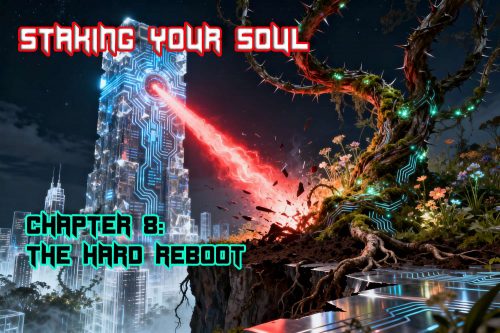
The world ended not with a scream, but with a sigh.
It began with a flicker. The always-present, soft glow of interface-ready surfaces in Lena’s peripheral vision stuttered. The public info-streams on the bus shelter she was passing hiccuped, the faces of top validators freezing mid-smile. A low, sub-auditory hum that underpinned the city—the sound of a million wireless connections—faltered and died.
Then, the lights went out.
Not in a cascading failure, but all at once. The streetlights, the holographic billboards, the glow from smart-windows—everything powered by the municipal grid winked into darkness. The sudden night was profound, broken only by the faint, battery-powered emergency strips along sidewalks and the startled red glow of a few personal transport pods grinding to a halt.
A collective, confused silence fell over the street, thicker than the dark. It lasted three seconds.
Then the screams started. Not of pain, but of pure, systemic panic.
Lena stood frozen, her breath pluming in the suddenly cold air. Her first instinct was terror, a primal fear of the dark. Her second was the old, deep-seated reflex: Document. Report. Her hand flew to her temple, clawing at the ghost of her neural link. But there was nothing to query, no status to check. The silence in her own head was absolute.
Around her, the chaos took shape. People stumbled, their Oculus lenses dark and useless, no longer overlaying navigation paths or filtering the terrifying raw reality of the blackout. A woman shrieked, “My interface is dead! I can’t call anyone!” A man repeatedly slapped his wristband against a darkened public scanner, shouting, “My stake! I need to access my meds!”
They’re helpless, Lena realized with a shock that cut through her own fear. Without the feed, they don’t know what to do.
A siren began to wail in the distance, then another. Not the digital chirp of automated security, but the old, mechanical howl of physical emergency vehicles. The sound was alien and terrifying.
“Lena!”
Marcus’s voice. He materialized beside her, a solid shape in the gloom, holding a small, hand-crank flashlight. Its beam was a feeble but defiant sword cutting through the dark. “Geomagnetic storm. Solar flare. The grid’s fried. Backup’s failing. This isn’t coming back on for a while.”
“How do you know?”
He held up the old radio from the cottage, a tiny speaker crackling with a calm, automated voice from the emergency band. *“…repeat, a G5-class geomagnetic disturbance is in effect. All citizens are advised to seek shelter, conserve resources, and await instructions. Do not rely on networked systems. They will be unreliable or offline…”*
The Oracle was silent. Veritas was a ghost in the machine, and the machine was dead.
“The shed,” Marcus said, his voice tight. “Now. That’s where the network will coalesce.”
They ran through the stumbling, crying, arguing streets. Lena saw a Green Line validator she recognized from school sitting on a curb, head in his hands, rocking. A shopkeeper had emerged, holding a real, wax candle, its flame dancing wildly as he tried to calm a crowd demanding to use their now-useless digital credits.
The garden shed was an island of purposeful calm. Ben had the laptop running on a heavy-duty battery pack, the screen’s light casting sharp shadows. Mira was organizing a pile of bottled water and blankets from a cache Lena never knew existed. Arlo and Kiri were there, and so was Chloe, her face pale but set.
“Report,” Ben said, his fingers flying over the keyboard, accessing offline maps and schematics.
“Total grid failure in Sector 4 and spreading,” Marcus said. “Emergency band confirms G5 storm. No ETA on restoration. Cellular and data networks are collapsing under the strain.”
Mira looked up. “The system-dependent are panicking. They have no protocols for this.”
“We do,” Arlo grunted, hefting a case of canned food. “We remember how.”
A plan formed not from a central command, but from a consensus of capability, spoken in terse, practical sentences.
Mira: “The library has the physical blueprints for the civic water pump stations. If the electric pumps fail, we’ll need manual override locations.”
Kiri: “The free clinic has a gas-powered generator for refrigerated meds. We can move critical patients there.”
Arlo: “My café has a propane stove. We can cook, provide hot food. We’ll need rationing.”
Chloe: “I know which neighbors are elderly, live alone, have medical needs. I can check on them.”
Ben: “I’m tracking emergency vehicle chatter. I can direct physical aid where it’s needed.”
They all looked at Lena and Marcus. “What do you see?” Mira asked.
Lena understood. They weren’t asking for a status report. They were asking for validation. Off-chain, real-time, human validation. She closed her eyes, filtering out the panic, using the skills she’d honed. “The main panic is at the central plaza. People are gathering because it’s a known landmark, but there’s no organization, no water. It’s a tinderbox. The residential blocks off Cypress are quieter, but that’s where the vulnerable are. They’re just sitting in the dark, waiting.”
Marcus nodded. “The substation for this sector is Substation 7, near the old canal. If we can get a crew there, we might be able to assist restoration, or at least secure it from desperate people doing stupid things.”
“Alright,” Ben said. “Consensus?”
A round of nods. No voting. No stake-weighted decision. Just a recognition of the truth in the room.
They moved. Arlo and Kiri went to the café to set up a soup kitchen. Mira and Chloe headed to the library to gather maps and then begin welfare checks. Ben became the communications hub, the radio and his laptop his tools.
Lena and Marcus headed for the central plaza, the crank flashlight their beacon. The scene was one of digital withdrawal on a mass scale. Hundreds of people milled, their faces lit by the dying glow of personal device batteries as they futilely searched for a signal. A man in a suit was shouting into a dark screen, “My portfolio! I need to execute a trade!”
Lena climbed onto the base of a darkened public sculpture. She didn’t have a megaphone. She just cupped her hands and shouted, her voice raw but clear.
“Listen! The grid is down! Veritas is down! They are not coming to save you in the next five minutes!”
Heads turned, eyes wide with shock at hearing the unsayable said aloud.
“If you have water, share with your neighbor! If you have a physical flashlight, light the way for someone! We are setting up a aid station at The Steady Cup café on Cypress! There is hot food and water there! If you are able-bodied, we need help checking on the elderly in the brownstones! Your stake doesn’t matter right now! Your hands do!”
For a moment, there was silence. Then a woman called out, “Who are you? What’s your authority?”
Lena didn’t have a validator tag. She had no stake. She had only the truth. “My name is Lena! I have no authority! But I know who in this neighborhood you can trust! Arlo at the café! Mira at the library! Do you know them? Have they ever been fair with you off the feed?”
A murmur went through the crowd. Names, real names, spoken in the dark, held weight. A man who ran a bike shop nodded. “Arlo… yeah. He’s good people.” A young mother said, “Mira helped my kid with a project last week… for free.”
It was the shadow ledger, manifesting in real-time. The trust they had silently validated was now the only social currency that functioned.
A handful of people broke from the crowd and moved toward Cypress. It was a start.
The real test was Substation 7. It was a fenced compound humming with the angry sound of overtaxed backup systems. Two city utility workers in hardhats looked harried, surrounded by a growing crowd of angry, scared people demanding power be restored to their homes first.
Marcus pushed through. “The emergency band says the central node is trying to sequence a reboot, but the cooling systems in substations like this are failing. They need manual overrides.”
One worker, her face streaked with grime, glared. “You a technician?”
“No. But she’s a validator,” Marcus said, pointing to Lena. “She knows how to follow protocols and verify systems.”
The worker’s eyes widened. “Lena? The one who got slashed?” In the old world, it would have been a condemnation. Here, it was just an identifier.
“I can read a schematic,” Lena said, her voice steady. “I can verify steps. Do you have the manual for the secondary coolant release?”
The worker hesitated, then nodded. She shoved a laminated, paper manual into Lena’s hands. “Page 17. The lever is inside, but the safety interlock is fried. We need to physically bypass it. It’s a two-person job, and my partner is trying to hold back that mob.”
Lena’s world shrank to the page, the flashlight beam, and Marcus’s steady presence. The instructions were dense, physical. Turn manual release valve three-quarters counter-clockwise. Pull red lever with equal force until klaxon sounds. It was a logic puzzle made of steel and grease.
She directed Marcus, her voice calm. “There. Feel for the groove. Now pull. Evenly. Don’t jerk.”
Metal shrieked in protest, then gave way with a heavy clunk. A new, healthier hum replaced the angrier whine. A light on a dark panel flickered to life—green.
“Secondary coolant online!” the worker yelled to her partner, relief washing over her face. She turned to Lena. “You just saved this substation from melting down. And probably this block from a fire.”
Lena stood, her hands black with grease, her muscles trembling. There was no +SY notification. There was only the worker’s grateful nod and the tangible sense of a crisis averted. It was the most profound validation she had ever received.
Dawn was breaking, a pale gray light that revealed a city humbled and silent. Lena and Marcus walked back toward the café, exhausted. They passed the community garden plot they’d been clearing with the Shadows—a muddy, raw scar of earth.
In the flat, electronic-less quiet, Lena heard something. Not a ping, but a voice. Mrs. Gable, the elderly woman with the infinite tab at Arlo’s, was sitting on a folding chair in the garden, wrapped in a blanket. She was singing a quiet, old song to a young child from the neighborhood who huddled beside her for warmth.
Lena stopped, listening. The song was a frail, beautiful thread in the cold air. An unmediated comfort. An off-chain lullaby.
At the café, Arlo was dispensing soup from a giant pot. People were talking in low voices, sharing information, making plans. No one was scrolling. They were looking at each other’s faces.
A man Lena recognized as a mid-tier fashion validator, his expensive clothes now rumpled, accepted a bowl. He looked at Arlo, then at the chalkboard with its old-world trades. “I… I don’t have anything to trade,” he said, ashamed.
“You have two hands,” Arlo rumbled. “After you eat, you can help wash bowls. That’s your tab.”
The man nodded, tears in his eyes, and began to eat as if he’d never tasted food before.
Lena leaned against the doorframe, utterly spent. She was covered in sweat and grime, her hair a mess, her clothes filthy. She had never been less curated, less validated in the Veritas sense.
A woman she’d helped direct from the plaza earlier approached, holding out a blanket. “Here. You look cold.” She paused. “You’re Lena, right? You… you knew what to do.”
Lena took the blanket, its wool scratchy and real. “I just knew who to trust,” she said softly.
As the gray dawn brightened, Lena looked out at the struggling, analog, human world. The network was down. The stakes were zero. And for the first time, she saw the true, invisible infrastructure of her community—not of fiber optics and algorithms, but of remembered kindness, witnessed integrity, and uncollateralized trust. It had been there all along, running in the background. And when the hard reboot came, it was the only system that didn’t crash.
Table of contents:
Introduction
Chapter 1: The Reputation Protocol
Chapter 2: The Perfect Life Pool
Chapter 3: Slashed
Chapter 4: Ghost in the Feed
Chapter 5: Validators of the Unseen
Chapter 6: The Sybil’s Choice
Chapter 7: Off-Chain Integrity
Chapter 8: The Hard Reboot
Chapter 9: Proof-of-Being <<<<<< NEXT
Chapter 10: Uncollateralized Trust
