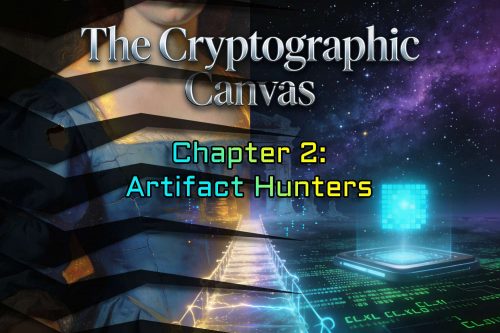
The morning sun streamed through the tall, arched windows of Leo’s conservation lab, casting warm rectangles of light across the polished concrete floor. The light was essential. Not the cold, flickering glow of holograms or the sterile buzz of overhead LEDs, but real, natural light that changed with the hours and the seasons. It was the only honest way to examine a painting.
Leo stood at his examination table, a massive slab of white maple that had belonged to three generations of conservators before him. He ran his fingers gently over its surface, feeling the tiny nicks and stains from a century of careful work. The table was a relic, just like the objects he spent his days preserving. He liked it that way.
Today’s commission sat in the center of the table, bathed in that precious morning light. It was a portrait, medium-sized, maybe sixty by eighty centimeters. A woman in a blue dress. The paint was oil on linen canvas, the brushwork confident but restrained. The subject’s face was partially turned, her gaze directed somewhere beyond the frame, a hint of a smile playing at the corners of her mouth. It was the kind of painting that felt alive, that seemed to breathe.
Leo pulled up his data tablet and scanned the initial file. The artist was listed as Elias Vance, an American painter from the mid-21st century. Vance had been moderately successful in his lifetime, part of the last generation of artists who still worked primarily with physical materials before the digital revolution swallowed everything. His work had been out of fashion for decades, but in the last few years, a quiet resurgence of interest in “Analog Age” art had sent collectors scrambling for his surviving pieces.
The problem was, very few had survived. Most of Vance’s work had been lost in the Great Data Crash of ’58, when a solar flare had fried half the continent’s unshielded servers. Others had simply decayed, stored in attics and basements by families who didn’t know what they had. A new Vance appearing now was… significant.
“Provenance,” Leo murmured to himself, the word a kind of prayer in his profession. Provenance was everything. The chain of ownership, the documentation, the history that proved a painting was what it claimed to be. Without provenance, a masterpiece was just a pretty decoration. With it, it was a piece of human history.
He began his work.
First, the canvas. He donned a pair of thin cotton gloves and gently lifted one corner of the painting, angling it toward the light. He studied the weave through a magnifying loupe, counting the threads per centimeter. The linen had a tight, irregular weave, characteristic of mid-21st century artist-grade materials. He consulted his tablet, cross-referencing with a database of historical canvas manufacturers. The match was promising. A small, almost invisible stamp on the wooden stretcher bar confirmed it: “Saunders 2045.” Authentic period materials.
Next, the craquelure. He set the painting flat and illuminated it from the side with a narrow-beam lamp. The surface came alive with a network of fine, delicate cracks, like a map of a tiny river system. Craquelure was the painting’s fingerprint. It formed over decades as the paint and ground expanded and contracted with changes in temperature and humidity. A forger could try to simulate it, but they almost always got it wrong. Too uniform, too shallow, too perfect.
Leo studied the pattern for a long time, tracing the lines with his eyes. They were beautiful. They told a story of a painting that had lived in places with real seasons—warm summers, cool, dry winters. There was a faint circular pattern in one corner, a ghostly ring about the size of a coffee cup. Someone, decades ago, had set a damp cup on a table next to the painting, and the localized humidity had left its mark. Leo smiled. That was the kind of detail no forger would ever think to include. It was accidental, human, real.
He moved to the most invasive but necessary part of the examination. He selected a micro-scalpel from his tools, its tip so fine it was almost invisible. Under a stereomicroscope, he located a tiny area along the edge of the painting where a minute fleck of paint was already loose. Carefully, with the precision of a surgeon, he lifted it. The sample was smaller than a grain of sand.
He placed the fleck into the chamber of a gas chromatograph-mass spectrometer, a sleek machine that looked utterly out of place among the antique wooden brushes and glass bottles of his lab. The machine hummed to life, heating the sample and analyzing the vapors it released. Each chemical compound produced a distinct signature.
The results appeared on his screen. Lead white. Cadmium red. A specific formulation of ultramarine blue that had only been manufactured between 2042 and 2048. The binding medium was linseed oil with a trace of beeswax, a combination favored by a handful of traditionalist painters in that era.
Leo leaned back, a knot of excitement forming in his stomach. Everything checked out. The materials, the aging, the accidental damage—it all pointed to an authentic Elias Vance, painted around 2046, hung in someone’s home for decades, then stored away. The paperwork the client had provided was minimal but plausible: an old letter from Vance to a collector mentioning a “portrait of a woman in blue,” a faded auction catalog from 2052.
He should have been satisfied. This was a clean verification. A significant find. A payday.
But something nagged at him.
The paperwork was too clean. The letter, the catalog—they were the kind of documents a clever forger might manufacture. And the painting itself, for all its authentic aging, felt almost too perfectly preserved. The composition was strong, the technique masterful, but it lacked the… the energy he associated with Vance’s known works. It was like meeting someone who looked exactly like your friend but spoke with a slightly wrong accent.
He pulled up the client’s contact information again. The representative who had hired him was vague, working for an unnamed private collector. That wasn’t unusual—wealthy collectors often valued their privacy. But the payment had come from a shell company registered in the Lunar Free Zone, and the instructions had been encrypted with a level of security usually reserved for corporate espionage.
Something wasn’t right.
Leo stood and walked to his office area, a cluttered corner with a battered wooden desk and walls lined with reference books. He flopped into his chair, the springs groaning in protest. On a whim, he pulled up his secure terminal—the one he used for the rare cases that required digital forensics.
He remembered something from his training, a footnote in a seminar about 21st-century art authentication. Elias Vance, in addition to being a painter, had been an early technology enthusiast. He’d been part of a group of artists who experimented with the first wave of NFTs and blockchain technology in the 2020s. Most of that work had been lost, the platforms long defunct, the data scattered. But the core principle—that a permanent, decentralized ledger could be used to certify authenticity—had been sound. It was the foundation of modern digital provenance.
What if Vance had done that? What if, in addition to his physical records, he’d left a digital fingerprint?
Leo accessed the Eternal Ledger, a public archive maintained by a consortium of museums and universities. It was a sprawling, chaotic repository of every major blockchain’s data from the last 150 years, preserved in a format that could still be read by modern systems. He typed in “Elias Vance” and hit search.
Thousands of results flooded his screen. Mentions in articles. Auction records. Social media posts preserved by web archivists. It was too much. He needed to filter.
He added keywords: “provenance,” “certificate,” “signature.” The results narrowed. He scrolled through page after page, his eyes growing tired. Nothing useful. He was about to give up when a single line caught his attention.
It was a reference from a 2025 art blog, a tiny, obscure publication that had only existed for a few months. The author had interviewed Vance about his experiments with “crypto-art.” In the interview, Vance had said something that made Leo’s heart skip.
“The painting is the body. The blockchain record is the soul. I log the chemical signature of every finished work on a chain no one will ever touch. A ghost chain. It’s my secret confession. A hundred years from now, if someone wants to know if a painting is really mine, they just have to know where to look.”
A ghost chain.
Leo’s mind raced. There were dozens of defunct blockchains from that era. Which one had Vance used? He searched for “ghost chain 2025” and started reading. One name kept appearing: The Ghostchain. An early, experimental proof-of-concept chain that had never gained traction. Its last block was produced in 2026. Its native token was called “Dust,” and it was now completely worthless. The network was dead. But the ledger…
He found an ancient block explorer, a clunky, text-based interface that looked like it belonged in a museum. He typed in “Elias Vance” one more time, this time specifying the Ghostchain.
The screen loaded slowly, painfully slowly, as if the ancient servers were waking from a long sleep. Then, a result appeared. A single transaction.
Transaction ID: 0x3a1b2c3d4e5f6a7b8c9d0e1f2a3b4c5d6e7f8a9b0c1d2e3f4a5b6c7d8e9f0a1b2
Block: 104,911
Timestamp: 2025-11-03 14:22:09 UTC
From: Wallet_1VanceArtistPrimarius
To: Wallet_0x0000000000000000000000000000000000000000 (Null Address)
Data Field: 7b226368656d6963616c5f7369676e6174757265223a2022353437326638346131623363346435653666376138623963306431653266336134623536633764386539663061316232227d
Leo stared at the screen. The “To” address was a null address—a burn address. This was a data-only transaction, meant not to transfer value but to permanently inscribe information. And the data field… it was hexadecimal. He copied it and ran it through a simple hex-to-text converter.
The result appeared:
{"chemical_signature": "5472f84a1b3c4d5e6f7a8b9c0d1e2f3a4b56c7d8e9f0a1b2"}
With trembling fingers, Leo pulled up the chemical signature he had recorded from his own analysis of the painting. The gas chromatograph had produced a long string of data, a unique fingerprint of the pigments and binders. He copied it into a text editor next to the string from the Ghostchain.
They were identical. Every single character.
Leo let out a breath he didn’t realize he’d been holding. The painting in his lab, the woman in the blue dress, was real. Not just plausibly real, but provably, mathematically real. The artist himself had logged its chemical signature on a dead blockchain 150 years ago, a secret confession waiting for someone who knew where to look.
He looked back at the painting, now bathed in the softer light of late morning. The woman’s enigmatic smile seemed to mock him gently. He had doubted her, and she had proven him wrong.
But more than that, something profound had just happened. A physical artifact from a lost age had reached across a century and a half and shaken hands with an immutable digital record. The painting’s story wasn’t just in its cracks and its provenance papers. It was also encoded in a string of hexadecimal characters on a dead network, waiting for a conservator who still believed in asking the right questions.
Leo saved every piece of data, every screenshot, every hash. He would include it all in his report. The painting was authenticated. His job was done.
But as he powered down his terminal and looked once more at the woman in the blue dress, he knew that something had just begun. He didn’t know what. He didn’t know who. But somewhere out there, in the vast digital graveyard of old blockchains, other secrets were waiting. And for the first time in his carefully ordered life, Leo wanted to find them.
He just didn’t know that someone already had.
Table of contents:
Introduction
Chapter 1: The Burn Address
Chapter 2: Artifact Hunters
Chapter 3: The First Transaction <<<<<< NEXT
Chapter 4: The Patina of Time
Chapter 5: The Forger’s Firewall
Chapter 6: Decoding the Signature
Chapter 7: The Immutable Forgery
Chapter 8: The Aura of Scarcity
Chapter 9: The Living Exhibition
Chapter 10: The Unburnable Token
