Eighty Years Ago
The sky was the color of a bruise.
That was the first thing Mira remembered—the way the sun, once a dependable arbiter of day and night, had become a sickly coin behind veils of ash and superheated vapor. The storms that lashed the coast came not in seasons but in ceaseless, howling waves, each one angrier than the last. The old maps were already obsolete; the cities they marked had either drowned or been abandoned to the rising saltwater.
Mira stood on the bridge of the Arctic Dawn, a retrofitted cargo vessel that now served as the flagship of the largest evacuation convoy humanity had ever assembled. Around her, a flotilla of rust-streaked ships stretched to the horizon, a scattered armada of tankers, fishing boats, and repurposed pleasure yachts, all loaded with the last remnants of a civilization that had finally understood its own fragility. Above, cargo planes droned in ragged V-formations, their bellies swollen with seed banks, server cores, and the few machines that could still be spared.
It was not a triumphant exodus. It was a retreat.
“The final DAO ratification is complete.”
The voice came from a screen embedded in the bulkhead—Dr. Anya Sharma, her face gaunt with exhaustion but her eyes still burning with the intensity that had made her the unofficial architect of what they were about to do. She was not on the Arctic Dawn; she was on a research vessel three kilometers to port, but the satellite network, though frayed, still held.
Mira turned from the window. “And the dissenting nodes?”
“All resolved or overridden.” Anya’s jaw tightened. “There was a… final objection from the Southeast Asian collective. They wanted to keep their remaining assets liquid, for immediate distribution.”
“They’re not wrong to want that,” Mira said quietly.
“No,” Anya agreed. “But if we fragment the fund now, it becomes nothing. A thousand tiny candles that gutter out in the dark. Earthseed has to be one flame. One that can last.”
Mira understood the logic. She had helped design it, after all. She was a systems architect by training—or had been, before the world ended. Her specialty had been cryptographic consensus protocols, the kind that underpinned the last stable blockchains. When the old governments crumbled, it was the decentralized autonomous organizations—the DAOs—that had coordinated the final evacuations, pooled the last resources, and preserved what could be preserved. Earthseed was the largest of them, a collective of collectives, and it had one purpose: to ensure that humanity, reduced to a handful of scattered refuges, would have the means to rebuild when the planet finally stabilized.
If it ever stabilized.
“And the Stewards?” Mira asked.
Anya’s expression softened, just for a moment. “They’re ready. We’re bringing them aboard now.”
Mira nodded and left the bridge, descending through the ship’s labyrinthine corridors. The Arctic Dawn smelled of diesel, salt, and the faint metallic tang of recycled air. Every surface was cluttered with cargo netting, hastily welded storage racks, and the quiet desperation of people who had left everything they knew behind.
She found them in the forward hold, which had been cleared for the purpose.
There were three of them—two women and one man, none older than thirty, all dressed in the heavy thermal gear that would become their uniform for the rest of their lives. They stood in a loose semicircle around a reinforced alloy case that sat on a steel table, its surface unmarked save for a single biometric lock.
“You understand what you’re agreeing to,” Mira said. It was not a question.
The first Steward, a woman named Elara with close-cropped hair and a soldier’s posture, spoke first. “We understand. We carry the words. We protect the vault. We pass the duty to our children, and they to theirs, until the Return Date.”
“One hundred years,” Mira said. “That’s the projection. Maybe less, if the thaw stabilizes faster than the models predict. Maybe more, if it doesn’t. But you will not see the end of this mission. Your grandchildren may not see it. The duty is to something beyond yourselves.”
The second Steward, a soft-spoken man named Jørgen who had been a glaciologist before the collapse, nodded slowly. “The phrase must never be written. Never recorded. Only held in living memory, split three ways, so that no single person, no single clan, can ever access the fund alone.”
“And the survival dividends?” The third Steward, a young woman named Imani with sharp eyes and a sharper mind, asked the question that hung in the air. “The trickle to sustain the guardians. How do we ensure it isn’t… abused?”
Mira allowed herself a thin smile. “You don’t. That’s the point. The dividends are automatic—programmed into the smart contract, keyed to the vault’s location and the biometric signatures of the Stewards’ bloodlines. You cannot increase them. You cannot redirect them. They are enough to keep the vault operational and its protectors alive, but no more. The principal remains locked until all twelve words are assembled and signed by a majority consensus of the Steward clans.”
“And if the world is not ready at the Return Date?” Jørgen asked.
“Then you wait longer.” Mira’s voice was firm. “The DAO’s final resolution was clear. The fund is not an emergency cache. It is a seed. Seeds do not sprout before the season is right. The Stewards are the soil, not the gardener.”
Elara reached out and placed her hand on the alloy case. “Show us.”
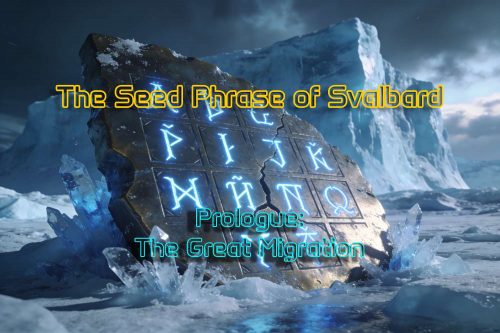
Mira input her code, then pressed her palm to the lock. The case opened with a soft hiss of released pressure, revealing a single object nestled in shock-absorbent foam: a plate of polished, inert alloy, the size of a notebook, its surface etched with twelve words in characters so fine they seemed to have been written by a machine.
The seed phrase.
Twelve words, randomly generated by an air-gapped computer that had been destroyed immediately after. Twelve words that controlled a cryptographic wallet holding the accumulated wealth of the last organized remnants of human civilization—energy credits, mineral rights, intellectual property, the digital deeds to infrastructure that no longer existed but might one day be rebuilt. It was a fortune beyond measure, locked in code, waiting for a future that might never come.
Mira watched the three Stewards as they leaned forward, committing the words to memory. They did not speak them aloud. They did not write them down. Each of them would memorize only four—a third of the whole—and those four would become the core of a new identity, a new lineage, a new purpose.
When they had finished, Elara closed the case. The seal engaged with a click that seemed to echo in the quiet hold.
“The vault at Svalbard,” Jørgen said. “It’s ready?”
“As ready as we can make it,” Mira replied. “The Global Seed Vault was designed to last. We’ve expanded the tunnels, reinforced the permafrost shielding, installed independent life support. It’s not comfortable. It’s not meant to be. But it will survive.”
“And the others?” Imani asked. “The ones who aren’t coming with us?”
Mira didn’t answer immediately. She looked toward the small porthole in the hold, where the bruised sky was visible between the hulls of other ships. There were other convoys heading to other refuges—the Antarctic ice shelves, the high-altitude caves of the Himalayas, the deep bunkers beneath the Australian outback. Some would make it. Most, she knew, would not.
“We do what we can,” she said finally. “Earthseed is not the only hope. But it is the only one that was built to last.”
The ceremony, such as it was, took place on the ice itself.
Two days later, the convoy reached the Svalbard archipelago. The islands rose from the sea like the bones of a drowned world, their mountains white with ancient ice that had somehow, against all odds, remained. The old Global Seed Vault was buried in the side of a mountain near Longyearbyen, its entrance a concrete wedge protruding from the snow like the brow of a sleeping giant.
Mira stood with the three Stewards at the entrance, the alloy case in her hands. Behind them, the convoy had anchored in the fjord, its ships dark shapes against the pale water. Above, the first of the cargo planes was descending, its payload of seed containers and server racks bound for the expanded tunnels below.
“This is the point of no return,” Mira said, her breath clouding in the cold. “Once the plate is sealed inside, no one person can retrieve it. Not me. Not any of you. Only the three clans, acting together, can open the inner chamber.”
Elara nodded. “We know.”
Mira handed her the case. “Then go.”
They descended into the mountain, through a tunnel lit by portable floodlights, past the main vault door that had been retrofitted with new locks and sensors. The air grew colder as they walked, the walls pressing close, until they reached a secondary chamber that had been carved from the permafrost itself. It was small, barely larger than a walk-in closet, with a single pedestal at its center.
Elara placed the case on the pedestal. Jørgen and Imani stood on either side of her.
For a long moment, none of them spoke. Then, one by one, they recited the words they had memorized—not aloud, but in the silence of their minds, a final affirmation that the knowledge was now theirs to carry.
Elara closed the chamber door. The biometric lock engaged with a series of heavy bolts sliding into place.
The seed phrase was sealed.
On the surface, Mira watched the convoy begin to disperse. Some ships would remain, their crews becoming the first settlers of the Svalbard refuge. Others would push on to other outposts, carrying the last threads of connection between the scattered remnants of humanity.
A young officer approached her, his face troubled. “Ma’am, the satellite network is showing increased solar activity. The communications array may not—”
“It doesn’t matter,” Mira said. She turned away from the fjord, toward the mountain that now held the vault. “We’ve sent the message. The protocol is in place. Whatever happens next, Earthseed will wait.”
She thought of the three Stewards, already beginning their new lives in the tunnels below. They would have children. Those children would have children. A hundred years was a long time—long enough for memory to fade, for purpose to become myth, for the twelve words to become a legend whispered in the dark.
But that was the design. Not a bank, but a seed. Not a treasure, but a trust.
Mira looked up at the bruised sky one last time. The sun was setting, or perhaps it was rising—it was hard to tell anymore, through the ash and the storms. But somewhere beyond the clouds, she knew, the old star was still burning.
And so, she hoped, would they.
She turned and walked back toward the Arctic Dawn, leaving the mountain behind. Behind her, the entrance to the vault was already being sealed, the steel doors closing with a sound like the turning of a page.
The first chapter of their story was over.
The next would begin in the ice, with the words waiting in the dark.
Table of contents:
Introduction
Prologue: The Great Migration
Chapter 1: Vault in the Ice <<<<<< NEXT
Chapter 2: Twelve Words to Remember
Chapter 3: The Dividends of Survival
Chapter 4: The Halving
Chapter 5: The Frostbyte Schism
Chapter 6: Hard Fork in a Hard Place
Chapter 7: Proof-of-Life
Chapter 8: The Consensus of the Sun
Chapter 9: A New Genesis Block
