The Audit was held twice a year, on the solstices, when the sun either appeared for a few hours or not at all. Today was the summer solstice—or what passed for summer in this latitude—and a pale disk of light had actually broken through the clouds, casting weak shadows across the snow. The vault’s inhabitants called it the Sun Witness, and they considered it a good omen for the proceedings.
Kiran stood with his clan in the vault’s central hall, a cavernous space carved from the mountain’s heart. The hall had been a storage bay once, back when the Global Seed Vault was still accepting deposits from the world’s gene banks. Now it was a gathering place, its walls lined with hydroponic towers that glowed with the soft green of growing things. The air was warmer here, thick with the smell of damp earth and the low hum of circulation fans.
The Stewards of the Root were arranged in a semicircle behind Elder Aris, who stood at the front of the clan. Kiran was positioned at Aris’s right hand—a place of honor, and a sign that he was now a full Steward. He wore the ceremonial tunic of his clan, a heavy garment woven from salvaged fibers and dyed deep blue, the color of the deep ocean that the founders had crossed. On his chest was embroidered a single root, branching down into darkness.
Across the hall, the other two clans had taken their positions. To the left stood the Keepers of the Branch, their tunics green like new growth. Their elder was a woman named Saria, with silver hair braided tight against her scalp and eyes that missed nothing. To the right were the Guardians of the Leaf, their tunics the pale gold of sunlight. Their elder was a man called Orin, broad-shouldered and quiet, who spoke rarely but carried authority in every movement.
Between the three clans, at the center of the hall, stood a stone table. On it rested three objects: a sealed case containing a portable biometric scanner, a heavy brass bell that had come with the original convoy, and a small brazier filled with glowing coals.
The hall was full. Every member of the vault who was old enough to stand had gathered for the Audit. They were not Stewards—most of them were descendants of the original support staff, the engineers and farmers and medics who had kept the vault running for three generations. But they were the reason the Stewards existed. They were the community the fund was meant to protect.
Kiran felt their eyes on him, and he stood a little straighter.
Elder Aris stepped forward, and the hall fell silent. Despite their age—they were the oldest person in the vault by at least two decades—Aris moved with a deliberate grace, their steps measured, their hands steady. They had performed this ritual more times than anyone alive.
“We gather on the day of the Sun Witness,” Aris said, their voice carrying easily in the quiet space. “We gather to do what our ancestors did, and their ancestors before them. We gather to prove that the promise remains unbroken.”
Saria of the Keepers stepped forward. “The promise was made in blood and fire. It was sealed in ice and stone. It binds us still.”
Orin of the Guardians stepped forward. “The words are the lock. The three clans are the keys. Together, we hold the future.”
Aris raised their hand. “Let the Audit begin.”
The ritual unfolded with the precision of a clockwork mechanism, each step prescribed by traditions that had been passed down for eighty years. First, the biometric scanner was removed from its case and placed on the stone table. A neutral arbitrator—a woman named Hana from the engineer caste, chosen for her impartiality—stepped forward to verify that the device was functioning correctly.
“The scanner is calibrated,” Hana announced. “It is ready to receive.”
Then came the test. One by one, the three elders approached the table. Each placed their palm on the scanner, confirming their identity and their right to speak for their clan. The scanner beeped once for Saria, twice for Orin, three times for Aris.
“The elders are verified,” Hana said. “The clans are present.”
Kiran watched, his heart beating faster. He had seen this ritual many times, but now he understood it differently. Now he knew that his own words were part of what was being protected. The four words in his mind were one third of a key that had not been turned in eighty years. If he died without passing them on, the key would be broken forever.
Aris turned to face the assembly. “You have heard the proof of our bodies. Now you will hear the proof of our memory. The Stewards will speak their words—not aloud, but in the silence of this hall. The scanner will confirm that the words remain unchanged.”
Kiran closed his eyes. He felt Aris beside him, and beyond Aris, the other members of his clan who carried the root words. There were seven of them in total—elders and adults and young Stewards like Kiran—but only one of them needed to speak for the clan. The others were redundancies, backups in case of death or accident.
Aris began to speak, but not with their voice. Kiran felt the words forming in his mind, as clearly as if they had been spoken aloud. They were not his words—they were the clan’s words, the four syllables that had been passed down through generations. He did not know what they meant, not really. They were sounds, shapes, patterns that had been preserved like seeds in a vault.
Whisper. Caldera. Nighthawk. Tethered.
The words resonated in his mind, and he felt the other Stewards of the Root receiving them, confirming them, holding them. Across the hall, Saria and her Keepers were doing the same with their words. Orin and his Guardians with theirs.
The scanner beeped three times, then fell silent.
Hana examined the readout, then looked up. “The words are confirmed. The phrases remain whole. The clans have kept the promise.”
A low murmur rippled through the assembly. Kiran let out a breath he hadn’t realized he was holding. The ritual was not over—there was still the distribution of the dividends, the formal speeches, the feast that followed—but the core of it was done. The words were safe. The key was intact.
He opened his eyes and looked across the hall, at the faces of the people who depended on him. They were looking back at him, and for a moment, he saw something in their expressions that he had never noticed before. It was not reverence, or gratitude, or even respect. It was something harder, something closer to expectation.
They were waiting, he realized. Not for the dividends, not for the feast. They were waiting for the future that the words were meant to unlock. And they were growing impatient.
After the Audit, Elder Aris led Kiran to the upper levels of the vault, where the old observation deck looked out over the fjord. The glass was frosted at the edges, and the view was mostly gray—gray sky, gray sea, gray ice—but it was the closest thing to outdoors that most of the vault’s inhabitants ever experienced.
Aris stood at the window, their hands clasped behind their back, their breath misting on the cold glass. Kiran stood beside them, waiting.
“You did well today,” Aris said finally. “You held the words without faltering. That is not nothing.”
“Thank you,” Kiran said. He hesitated, then added, “Elder Aris, I have questions.”
Aris smiled, a thin expression that did not reach their eyes. “Of course you do. Every Steward has questions, after their first Audit. Some of them even ask them.”
Kiran took a breath. “The words. The fund. Why do we keep it locked away? I understand the founders’ plan—wait a hundred years, let the climate stabilize, then use the fund to rebuild. But the dividends are shrinking. The cold is getting worse. People are—” He stopped, not sure how to say what he was thinking.
Aris was silent for a long moment. When they spoke, their voice was softer than Kiran had ever heard it. “You have been listening to the Frostbytes.”
It was not a question, but Kiran answered anyway. “I’ve heard things. From traders, from the market. They say the fund could heat their homes for a thousand years. They say we’re hoarding while they freeze.”
“And what do you say?”
Kiran struggled to find the words. “I say the founders made the rules for a reason. But I also wonder if they could have imagined this. The Halving coming up. The Frostbytes living in ruins. A hundred years that feels like a thousand.”
Aris turned from the window to face him. In the dim light, their face was a landscape of shadows and lines, a map of a life spent in service to a promise.
“The founders were not fools,” Aris said. “They knew the world would change. They knew the conditions would shift. That is why they built the system the way they did—not with a single key, but with three. Not with a date carved in stone, but with a mechanism that requires consensus.”
“Then why can’t we—” Kiran began.
“Because consensus requires more than agreement.” Aris’s voice hardened. “It requires wisdom. The Frostbytes want the fund opened now. They say it will ease their suffering. Perhaps it will, for a season. But what happens when the fund is spent? What happens when the energy credits flood the market and become worthless because there is nothing left to back them? What happens when the vault itself begins to crumble because there is no reserve to maintain it?”
Kiran had no answer.
Aris sighed, and some of the hardness went out of them. “The founders understood something that the Frostbytes have forgotten. Wealth that is not preserved is not wealth. It is just consumption. The fund is not a treasure to be plundered. It is a seed to be planted. If you eat the seed, you may feast for a day. But you will starve in the winter that follows.”
“So we just wait,” Kiran said. It came out more bitter than he intended.
“We wait,” Aris agreed. “But waiting is not doing nothing. Waiting is preparing. Every day, we maintain the vault. We tend the hydroponics. We teach the next generation. We hold the words. When the time comes—when the thaw has stabilized, when the planet can support rebuilding—we will be ready. And the Frostbytes, if they have survived, will be part of that rebuilding. But only if the fund remains intact.”
Kiran stared out the window, at the gray expanse of ice and sea. Somewhere out there, three kilometers away, the Frostbytes were huddled in their warrens, burning scrap for heat, watching their children die. And he was here, in the warmth, guarding a promise that might not be kept for another twenty years.
“The Halving,” he said. “It’s coming. The dividends will be cut in half. What happens to the Frostbytes then?”
Aris was silent.
“That’s what I thought,” Kiran said quietly.
He left the observation deck, his footsteps echoing in the empty corridor. Behind him, Aris stood alone at the window, their reflection ghosting on the frosted glass, watching the gray horizon where the sun had already begun to set.
The Warren Exchange was a chaos of noise and bodies.
Talia had been coming to the market since she was old enough to carry a sack, but it still overwhelmed her sometimes. The Exchange was held in the largest of the old server rooms, a cavernous space that had once housed row after row of computing equipment. Now the racks had been stripped and repurposed, leaving only a forest of steel frames that the Frostbytes used as stalls and shelters. The ceiling was lost in shadow, and the only light came from flickering electric lamps and the occasional torch.
Talia moved through the crowd, her sack of scavenged components slung over her shoulder. Dex was ahead of her, clearing a path with his bulk, his scarred face turned to stone. The other members of their group—a wiry woman named Rina and a silent boy called Toma—flanked them, watching for thieves.
The Exchange was not a safe place. The Frostbytes had no police, no laws, no rules beyond the ones they made for themselves. If someone took what was yours, you either took it back or you learned to live without it. Talia had learned both lessons, early and hard.
They reached the section of the Exchange where the energy brokers had their stalls. These were the most powerful people in the warrens—the ones who controlled the flow of credits that kept the heaters running. They sat behind tables piled with tokens and circuit boards, their faces unreadable in the lamplight.
Dex approached a broker he knew, a thin man with quick eyes and quicker hands. “Got good stuff today,” he said, hefting his own sack onto the table. “Copper, intact boards, a few chips that still have gold on them.”
The broker examined the contents of the sack with practiced disinterest. “Copper’s down. Too much of it coming in from the old transformer yard. The boards are decent, but the chips—” He held one up to the light, squinting. “These are burned out.”
“They’re not burned out,” Talia said, stepping forward. “The contacts are dirty, that’s all. A little work and they’ll be fine.”
The broker looked at her, then back at Dex. “Yours?”
“She’s with me,” Dex said. “What’s the offer?”
The broker named a price. Dex countered. The negotiation went back and forth, the rhythm as familiar to Talia as breathing. In the end, they settled on a number that was lower than Talia had hoped but higher than she had feared. Dex took the tokens—thin slivers of metal stamped with the Exchange’s mark—and divided them among the group.
Talia counted her share. It was enough for three days of heat. Maybe four, if they were careful.
As she tucked the tokens into her coat, she heard a commotion from the far end of the Exchange. Voices raised, the sound of something heavy being dragged across the floor. She looked up, curious despite herself.
A group of Frostbytes was pushing through the crowd, hauling something on a makeshift sled. Talia craned her neck to see, and then she saw it.
It was a server rack. Not the stripped-down skeletons that most scavengers brought in, but a complete unit, its casing intact, its lights still flickering. The crowd parted around it, and Talia heard whispers: Vault. Dividends. New shipment.
She grabbed Dex’s arm. “What is that?”
Dex’s eyes had gone hard. “That’s from the vault. The Stewards are selling off old equipment. Rumor is they’re preparing for the Halving. Need to raise credits for something.”
“They’re selling servers?” Talia stared at the rack as it was hauled past. It was old, certainly—the design was decades out of date—but it was whole. It had been maintained, cared for. It was a piece of the world that the Stewards had kept for themselves while the Frostbytes scrabbled in the ruins.
“They’re selling what they don’t need,” Dex said. “What they never needed. We get the scraps. They get the warmth.”
Talia watched the rack disappear into the crowd, and something cold settled in her chest. It was not the cold of the warrens, the bone-deep chill that came with winter. It was something else. Something that burned.
“Dex,” she said. “The Audit was today. I heard the traders talking. The Stewards did their ritual, proved they still had the words. And tomorrow, they’ll go back to their warm rooms and their full bellies, and we’ll go back to freezing.”
“I know.” Dex’s voice was flat.
“Someone should make them understand,” Talia said. “Someone should make them see what it’s like out here. What we’re living through.”
Dex looked at her, and for a moment, she saw something in his eyes that she had never seen before. Not anger, not resentment. Something colder, more patient. “Someone will,” he said. “But not yet. We need to be smart. We need to wait for the right moment.”
“When is the right moment?” Talia demanded.
Dex didn’t answer. He turned away, his sack of scavenged goods slung over his shoulder, and disappeared into the crowd. Talia stood alone in the chaos of the Exchange, the tokens burning a hole in her pocket, and watched him go.
She thought about the vault, three kilometers away. She thought about the Stewards in their blue and green and gold tunics, reciting their secret words in the warmth. She thought about the server rack, the scraps they deigned to sell when they needed credits.
And she thought about her father, buried in the rubble, and her brother, coughing in the cold, and all the children who had died because there wasn’t enough heat to keep them alive.
The right moment, Dex had said. Talia didn’t know when that moment would come. But she knew, with a certainty that settled into her bones like frost, that when it came, she would be ready.
She turned and walked back into the crowd, her steps steady, her gaze fixed on the path ahead.
That night, Kiran lay awake in his bunk, staring at the ceiling.
The vault was quiet at this hour, the corridors empty, the hydroponic fans reduced to a low hum. Most of the inhabitants were asleep, conserving energy for the day to come. But Kiran’s mind was still racing, still circling the questions that Aris had not answered.
He thought about the words. Whisper. Caldera. Nighthawk. Tethered. They were just sounds, meaningless patterns, but they were also the most valuable thing in the world. Without them, the fund was just a number on a dead ledger. With them, it was a future waiting to be born.
But what kind of future? A future that required children to freeze while the guardians stayed warm? A future that demanded sacrifice from the many for the benefit of the few?
He sat up, swinging his legs over the side of the bunk. The room was cold—not as cold as the warrens, but cold enough to make him shiver. He pulled on his coat and walked to the small window that looked out over the mountain.
The sun had set hours ago, but the sky was not entirely dark. A pale glow lingered on the horizon, the last trace of the day that had barely been. Below, the snow stretched away into the darkness, broken only by the distant shapes of the Frostbyte warrens.
He thought about the people who lived there. He had never met them, not really. He had seen them at the market, sometimes, bundled in rags, their faces pinched with cold. He had heard their voices, their laughter, their arguments. They were not enemies. They were just people, trying to survive.
And he was keeping something from them. Something that could ease their suffering. Something that could save their children.
Wealth that is not preserved is not wealth, Aris had said. It is just consumption.
But what was preservation without purpose? What was a seed that was never planted?
Kiran pressed his forehead against the cold glass and closed his eyes. He was a Steward now. He carried the words. He had made a promise, not just to the founders, but to everyone who depended on the fund. He could not break that promise.
But he could not stop thinking about the Frostbytes, either. Three kilometers away, shivering in the dark, waiting for a warmth that never came.
The right moment, Aris had said. The time when consensus could be reached, when the fund could be opened without destroying everything it was meant to protect.
Kiran opened his eyes and looked out at the darkness. Somewhere out there, he knew, someone was looking back at the mountain, wondering the same thing he was.
When is the right moment?
He did not have an answer. Not yet. But he knew, with a certainty that frightened him, that the moment was coming. And when it came, he would have to choose.
He pulled away from the window and returned to his bunk, the cold still clinging to his skin. He lay down and closed his eyes, but sleep did not come. The words were waiting in his mind, patient and eternal, and the questions would not leave him alone.
Outside, the wind began to rise, carrying the first whispers of the coming storm.
Table of contents:
Introduction
Prologue: The Great Migration
Chapter 1: Vault in the Ice
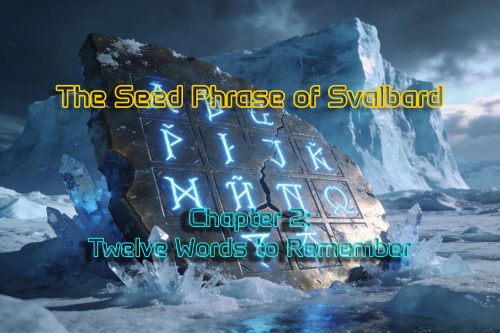
Chapter 2: Twelve Words to Remember
Chapter 3: The Dividends of Survival <<<<<< NEXT
Chapter 4: The Halving
Chapter 5: The Frostbyte Schism
Chapter 6: Hard Fork in a Hard Place
Chapter 7: Proof-of-Life
Chapter 8: The Consensus of the Sun
Chapter 9: A New Genesis Block
