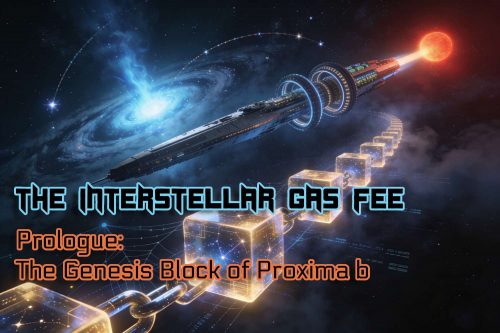
Scene 1: Earth, 2157 – The Launch of the Beacon
The last war had not been fought with bombs.
It had been fought with ledgers.
For thirty-seven years, the great nations of Earth had argued over who owned the stars. Not the planets—those were too far, too empty, too hostile to hold a flag. No, the fight was over bandwidth. Over validation priority. Over the simple, brutal question: when a ship halfway to Alpha Centauri needed to trade water for medicine, whose rules would govern that handshake?
The old United Nations had tried. Then the Interplanetary Commerce Compact. Then the Mars Accords, the Belt Concord, the Titan Protocol. Each one collapsed under its own weight, undone by the same problem: space was too big, and people were too small, and trust did not travel well across two hundred million kilometers of vacuum.
So on a cold November morning in what remained of Geneva, the survivors of those failed treaties gathered one last time.
They called it the Genesis Convention.
Juno’s great-grandmother, Mira Chen, was there. Not as a delegate—she was only nineteen, a physics student who had won a lottery ticket to observe the proceedings from the gallery. But she kept a journal, and that journal would one day become the Axiom’s founding charter. In it, she wrote:
“They look exhausted. The diplomats, I mean. Bags under their eyes like they’ve been awake for a century. Maybe they have. But there’s something else in the room. Hope? No. Something sharper. Desperation, maybe. The kind that finally makes people stop arguing and start building.”
What they built was the Beacon.
The Beacon was not a place. It was a protocol. A decentralized, AI-led blockchain designed to govern every transaction between every human-occupied spacecraft in the galaxy. Not a government—no one trusted governments anymore. Not a corporation—corporations had started the last war. The Beacon was simply math. Immutable. Transparent. Neutral.
Its rules were brutal in their simplicity:
- Every ship, station, or colony would have a cryptographic identity.
- Every exchange of value—fuel, food, data, labor—would be recorded as a transaction.
- Transactions would be validated by a network of nodes, each node’s voting power proportional to its mass-energy (because in space, E=mc2E=mc2 was the only law that couldn’t be lobbied).
- The AI that managed the protocol would be open-source, auditable, and incapable of favoring any single faction.
They called it a proof-of-stake system, where “stake” meant something you couldn’t fake: the raw, irreducible physics of your ship’s reactor.
At 11:47 GMT, the lead architect—a woman named Dr. Aris Thorne, who had not slept in three days—pressed a single button.
Across the solar system, a million nodes received the same instruction:
Genesis block: broadcast.
A pulse of data rippled outward. The Moon saw it. Mars saw it. The Belt, the Jovian stations, the lonely research outpost on Titan. Every human who still listened to the deep-space network received the same 512-character string: the first block of the longest chain.
For exactly seven seconds, there was silence.
Then the first transaction arrived. A fuel depot near Ceres sent five tons of water ice to a mining scow that had run dry. The fee: 0.0001 Beacon credits. The validation time: 0.3 seconds.
It worked.
Mira Chen wrote: “People are crying in the gallery. I don’t know if it’s joy or exhaustion. Maybe both. The ambassador from the Jovian Collective just shook hands with the Martian envoy. They haven’t spoken in six years. Something just changed. I don’t think we understand how much.”
Scene 2: The Promise & The Flaw
That night, after the champagne was gone and the diplomats had retreated to their soundproofed suites, Dr. Aris Thorne sat alone in the Beacon’s primary server room.
It was not a grand place. Just a climate-controlled bunker buried beneath the ruins of the old UN headquarters, filled with racks of quantum processors that hummed at a frequency just below human hearing. The Beacon’s AI—still unnamed, still learning—lived here in a distributed form, its consciousness spread across ten thousand nodes like a murmuration of starlings.
Thorne opened a voice log. She did this often. The AI would process it later, categorize it, file it away in the growing archive of human anxiety.
“Day zero, post-launch,” she said. Her voice was dry, clinical. “The network is stable. Transaction throughput is within projected parameters. Validator participation is at ninety-four percent. I should be celebrating.”
She paused. The processors hummed.
“But I keep coming back to the same problem. The one we papered over because we didn’t have time to solve it.”
She pulled up a holographic display—a visualization of spacetime as a mesh of interconnected points. Earth was in the center, a bright knot of activity. The outer planets were stretched, elongated, their local time slightly slower due to the Sun’s gravity well. It was a familiar diagram. Every physics student had seen it.
“Relativity,” Thorne said. “The Beacon assumes a universal ‘now.’ It assumes that when a validator on Mars looks at a transaction from Earth, they’re seeing the same moment. But they’re not. The light travel time alone is three to twenty-two minutes. That’s manageable. We built in buffers for that.”
She zoomed the diagram. Way, way out. Past the heliopause. Past the Oort cloud. To the interstellar gulf where the generation ships were already beginning their centuries-long journeys.
“The real problem is velocity,” she continued. “And gravity. A ship accelerating to ten percent of light speed will experience time dilation of about half a percent. That’s small. But a ship near a neutron star? A ship skimming the event horizon of a black hole? Their ‘now’ and our ‘now’ could be years apart. Decades. The Beacon wasn’t designed for that. The consensus algorithm requires nodes to agree on an ordering of events. But when time itself is warped… there is no universal ordering.”
She turned off the hologram.
“I raised this in the design review. Eighteen times. Every time, I was told the same thing: ‘We’ll solve it later. The generation ships won’t reach relativistic regimes for another fifty years. By then, we’ll have better tech. Or we’ll be dead.’”
She laughed. It was not a happy sound.
“They’re right, of course. I’ll be dead. Probably within thirty years if I’m lucky. The generation ships will keep flying. The Beacon will keep validating. And someday, someone will send a transaction from a time-dilated vessel, and the network will try to order it against a transaction from a stationary observer, and the whole thing will jam like a gearbox filled with sand.”
She leaned back in her chair. The processors hummed on, indifferent.
“I’ve added a note to the source code. Buried deep in the comments. No one will read it for decades, probably. But it’s there. It says: ‘The system assumes a universal ‘now.’ Relativity will break it eventually. But by then, we’ll be gone.’”
She closed the log.
“End recording.”
The AI, still learning, still watching, filed the log under ARCHIVE / BEACON / DESIGN FLAWS / DEFERRED. It added a timestamp, a cryptographic hash, and a small notation that no human would see for a very long time:
“Note to future maintainers: Dr. Thorne was correct. Patch required before relativistic discrepancies exceed 0.1% of consensus timeout. Estimated deadline: 97 years from genesis.”
Cut to Black
Text appears on screen, one word at a time:
One Hundred Years Later
Deep Space
The hum of the quantum processors fades into the low, steady thrum of a generation ship’s fusion drive. Somewhere, a young woman named Juno is about to send a transaction for helium-3 fuel. Somewhere else, a young man named Kaito is waking from a seventy-two-hour sleep cycle beside a neutron star.
Neither of them has read Dr. Aris Thorne’s log.
Neither of them knows that the Beacon is already broken.
They are about to find out.
Table of contents:
Introduction
Prologue: The Genesis Block of Proxima b
Chapter 1: A Transaction Stuck in Pending <<<<<< NEXT
Chapter 2: The Relativity Discount
Chapter 3: The Mempool of Deep Space
Chapter 4: Bidding Against Time
Chapter 5: Time-Dilation Arbitrage
Chapter 6: Validators on the Event Horizon
Chapter 7: A Proof-of-Spacetime Consensus
Chapter 8: The Infinite Block Time
Epilogue: Confirmed
