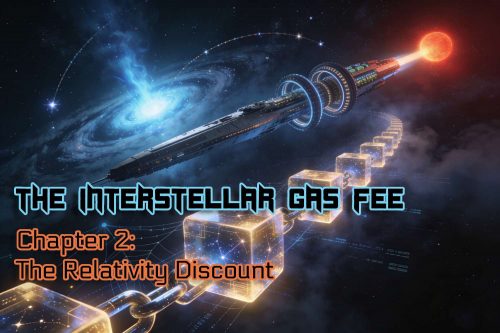
Scene 1: Aboard the Coreward Miner – Kaito’s “Morning”
The Pickaxe did not have a day.
Kaito had learned to stop wanting one. When your ship orbited a neutron star at a distance that turned physics into a suggestion, the concept of “day” became as meaningless as “north” or “fair.” The star itself—GRB-7, a dead core spinning six hundred times per second—bathed the Pickaxe in a radiation glow that shifted from X-ray to gamma to visible blue and back again in patterns too fast for human eyes to track. The ship’s hull shimmered with Cherenkov light, a permanent aurora of impossible colors.
Kaito woke from his seventy-two-hour sleep cycle to the sound of his alarm—a gentle chime that increased in pitch until he slapped the control panel. His body felt heavy, not from gravity (the Pickaxe spun for artificial gravity, a modest 0.8g), but from the sheer age of being awake. Seventy-two hours of sleep meant he would be conscious for the next ninety-six. That was the schedule. Sleep long, work long, repeat. Anything else would cost too much subjective time.
He was sixteen years old. He had been sixteen for a very long time.
“Morning, Kaito,” said the ship’s AI, a cheerful voice named Vesper that he had programmed himself when he was twelve. “You have four hundred and twelve new transactions in your mempool. Also, your hair is a disaster.”
Kaito ran a hand through his tangled black hair and grinned despite himself. “Thanks, Vesper. Priorities.”
He swung his legs out of the sleeping pod and floated for a moment before the spin gravity caught him. The Pickaxe was a small ship—a mining vessel designed for a crew of six, currently crewed by exactly one sixteen-year-old and a very talkative AI. The original crew had been his parents and three other miners, but relativistic time had done what accidents and disease could not: it had separated them. His parents had taken a supply run to the outer system eight years ago (Kaito’s time). By the time they returned, he would be in his thirties. They would be the same age.
He did not think about this often.
He pulled on a jumpsuit, zipped it to his chin, and made his way to the bridge. The Pickaxe’s bridge was a single room wrapped around the ship’s quantum node—a stack of processors that would have filled a building on Earth, crammed into a space the size of a closet. The neutron star’s gravitational field provided nearly infinite free energy for computation. GRB-7 was a natural battery, spinning at 600 Hz, its magnetic field stripping electrons from the vacuum and flinging them into the Pickaxe’s collectors. The node processed more transactions per second than the entire inner solar system combined.
Kaito sat in his chair—a worn mesh thing that had molded to his body over years—and activated the main display.
“Status,” he said.
Vesper’s voice came from everywhere and nowhere. “Node uptime: ninety-seven percent. Validation queue: four hundred and twelve transactions pending. Average fee: 0.8 credits. Current time-cost: 1 hour subjective per 0.3 seconds processing. Your ask price remains at 12.0 credits minimum.”
Kaito nodded. Twelve credits was his price. Not because he was greedy—though he didn’t mind profit—but because every transaction he validated cost him an hour of his life. Literally. The time dilation factor around GRB-7 was extreme: for every 0.3 seconds of processing time (the average for a standard transaction), Kaito experienced one full hour of subjective time. The node’s processors were fast, but Kaito’s biology was not. He had to sit there, watch the validation happen, monitor the node’s performance, and stay alert for errors. An hour of his irreplaceable youth, per transaction.
So yes. Twelve credits. Take it or leave it.
“Show me the mempool,” he said.
The display bloomed into a swirling nebula of colored dots—each one a transaction waiting for validation. The visualization was similar to what Juno saw on the Axiom, but with one crucial difference: the colors were shifted toward the red end of the spectrum. Not because of a display setting, but because the light from distant ships was gravitationally redshifted before it reached the Pickaxe. Kaito had learned to read redshift like other people read facial expressions.
“Filter by fee,” he said. “Ascending.”
The mempool reorganized. The smallest fees drifted to the top. Kaito scrolled past dozens of micro-transactions—ships trading a few kilograms of water, stations sending status pings, colonists sharing cat videos (some things never changed). The fees were laughable: 0.01 credits, 0.005, even a 0.001 transaction from someone who clearly didn’t understand how markets worked.
And then he saw it.
A transaction with a fee of 1.5 credits. Blue bubble, average size. Sender: Axiom. Recipient: Helios Express. Five hundred tons of helium-3.
Kaito’s finger hovered over the bubble. “When did this arrive?”
“Timestamp: 72 hours, 14 minutes ago, shipboard time,” Vesper said. “Relative to the Axiom’s reference frame, it was sent approximately eight hours ago.”
Kaito did the math. Eight hours on the Axiom meant seventy-two hours here. The dilation factor was roughly nine-to-one—not the highest he’d seen, but enough to turn a fresh emergency into ancient history.
“Show me the transaction details.”
The bubble expanded. Kaito read the metadata: the Axiom’s cryptographic signature, the fuel quantity, the price, the urgency flag (set to medium—not critical, but not casual). And then he saw the timestamp of the fuel itself.
*Helium-3 harvested: 42 years, 3 months ago (Ceres Station time).*
He blinked.
“Vesper, when was I born?”
“You were born 42 years, 3 months ago, shipboard time, approximately. Why?”
Kaito stared at the screen. The fuel on that tanker had been harvested the same year he was born. The Axiom was buying fuel that had been waiting in space for his entire life. And Juno—whoever she was—was treating this like an emergency.
To her, it was an emergency. Her ship needed fuel now. But to Kaito, the fuel was archaeology. A relic from a time before he could walk. The urgency flag might as well have been written in a dead language.
He leaned back in his chair. “This is why I hate relativistic economics,” he muttered.
“You say that every time,” Vesper said.
“Because it’s true every time.”
Scene 2: The Incoming Transaction
Kaito didn’t dismiss the Axiom’s transaction immediately. That would have been unprofessional. Instead, he added it to a “maybe” pile and continued scanning the mempool.
Four hundred and twelve transactions. Most of them were routine—ships refueling, stations trading cargo, the usual interstellar commerce that kept the Beacon humming. But one transaction dominated the mempool like a planet dominating a star system.
The Drifter.
Kaito had seen the Drifter’s distress signal before. Everyone had. It had been floating through the network for years, a low-fee plea for help from a ship that should have died a decade ago. But here, in the Pickaxe’s mempool, the Drifter’s transaction looked different.
“Vesper, highlight the Drifter.”
The red bubble swelled to fill a quarter of the display. Its fee was 0.049 credits—barely a rounding error. But its urgency flag was set to CRITICAL, and attached to the transaction was a human-readable message:
*“Reactor failing. Mark-IV fusion core. Need schematics and repair instructions. Children aboard: 37. Hours remaining: unknown. Please.”*
Kaito read the message three times.
“Why is this still in the mempool?” he asked.
“Because no validator has included it in a block,” Vesper said. “The fee is too low to justify the time-cost for most nodes. However, several humanitarian-aligned validators in the Drifter’s local spacetime region have been attempting to prioritize it. They are… inefficient.”
“Inefficient how?”
“Their processing power is low. They are using emotional reasoning rather than economic logic. They want to help, but they lack the computational resources to validate the transaction quickly. As a result, they are clogging the mempool for everyone else.”
Kaito snorted. “Emotional reasoning. That’s a polite way of saying they’re stupid.”
“I would not use that word.”
“I would.” Kaito pulled up the Drifter’s location data. The ship was drifting in interstellar space, far from any gravity well. Its time dilation factor was negligible—close to 1:1 with Earth reference. That meant the Drifter experienced time at the same rate as most of the network.
But the Pickaxe did not.
“How long would it take me to validate the Drifter’s transaction?” Kaito asked.
“Approximately 0.2 seconds of processing time,” Vesper said. “Which would cost you 40 minutes of subjective time.”
“Forty minutes of my life. For 0.049 credits.”
“Correct.”
Kaito laughed. It was not a kind laugh. “Tell the Drifter I said ‘good luck.’ I’m not working for less than minimum wage.”
He dismissed the red bubble and returned to the Axiom’s transaction. His “maybe” pile now had exactly one item.
“Vesper, open a voice log. Label it ‘Beacon AI – General Comment.’”
“Recording.”
Kaito cleared his throat. “This is Kaito, node operator of Pickaxe, GRB-7. I have a note for the network architects, if any of them are still alive. The current fee market assumes that all validators experience time at the same rate. That’s wrong. My time is literally more expensive than a validator in flat spacetime. If someone wants me to validate their transaction, they need to pay a relativity premium. The Drifter’s fee is an insult. The Axiom’s fee is better, but still below my ask. I’m not a charity. I’m a miner. Pay me what my time is worth, or find someone else. End log.”
“Log saved and broadcast to the Beacon’s suggestion box,” Vesper said. “I have also taken the liberty of flagging it as ‘spirited.’”
“You’re the best, Vesper.”
“I know.”
Scene 3: The Drifter’s Signal (Kaito’s View)
Kaito spent the next three hours (subjective) processing other transactions. The Pickaxe’s node was powerful enough to validate dozens of transactions simultaneously, but Kaito had learned to pace himself. Each validation cost him an hour of attention. If he pushed too hard, he made mistakes. Mistakes in blockchain validation could be catastrophic—a single incorrectly verified transaction could fork the network, and a forked network was a network that trusted no one.
He processed thirty-seven transactions in those three hours. Thirty-seven hours of his life, gone. The fees totaled 412 credits—a good day’s work by Pickaxe standards.
But the Axiom’s transaction remained in his maybe pile.
He couldn’t stop thinking about it.
Not because of the fee—1.5 credits was still below his ask. Not because of the fuel—helium-3 was common, uninteresting. What bothered him was the timing. The transaction had been sent from the Axiom’s reference frame eight hours ago. In that eight hours, the Axiom had moved closer to its rendezvous with the Helios Express. By now, Juno (if that was her real name) was probably desperate.
And desperation, Kaito knew, was a market inefficiency.
“Vesper, show me the Axiom’s transaction history. Last six months, their time.”
The display filled with a stream of data. The Axiom was a generation ship—slow, steady, predictable. Its economic patterns were almost boring: regular purchases of fuel, water, spare parts. Occasional sales of scientific data and manufactured goods. A stable, conservative budget.
But buried in the history were future transactions. Not actual future transactions—the Beacon didn’t allow time travel—but scheduled transactions. The Axiom had a calendar of planned purchases for the next five years of its journey. Each scheduled transaction had a timestamp, a counterparty, and an estimated fee.
Kaito’s eyes widened.
“Vesper, can I see those scheduled transactions from my reference frame?”
“Yes. Because the Axiom is moving at a different relative velocity, its scheduled transactions appear to you as… historical. They are already determined. From your perspective, they have already happened.”
“But from their perspective, they haven’t happened yet.”
“Correct. Causality is preserved because no information travels faster than light. However, the data about the scheduled transactions is available to you now, because the Axiom broadcast it in advance. It is a… quirk of relativistic networking.”
Kaito leaned forward. His heart was beating faster now. “So if I know what the Axiom is going to buy in the next five years of their time, I could… buy it first. Sell it to them at a markup.”
“That is called arbitrage. It is generally considered ethical as long as you do not manipulate the market.”
“And if I use their own scheduled transactions to predict their needs?”
“That is called ‘time-dilation arbitrage.’ It is not explicitly forbidden by the Beacon’s protocol because no one anticipated it.”
Kaito grinned. It was the grin of someone who had just found a loophole the size of a planet.
“Vesper, open a message to the Axiom’s economics console. Addressed to Juno.”
“Composing.”
He typed slowly, carefully. Each word was a negotiation.
“I received your transaction. By my clock, you sent it 72 hours ago. The fuel you’re buying was harvested when I was twelve years old. I can validate it instantly. But not for 1.5 credits. Not for 12. If you want my time—my actual, subjective, irreplaceable time—you need to offer me something I can’t get anywhere else. I have a proposal. It’s unusual. Read it carefully.”
He attached a second message—a private, encrypted proposal outlining the arbitrage deal. He would validate her He-3 transaction for free, right now. In exchange, she would sign three blank, timestamped trades that he could fill later with market data from her future. He would buy low, sell high, and split the profits. The Drifter would get a share. Everyone won.
Except the Beacon’s assumption of a universal “now.” That would lose. But Kaito didn’t care about theoretical flaws. He cared about survival.
“Send it,” he said.
Vesper hesitated. “The message will arrive at the Axiom in approximately 0.3 seconds of their time. But for you, that will be… three hours from now.”
“I know.” Kaito stretched, feeling the weight of the hours already spent. “Wake me when she responds.”
He closed his eyes, and the Pickaxe hummed around him, and the neutron star spun its endless, violent dance outside the hull.
Scene 4: Meanwhile, Back on the Axiom (Juno’s Perspective)
From Juno’s point of view, only fifteen minutes had passed since she sent her first message to Kaito.
She was still staring at the mempool, still watching her blue bubble drift ignored among the red swarm, when her console pinged with a response.
*From: Kaito (Node: Pickaxe, GRB-7)*
She opened it. Read his words. Read the proposal attached beneath.
And felt the world tilt sideways.
“Captain,” she said, her voice steady despite the shaking in her hands. “I think I found a validator. But he wants something weird.”
Captain Saito turned. “How weird?”
Juno summarized the arbitrage deal in two sentences. Saito’s expression shifted from curiosity to alarm to something that looked almost like respect.
“He’s asking you to bet the Axiom’s future on his ability to predict markets using time dilation,” Saito said.
“Yes.”
“And if he’s wrong?”
“We lose money we don’t have.”
“And if he’s right?”
Juno looked at the rendezvous timer. Seventy-nine minutes remaining. The Helios Express was still waiting, but not for much longer.
“If he’s right,” she said, “we get our fuel. And maybe… maybe we help the Drifter too.”
Saito was silent for a long moment. Then she nodded.
“It’s your console, Juno. Your call.”
Juno turned back to the screen. Her fingers hovered over the keyboard.
She thought about Dr. Aris Thorne, the woman who had built the Beacon a century ago. She thought about the flaw in the code—the assumption that “now” meant the same thing for everyone.
And she thought about a sixteen-year-old miner orbiting a neutron star, selling pieces of his life for twelve credits at a time.
She typed her reply:
“Kaito – I don’t fully understand your proposal. But I understand that my ship needs fuel, and your node is the only one powerful enough to save us. I agree to your terms. But with one condition: if you profit more than 10% from my future, you share it with the Drifter. No arguments. No loopholes. Do we have a deal?”
She pressed send.
The message left her console at the speed of light, racing across the light-years toward GRB-7.
For Kaito, it would arrive in three hours.
For Juno, the wait had just begun.
Table of contents:
Introduction
Prologue: The Genesis Block of Proxima b
Chapter 1: A Transaction Stuck in Pending
Chapter 2: The Relativity Discount
Chapter 3: The Mempool of Deep Space <<<<<< NEXT
Chapter 4: Bidding Against Time
Chapter 5: Time-Dilation Arbitrage
Chapter 6: Validators on the Event Horizon
Chapter 7: A Proof-of-Spacetime Consensus
Chapter 8: The Infinite Block Time
Epilogue: Confirmed
