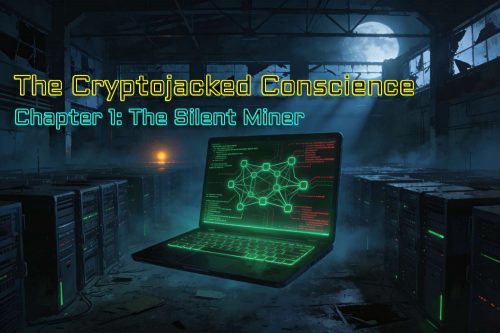
The fan screamed like a dying animal.
Pax Chen jerked awake, tangled in his bedsheets, heart hammering against his ribs. For a confused second he thought the smoke alarm was going off—but no, the sound was coming from his laptop. The laptop that had been sitting closed on his desk for the past four hours.
He checked his phone. 3:14 AM.
The fan noise was wrong. Not the usual quiet whir of background cooling, but a full-throttle, jet-engine roar that he’d only ever heard once before—when he’d accidentally run a stress test on all eight cores simultaneously.
He wasn’t running a stress test now. He wasn’t running anything.
Pax threw off the covers and padded across the cold floor to his desk. The laptop’s chassis was hot to the touch. Too hot. He could have fried an egg on the trackpad.
“Okay,” he muttered, opening the lid. “What are you doing?”
The screen flared to life. His desktop looked normal—same wallpaper (a schematic of the Apollo Guidance Computer), same icons, same cluttered download folder that he kept meaning to organize. But when he pulled up Task Manager, his blood ran cold.
CPU usage: 100 percent.
All eight logical cores maxed out. And the process eating everything didn’t have a name he recognized. Just a string of random characters: xmr-stak-rx.exe
But underneath that random string, in the process description field, was something that made his stomach drop.
System Optimizer v2.0 – Silent mode
His System Optimizer. His script. The one he’d written six months ago to stop the school computers from overheating.
Someone had taken his code. Someone had turned it into a weapon.
Six months earlier
Pax had been sitting in Mrs. Davison’s third-period Algebra II class when the computer next to him made a sound like a hovercraft taking off. The old Dell OptiPlex—one of thirty identical gray boxes that the school district had bought refurbished from a bankrupt dental office—was running at full fan speed for no apparent reason. All Ryan Nakamura had open was a single tab of Khan Academy.
“It does that,” Ryan whispered, not looking up from his worksheet. “Just ignore it.”
But Pax couldn’t ignore it. He’d been taking computers apart since he was nine. He knew that sound meant thermal throttling—the CPU slowing itself down to avoid melting. And thermal throttling meant the computer was working way harder than it should have been.
He’d checked the lab computers after school that day. Every single one of them was running background processes that didn’t belong there. Bloatware. Telemetry. Security scanners that ran on a loop. Combined, they were eating forty to sixty percent of the CPU at idle.
The school didn’t have money for new computers. The PTA bake sales could barely afford replacement mice. But Pax had time, and he had a GitHub account, and he had exactly forty-seven lines of Python that could fix everything.
The script was elegant, if he said so himself. It monitored CPU temperature and usage, then dynamically adjusted fan curves and process priorities to keep the system cool without slowing down the user. It wasn’t revolutionary—Linux had been doing similar things for years—but on these decrepit Windows machines, it was magic.
He’d tested it on his own laptop first. Then on Ryan’s computer in third period. Then on all thirty lab machines over a weekend when no one was around.
It worked. The fans ran quieter. The computers ran faster. The teachers stopped complaining.
On a Monday morning in September, Pax pushed the script to GitHub with an MIT license—free for anyone to use, modify, improve. He wrote a README that said: “Made for my school’s computer lab. Hope it helps someone else too.”
He never thought about it again.
Until now.
Present
Pax’s fingers flew across the keyboard, pulling up process logs, network connections, file locations. The malware—because that’s what it was, malware—had buried itself deep. It had renamed itself to look like a Windows system process. It had added registry keys to launch at startup. It had even disabled Windows Defender.
But the core of it was unmistakably his code. The temperature thresholds were the same. The fan control logic used his unique approach of averaging three temperature readings to avoid oscillation. The error handling even had his signature comment—# if it breaks, blame Pax—still sitting there in plain sight.
Someone had taken his script, wrapped it in layers of obfuscation, and attached it to a Monero miner.
Monero. The cryptocurrency of choice for people who didn’t want to be tracked. Privacy coins, they called them. Pax had read about cryptojacking—hackers secretly using other people’s computers to mine crypto—but he’d always thought of it as something that happened to big corporations or careless grandparents. Not to him. Not to his school.
He checked the miner’s logs. The thing had been running for three weeks, stealing his laptop’s processing power for someone else’s profit. It had generated 0.042 XMR so far. That was only about eight dollars at current prices, but that wasn’t the point.
The point was that someone had reached into his machine without asking. His machine. His private space. The laptop he’d saved for two summers to buy. The laptop that held his school projects, his personal notes, his chat logs with his mom who worked nights and barely had time to text back.
The violation felt physical. Like coming home to find a stranger sitting on your bed, going through your drawers.
And it was his own code that had let them in.
His phone buzzed on the desk. He ignored it. Then it buzzed again. And again. Five times in thirty seconds.
He grabbed it, squinting at the brightness. The school Discord server was exploding.
RyanNakamura: anyone else’s computer running super slow?
MayaWong: omg yes I thought it was just mine
KevinTran: my laptop battery died in like an hour today
RyanNakamura: check task manager there’s something called system optimizer using all the cpu
MayaWong: i can’t even open task manager it’s frozen
KevinTran: my dad works at the middle school and he said all their computers are doing the same thing
RyanNakamura: wait someone posted a reddit thread about this
The link took Pax to a subreddit he’d never visited before—r/cryptojacking. The post was from three hours ago, titled “Is your school computer slow? Check your CPU usage.”
The screenshots made his stomach clench. Six different schools across the district. Same process name. Same random executable. Same pinned CPU usage.
The comments were worse.
“This is definitely cryptojacking. Someone’s mining Monero on your school’s computers.”
“Check the network traffic. Bet you’ll find a C2 server in Russia or something.”
“My cousin’s school had this. They had to reimage every single machine.”
Pax’s hands were shaking. He pulled up his own monitoring dashboard—the custom one he’d built to track all thirty lab computers from a single screen. It was not good.
Every single machine was running at seventy to eighty percent CPU. The network switch logs showed constant outbound traffic to an IP address he didn’t recognize. The lab computers were supposed to be idle at this hour. Instead, they were working harder than they did during final exams.
He traced the IP. The geolocation came back to… his own city. Not Russia. Not China. Somewhere within fifty miles.
And when he did a reverse DNS lookup, the domain name made his heart stop.
c2.paxs-cooling-script.xyz
Someone had registered a domain with his name in it. Someone was mocking him.
Or framing him.
He didn’t know which was worse.
The computer lab was empty when Pax arrived at 6:47 AM, two hours before first period. The hallway lights were still on night mode—dim, almost blue. His footsteps echoed off the cinderblock walls.
He’d come early to see the damage in person. To prove to himself that the dashboard wasn’t lying.
He pulled open the lab door and immediately heard it: the low, sustained drone of thirty cooling fans running at maximum speed. The sound filled the room like a beehive the size of a car.
The computers were on. All of them. The screens were dark—power-saving mode—but the fans told the real story. These machines were working.
He sat down at the teacher’s station and woke the monitor. The login screen appeared after a five-second delay—slow, sluggish, wrong. He typed his admin password, waited another eight seconds for the desktop to load, and opened Task Manager.
There it was. system_optimizer_v2.exe Running with high priority, eating seventy-three percent of the CPU. The fan was running at six thousand RPM. The CPU temperature was eighty-nine degrees Celsius.
On a machine that was doing nothing else.
Pax opened the file location. The executable was in C:\ProgramData\SystemOptimizer\, a folder that shouldn’t exist. He right-clicked, looked at the digital signature.
Not signed. Of course not. But the creation date was seventy-three days ago. And the owner of the file was listed as SCHOOL\pax.chen.
His own admin account had created this file. Or someone using his credentials had.
He thought back. Tried to remember every time he’d typed his password in front of someone. Every time he’d walked away from a logged-in machine. Every time he’d been careless.
The memory hit him like a slap.
Three months ago. The AV club. Their streaming server had crashed during a live broadcast of the winter concert, and the president—Marcus, a senior with a cocky grin and a basement “mining rig”—had begged Pax to help. Pax had remoted in from his laptop, typed his admin credentials while Marcus stood right behind him, and fixed the server in fifteen minutes.
Marcus, who had watched every keystroke.
Marcus, who had suddenly bought a used car last week.
Marcus, who had asked Pax last month “hypothetically” how hard it would be to run a miner on school computers without getting caught.
Pax had laughed it off. Told him it was impossible because of the network monitoring. Shown him the dashboard to prove it.
He’d handed Marcus everything he needed.
His phone buzzed again. This time it wasn’t Discord. It was a text from an unknown number.
“Your script is good. The cooling logic is smart. Too bad you didn’t lock it down.”
He stared at the message. His thumb hovered over the keyboard. Who was this? Marcus wouldn’t taunt him like this—Marcus wasn’t smart enough. Marcus was a script kiddie who downloaded tools other people made. This message had weight. Confidence.
He typed back: “Who is this?”
Three dots appeared. Then disappeared. Then appeared again.
“You’ll find out soon enough. Check your dashboard again.”
Pax pulled up the monitoring dashboard. The thirty lab computers were still running at seventy-plus percent. But now there was a new entry at the bottom of the device list. Something that shouldn’t have been there.
A ventilator. Model number, IP address, location: County General Hospital, ICU 3.
The cryptojacker had spread to hospital equipment.
Pax felt the room tilt. Ventilators. Life support. Machines that kept people breathing. If one of those crashed because some thief was mining crypto—
He didn’t finish the thought. The lab door slammed open.
Pax spun around.
A girl stood in the doorway, silhouetted against the dim hallway lights. She was about his age, maybe a year older, with sharp eyes and a dark ponytail. She wasn’t wearing his school’s colors—different district, different part of town. He’d never seen her before.
But she was holding a phone. And on the screen was the same Reddit thread he’d been looking at.
“You’re Pax Chen?” she said. Her voice was cold, flat, controlled.
“Yeah. Who are you?”
She walked into the lab, boots clicking on the tile floor. She didn’t introduce herself. She just held up her phone, showing a different screen now—a network map with dozens of red dots, all clustered around the city. At the center of the cluster was a single blue dot labeled PAX-COOLING-FAN.
“Your malware,” she said, “is killing my mom’s hospital.”
Pax opened his mouth to say It wasn’t me, but the words caught in his throat. The code on those screens had his name all over it. His script. His admin account. His cooling logic.
He’d built the weapon. Someone else had just pulled the trigger.
But that didn’t make him innocent.
He closed his laptop, stood up, and faced the girl who was looking at him like he was a criminal.
“I didn’t do this,” he said quietly. “But I’m going to find out who did.”
The girl’s eyes didn’t soften. “Then you’d better start now. Because if you don’t, I will. And I won’t be nice about it.”
She held out her hand. “Nova. And you and I just became reluctant partners.”
Pax shook her hand. Her grip was firm, almost painful.
Somewhere across the city, thousands of computers were mining for a ghost. And now the ghost knew they were coming.
Table of contents:
Introduction
Chapter 1: The Silent Miner
Chapter 2: A Thief in the Circuitry <<<<<< NEXT
Chapter 3: The Hashrate Hijack
Chapter 4: A Conscience in the Kernel
Chapter 5: The Botnet’s Lullaby
Chapter 6: Proof-of-Work, Proof-of-Harm
Chapter 7: The Green Mine Proposal
Chapter 8: Rewriting the Unwritten
Chapter 9: The Ethical Fork
Chapter 10: A Clean Block
