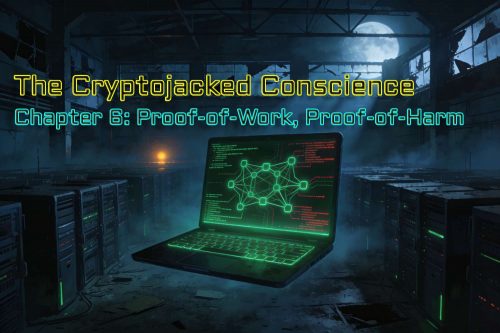
The radio station smelled like dust and old electricity.
Pax lay on the cold tile floor, using his backpack as a pillow, staring at the ceiling. Somewhere above him, the broadcast tower stood silent, its antennas pointing at a sky full of stars he couldn’t see through the grime-coated windows.
He should have been sleeping. Nova was asleep—or at least, her breathing had slowed to the steady rhythm of unconsciousness. Mrs. Wright had curled up in a broken office chair, her head tilted back, her mouth slightly open. Even Sage had finally drifted off, his laptop clutched to his chest like a teddy bear.
But Pax’s mind wouldn’t shut down.
Every time he closed his eyes, he saw the Puppeteer’s dashboard. The red dots. The list of hospitals. The ventilator in County General’s ICU, mining Monero while someone struggled to breathe.
Proof-of-work, he thought. Proof-of-harm.
Scene 1: The Waiting Game
Around 3 AM, Pax gave up on sleep. He sat up slowly, careful not to wake anyone, and pulled out his phone. No signal—the radio station was too far from any cell tower. But he had offline copies of the malware code, the Lullaby key, and Sage’s Green Mine prototype.
He opened the Green Mine code and started reading.
It was beautiful. Not just the syntax—though that was clean and elegant—but the logic. Sage had built a blockchain where the “work” wasn’t wasted. Instead of solving meaningless hash puzzles, miners performed useful computations: protein folding, climate modeling, astronomical data processing. The network verified results using cross-validation and consensus, then rewarded miners with tokens.
“Proof-of-Usable-Work,” Sage had called it in his comments. “Because energy shouldn’t be sacrificed to the void.”
Pax was so absorbed in the code that he didn’t notice Sage’s eyes open.
“You’re supposed to be sleeping,” Sage said. His voice was a dry whisper.
“So are you.”
Sage smiled weakly. “Touché.” He shifted on the couch, wincing as his IV line tugged. “What do you think?”
“It’s incredible.” Pax meant it. “But it’ll need a huge user base to be secure. A blockchain with low hashpower is vulnerable to attacks.”
“Which is why we need the botnet.” Sage’s expression turned serious. “Not to steal cycles—to ask for them. If we can convert even a fraction of Derek’s devices to Green Mine, we’ll have enough hashpower to rival small cryptocurrencies.”
“You’re talking about turning a weapon into a tool.”
“I’m talking about redemption.” Sage’s eyes glowed in the dim light. “Derek built the botnet to steal. But the devices themselves don’t care who controls them. They’re just processors and memory. If we give them a better purpose, they’ll follow.”
Pax thought about his cooling script. How it had been designed to help, then twisted to harm. Maybe Sage was right. Maybe the same code could be twisted again—back toward good.
“What happened between you and Derek?” Pax asked. “You said he was your partner. How did he go from building the Lily Pad to becoming the Puppeteer?”
Sage was quiet for a long moment. When he spoke, his voice was distant, like he was telling a story about someone else.
“Derek grew up in a system that didn’t care about him. Foster care, group homes, the whole broken pipeline. He was brilliant—genius-level IQ, self-taught programmer by twelve—but no one ever told him that his brilliance mattered. So he learned that the only way to get ahead was to take.”
Sage coughed—a dry, rattling sound that made Pax wince.
“When we met online, I was sixteen, he was nineteen. I came from a family that loved me, that supported my weird obsession with distributed computing. I thought everyone had that. I didn’t understand that Derek had never been given anything in his life.”
“So you tried to give him something.”
“The Lily Pad was supposed to be our shared dream. A way to prove that technology could be both profitable and ethical. But Derek saw it differently. He saw the Lily Pad as a tool—a tool that could be weaponized. And when I got sick, he stopped pretending to share my vision.”
Sage’s eyes closed. His breathing was shallow, the oxygen tank hissing softly.
“He visited me once, after the diagnosis. In the hospital. He sat where you’re sitting now, and he said, ‘I’m going to make us rich.’ I told him I didn’t want to be rich. I wanted to be right.”
“What did he say?”
“He said, ‘Right doesn’t pay for treatment.’ And then he left.” Sage opened his eyes. “I never saw him again. But I watched what he built. The Puppeteer botnet. The cryptojacking. And I built the conscience. The Lullaby. Just in case.”
“In case he went too far.”
“In case I needed to stop him.” Sage turned his head to look at Pax. “But I couldn’t do it alone. I’m stuck in this failing body, watching the world from a hospital bed. You and Nova—you’re the ones who can actually do something.”
Pax nodded slowly. “We’ll do it. For you. For everyone Derek has hurt.”
“No.” Sage’s voice was firm despite his weakness. “Do it for yourselves. Because it’s the right thing to do. Because you’ll have to live with the consequences either way.”
Pax didn’t have an answer to that. He just sat there, in the dusty radio station, while the night slowly gave way to dawn.
Scene 2: The Environmental Reckoning
Nova woke first, just as gray light began to seep through the windows. She found Pax at a broken desk, his laptop open, scrolling through articles.
“What are you doing?” she asked, her voice rough with sleep.
“Research.” Pax didn’t look up. “Proof-of-work energy consumption.”
Nova walked over and looked at his screen. He had a dozen tabs open—Bitcoin energy usage statistics, Monero mining benchmarks, environmental impact assessments.
“Bitcoin alone uses as much electricity as a small country,” Pax said. “A hundred and something terawatt-hours per year. That’s more than the entire nation of Argentina.”
“Okay,” Nova said slowly. “And?”
“And Monero isn’t much better. Each transaction uses the same energy as hours of gaming on a high-end PC. Multiply that by thousands of transactions per day, and you’re looking at a serious carbon footprint.”
Nova sat down on the desk edge. “You’re thinking about Derek’s botnet.”
“I’m thinking about all of it.” Pax finally looked up. His eyes were tired but intense. “Sage’s Green Mine is designed to replace proof-of-work with useful work. But the underlying problem is that mining itself—any kind of mining—is fundamentally extractive. It takes energy from the grid, from power plants, from the planet. Even if the computations are useful, they still consume resources.”
“You’re saying we shouldn’t build Green Mine?”
“I’m saying we need to be honest about its limitations.” Pax closed his laptop. “My cooling script was supposed to reduce energy waste. Instead, it got turned into a tool for increasing waste. The same thing could happen to Green Mine if we’re not careful.”
Nova was quiet for a moment. Then she said, “My mom always tells me that nothing is purely good or purely evil. It’s what people do with it that matters.”
“Your mom sounds wise.”
“She’s a nurse. She’s seen a lot of death.” Nova’s voice softened. “She’s also seen a lot of people try to do good and fail. But she doesn’t stop trying.”
Pax thought about that. About the ventilator in County General, mining Monero while a patient struggled to breathe. About Sage, dying in a hospice bed, still coding a better future.
“Okay,” he said. “We build Green Mine. But we build it with guardrails. Consent built in. Transparency. No hidden backdoors, no secret kill switches. Everything open source and auditable.”
“Agreed.” Nova held out her hand. Pax shook it.
Across the room, Mrs. Wright stirred in her chair. “You two are up early.”
“We’re up late,” Nova corrected. “None of us actually slept.”
Mrs. Wright stood up and stretched. “Sage needs to go back to the hospital soon. His oxygen won’t last much longer.”
“Not yet,” Sage said from the couch. His eyes were open, though his face was pale. “We have something to finish first.”
Scene 3: The Green Idea
They gathered around Sage’s laptop—Pax, Nova, and Mrs. Wright—while Sage pulled up his Green Mine prototype.
“The problem with proof-of-work,” Sage began, “is that the work is arbitrary. The network generates a math problem, miners solve it, and the solution proves they spent energy. But the solution itself has no value.”
“Like a Sudoku puzzle that burns coal,” Pax said.
“Exactly.” Sage smiled. “But what if the work wasn’t arbitrary? What if miners were solving real scientific problems? Protein folding, which can lead to new medicines. Climate modeling, which helps us understand global warming. Astronomical data processing, which helps us find new planets.”
“How would that work?” Nova asked.
Sage pulled up a diagram. “The network would distribute computational tasks from scientific research institutions. Miners would download a chunk of data, process it, and submit their results. Other miners would verify the results using cross-validation. If a majority agrees that the results are correct, the miner earns tokens.”
“But what stops someone from submitting garbage results just to earn tokens?” Pax asked.
“The verification mechanism. If your results don’t match the consensus, you get penalized—no tokens, and your reputation score drops. A low reputation means you get fewer tasks in the future.”
Nova was nodding slowly. “It’s like a distributed supercomputer, but with economic incentives.”
“Exactly.” Sage’s eyes were bright. “And the best part? Users can choose what to contribute to. If you care about cancer research, you can mine protein folding tasks. If you care about climate change, you can mine climate models. The network distributes tasks based on user preferences.”
Pax was already imagining the code. “We’d need a task scheduler, a verification oracle, a reputation system… it’s huge.”
“It’s been three years in the making.” Sage coughed—a wet, worrying sound. “The core is there. But it needs optimization. And it needs users.”
“Lots of users,” Nova said. “Otherwise the verification mechanism doesn’t work.”
“Which brings us back to Derek’s botnet.” Pax stood up and started pacing. “Hundreds of thousands of devices, all mining Monero right now. If we could redirect even half of them to Green Mine—”
“We’d have enough hashpower to secure the network,” Sage finished.
Nova frowned. “But Derek controls those devices. He’s not just going to let us take them.”
“He doesn’t have to let us. The Lullaby can overwrite his malware with our update. Every infected device gets a choice: keep mining for Derek, or switch to Green Mine for science and tokens.”
“And if they choose Derek?”
“Then the malware self-destructs. No more mining at all. Derek loses the device either way.”
Sage was quiet for a moment. Then he said, “You’re describing a hostile takeover. We’d be forcing Derek’s botnet to choose between two options we control.”
“Better than letting him keep stealing,” Pax said.
“Maybe.” Sage’s voice was thoughtful. “But we need to make sure the choice is real. No coercion. No trickery. The pop-up has to be clear: ‘Your device is currently mining cryptocurrency without your permission. Do you want to switch to Green Mine, which uses your idle cycles for scientific research and rewards you with tokens? Yes / No / Just stop all mining.'”
“Three options,” Nova said. “Yes, no, or stop.”
“Exactly. And the ‘stop’ option doesn’t ask any questions. It just disables the miner permanently.”
Pax nodded. “We can build that into the Lullaby update.”
“Then that’s the plan.” Sage leaned back on the couch, exhausted. “Broadcast the Lullaby through the school’s emergency system. Overwrite Derek’s malware with the consent pop-up. Let the users decide.”
Mrs. Wright stepped forward. “Sage needs to rest now. We’ll head back to the hospital in an hour.”
“Not yet,” Sage said. “There’s one more thing.”
Scene 4: Derek’s Location Discovered
Nova’s phone buzzed. She’d been running her monitoring tools in the background, using the radio station’s weak cellular signal to ping the botnet’s command structure.
“I’ve got something,” she said, her voice tight. “Derek’s traffic—it all routes through a single concentrator node before hitting the C2 server. I traced the latency. It’s local.”
She pulled up a map on her phone. The screen showed the city, with concentric circles indicating ping times. The circles converged on the industrial district—an area of abandoned warehouses and failed businesses.
“That’s where the C2 server is physically located,” Nova said. “Or at least, that’s where the concentrator node is.”
Pax leaned over her shoulder. “Can you get a street address?”
“Give me a minute.” Nova’s fingers flew across her phone. She cross-referenced the IP address with geolocation databases, then with property records, then with satellite imagery.
“I’ve got it,” she said. “An abandoned cryptocurrency mining facility. Closed in 2018 after the Bitcoin crash. Giant warehouse, rows of rusted ASIC miners, probably still has power.”
“ASIC miners?” Pax asked.
“Application-specific integrated circuits. Computers designed specifically for mining. They were obsolete by 2019, but the building is still there.” Nova zoomed in on the satellite view. “And look at this—the roof has new solar panels. Someone’s been maintaining the place.”
“Derek,” Sage said. “He’s using the old mining facility as his base. The solar panels power his servers. It’s off-grid, hard to trace, and full of equipment he can repurpose.”
Pax felt a chill. “He’s running a botnet from a graveyard of his own industry.”
“Poetic,” Nova said. “Or pathetic.”
“Both.” Pax stood up. “We need to go there.”
Nova shook her head. “Not yet. We don’t know what’s inside. Could be guards, cameras, traps. Derek is paranoid.”
“Then we go after the broadcast. Once the Lullaby is out, Derek will be distracted. That’s when we move.”
Sage grabbed Pax’s arm. His grip was surprisingly strong. “Don’t confront him alone. I know Derek. He’s dangerous—not physically, but he’ll get inside your head. He’ll use your fears, your guilt, your insecurities. He’ll make you doubt everything you believe.”
“He tried that already,” Pax said. “It didn’t work.”
“Because you haven’t met him face to face.” Sage’s eyes were intense. “When you do, remember: Derek isn’t a monster. He’s a broken person who chose to break others. That doesn’t mean you have to hate him. But it does mean you can’t trust him.”
Pax nodded slowly. “I’ll remember.”
Mrs. Wright stood up. “We’re leaving now. Sage needs the hospital.”
They packed up their things—laptops, phones, the USB drive with the Lullaby key. Sage was loaded back into the wheelchair, his oxygen tank strapped to the back.
As they walked out of the radio station into the gray morning light, Pax’s phone buzzed. A text from the Puppeteer’s number.
“You wanted to find me? Here I am. Come and get me.”
Attached was a photo. The abandoned mining facility, seen from the outside. The solar panels glinting on the roof.
Derek knew they’d found him. He was inviting them.
Pax showed the message to Nova. She read it, her face hardening.
“He wants us to come,” she said.
“Then we’ll come.” Pax put his phone away. “But on our terms, not his.”
The minivan pulled out of the radio station’s parking lot, heading back toward County General. Behind them, the broadcast tower stood silent, waiting for its final transmission.
Somewhere across the city, Derek was watching. Waiting. Preparing.
The game was almost over.
But the final move hadn’t been played yet.
Table of contents:
Introduction
Chapter 1: The Silent Miner
Chapter 2: A Thief in the Circuitry
Chapter 3: The Hashrate Hijack
Chapter 4: A Conscience in the Kernel
Chapter 5: The Botnet’s Lullaby
Chapter 6: Proof-of-Work, Proof-of-Harm
Chapter 7: The Green Mine Proposal <<<<<< NEXT
Chapter 8: Rewriting the Unwritten
Chapter 9: The Ethical Fork
Chapter 10: A Clean Block
