Three weeks after the funeral, Theo finally started packing his mother’s coats.
It wasn’t that he’d been avoiding it. Not exactly. He’d done the dishes. He’d sorted through the bathroom cabinets. He’d even tackled the junk drawer in the kitchen—the one with the dead batteries and expired coupons and the weird screwdriver that didn’t fit anything. But the coats? The coats hung in her closet like ghosts. Every time he opened that door, he smelled her perfume. Or maybe he imagined it. Either way, he closed the door and walked away.
But today, his aunt Margie was coming to “help.” And Aunt Margie’s version of helping involved a lot of sighing and a lot of “Your mother would have wanted you to move on, sweetheart.” So Theo decided to do the coats himself. Before she arrived. Before she could touch them with her impatient, perfumed hands.
His bedroom was half-packed already. Boxes labeled KEEP and DONATE and I DON’T KNOW leaned against the walls like tired soldiers. He was supposed to move to Grandma Margaret’s house in Ohio by the end of the month. New school. New room. New life. He wasn’t ready. But grief didn’t care about ready.
Theo pushed open his mother’s bedroom door. The room was dim. She’d liked it that way—heavy curtains, soft light. He flipped the switch and the overhead fixture buzzed to life, revealing a space that felt smaller than he remembered. The bed was made. Her books were still stacked on the nightstand. A half-empty glass of water sat on the dresser, the liquid long evaporated into a white ring.
She was supposed to come back, he thought. She was supposed to drink that water.
He turned to the closet.
The closet was a time capsule. Row after row of clothes his mother had collected over fifteen years of adulthood. Work blouses from her job at the nonprofit. Jeans with worn knees from weekends spent gardening. Two formal dresses she’d worn to weddings and funerals in equal measure. And coats. So many coats.
Theo pulled them out one by one, checking pockets as he went. He didn’t know what he was looking for. A note, maybe. A last message. Something that said I knew this was coming or I love you more than you’ll ever understand. But the pockets were empty. Lint. A movie ticket stub from a film he didn’t recognize. A single earring whose partner was probably under the bed.
He sorted them into piles. Donate. Keep (for memory). Donate. Donate. Keep.
Then he found the trench coat.
It was shoved all the way in the back, behind a puffy winter jacket that hadn’t fit her for years. The trench coat was vintage—the kind you’d find in a thrift store, with wide lapels and a belt that tied at the waist. Olive green. Faded but not worn. He didn’t remember his mother ever wearing it. In fact, he was almost certain she hadn’t.
The fabric smelled like mothballs. Not like her at all.
He almost put it in the DONATE pile without checking the pockets. But something made him stop. A little voice—his own, not hers—said check anyway.
The right pocket: empty.
The left pocket: a leather pouch.
It was small, about the size of his palm, made of dark brown leather that had softened with age. A drawstring cinched the top. Theo tugged it open and tipped the contents into his hand.
A USB drive.
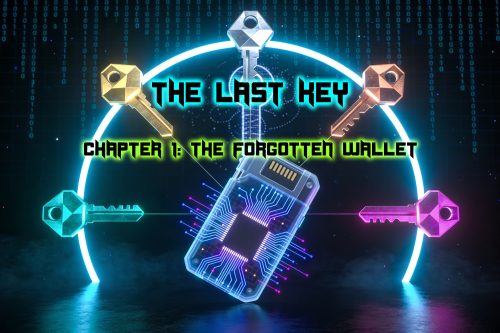
But not like any USB drive he’d ever seen. This one was metal, cold to the touch, with a matte black finish and a single button on one end. A tiny screen—no bigger than his thumbnail—sat next to the button, dark and unlit. On the back, etched in letters so small he had to squint, were two lines:
COLDBIT MK4
*SERIAL: CB4-2217-893*
“What are you?” he whispered.
He pressed the button. The screen flickered to life, showing a line of text: CONFIRM TRANSACTION? Below it, two options: YES and NO, navigable by the same button.
He didn’t know what a transaction was. He didn’t know what he’d be confirming. So he pressed again, cycling to NO, then held the button down. The screen went dark.
He stood there in the closet doorway, holding the strange device, and felt the first real spark of curiosity he’d experienced since the hospital called at 3 AM to tell him she was gone.
Theo plugged the device into his laptop.
He’d expected it to act like a regular USB drive—pop up as a folder, show him some files. Instead, his computer made a dong sound and opened a program he’d never seen before. The program was simple. Almost brutally simple. A black screen with green text, like something from the 1980s.
DEVICE DETECTED: COLDBIT MK4
CONNECTING…
WALLET LOADING…
Then the screen changed. Numbers appeared. Big numbers.
BTC BALANCE: 2,450.00000000
USD VALUE (EST): $147,000,000.00
Theo stared.
Then he laughed. It was a short, sharp, hysterical laugh—the kind that bubbles up when something is so impossible that your brain doesn’t know what else to do. His mother had never had money. She’d worked at a nonprofit that helped domestic violence survivors. She drove a twelve-year-old Honda. She clipped coupons and shopped at discount grocery stores and once, when Theo asked for a new video game, she’d said “maybe for your birthday” and then forgotten.
She did not have one hundred and forty-seven million dollars.
It had to be a glitch. Or a joke. Or some kind of weird scam where a virus pretended you were rich and then asked for your social security number.
He unplugged the device. Plugged it back in. The same screen appeared.
He refreshed the page. The numbers didn’t change.
Theo sat back in his chair. His heart was beating too fast. His palms were sweating. He looked around his mother’s room—the faded wallpaper, the chipped nightstand, the secondhand dresser—and tried to reconcile what he was seeing with what he knew.
She hadn’t been hiding money. She’d been hiding this. Whatever this was.
He needed more information.
The desk in the corner of his mother’s bedroom was a disaster of old mail and unpaid bills and a dried-out plant that Theo had forgotten to water. He started rifling through the drawers, not sure what he was looking for but certain he hadn’t found it yet.
Top drawer: pens, sticky notes, a broken calculator.
Second drawer: files. Taxes from 2019. Her lease agreement. Her will.
The will made his throat tighten. He’d already seen it—the lawyer had read it aloud three days after the funeral. Everything went to Theo. The car. The furniture. The savings account with its modest $4,000. There was no mention of a USB drive or a fortune in digital currency.
He kept searching.
Behind the bottom drawer, where the wood had warped and created a small gap, his fingers brushed against paper. He pulled it out carefully.
A cocktail napkin.
It was crumpled and soft, the kind you got at a bar or a restaurant. The edges were yellowed. On one side, in his mother’s familiar, loopy handwriting, were words.
Theo read them once. Then again. Then a third time.
Seek the circle of five. When four agree, the lock opens. The key is not a word—it is a circle.
Below that, a string of numbers: 41.4034, -81.1239 (coordinates, maybe? He’d check later). And below that, a name.
Zara Chen — Brooklyn — she knows the protocol
He turned the napkin over. The other side was blank.
“Circle of five,” he murmured. “What circle? What five?”
He thought about the USB device. The wallet with its impossible balance. The way his mother had hidden both—the device in a coat she never wore, the napkin behind a drawer. She hadn’t wanted anyone to find this. Or maybe she’d wanted exactly the right person to find it, exactly when they were ready.
He looked at the name again. Zara Chen. Brooklyn. She knows the protocol.
A quick search on his phone brought up a LinkedIn profile that made him blink. Zara Chen, Social Recovery Specialist — and below that, Age: 16. There was a photo: a girl with sharp eyes and short black hair, wearing a hoodie that said DECENTRALIZE EVERYTHING. Her profile description read: I help people recover lost crypto wallets using social trust networks. No keys? No problem. We find your circle.
She was sixteen. Sixteen years old, and she was a professional “social recovery specialist.” Theo didn’t even know that was a job.
He looked at the time. 9:47 PM. Too late to call? Maybe. But the funeral was three weeks ago. He’d been drifting through days like a ghost, eating when Grandma Margaret put food in front of him, sleeping when his body gave out, staring at walls the rest of the time. This was the first thing that had felt like doing something.
He called.
The phone rang four times. Then voicemail: a robotic voice reciting a number. No personalized message. He almost hung up. But at the last second, he spoke.
“Hi. Um. My name is Theo. My mom—she knew you. I think. I found a wallet and a napkin with your name on it. And there’s a lot of money? Maybe? I don’t know. I’m just. I’m just trying to figure out what’s going on.”
He hung up and felt stupid.
Then his phone buzzed.
Unknown number: Don’t touch anything. Send me the public address. And the first six digits of the napkin numbers.
Theo stared at the message. How did she know about the napkin numbers? He hadn’t mentioned numbers.
Theo: What public address?
Zara: The wallet. The hardware wallet. Plug it in. There should be an option to view public key. Looks like a long string of letters and numbers starting with bc1.
He plugged the device back in. Clicked through the menu. Found it: a string so long it made his eyes cross. He copied it and sent it to her.
Then he typed the first six digits of the coordinate string: 414034.
Three minutes passed. Then his phone rang. He answered.
“That’s a 3-of-5 multi-sig.” The voice on the other end was young but not hesitant. Fast. Certain. “And the numbers are shard pointers. Theo, your mom built a recovery network. Do you know what that means?”
“No,” he admitted.
“It means she didn’t trust banks. Or herself. Or time. She spread her signing power across five people. You need three of them to agree before that wallet opens. The napkin is a map. The device is a lock. The circle is the key.”
Theo sat down on the edge of his mother’s bed. The springs creaked.
“Is the money real?” he asked.
A pause. Then: “The public address shows 2,450 bitcoin. That’s been there for three years, untouched. No incoming. No outgoing. Just sitting. So either it’s real, or someone went to a lot of trouble to fake a multi-sig wallet, which would be harder than just stealing the money in the first place.”
“So it’s real.”
“I didn’t say that. I said it’s probably real. But Theo—people die with crypto all the time. And when they die without passing on the keys, that money doesn’t go to their families. It just… evaporates. Or gets eaten by predators.”
“Predators?”
“Wallet hunters. They watch obituaries. They file legal claims. They exploit loopholes. And if your mom’s wallet is as big as it looks, there’s someone out there who’s been waiting for her to die so they could pick the bones.”
Theo felt cold. “How long do I have?”
“Depends. When did she pass?”
“Twenty-four days ago.”
Zara let out a low whistle. “Then you have sixty-six days left. Give or take. Most states have a 90-day abandonment window for unclaimed digital property. After that, anyone can file a petition.”
“Sixty-six days to find five people?”
“Three people. You only need three signatures. But you have to find them first. And Theo?” Her voice softened, just a fraction. “Some of them might not want to be found.”
He looked down at the napkin in his hand. The key is not a word—it is a circle.
“Will you help me?” he asked.
Another pause. Then: “I’m in Brooklyn. You’re in… New Jersey, right? Based on the area code?”
“Yeah. I can take a bus.”
“Meet me at the public library in Newark tomorrow. 2 PM. Don’t tell anyone where you’re going. And Theo?”
“Yeah?”
“Don’t lose that napkin.”
She hung up.
Theo sat in his mother’s room, the hardware wallet in one hand and the cocktail napkin in the other. The room was quiet. The street outside was quiet. The whole world felt like it was holding its breath.
He looked at her empty chair. The one she’d sat in every morning while she drank her coffee and read the news. The cushion still had the imprint of her body.
“What did you get into?” he whispered.
The chair didn’t answer.
But somewhere, in a hard drive in Brooklyn, a girl named Zara was already searching for five names. And somewhere else, in a law office in Delaware, a man who called himself the Vulture was opening a file he’d been saving for three years.
The clock was ticking.
Table of contents:
Introduction
Chapter 1: The Forgotten Wallet
Chapter 2: 24 Words on a Napkin <<<<<< NEXT
Chapter 3: The Inheritance Contract
Chapter 4: The Social Recovery Network
Chapter 5: A Signer Vanishes
Chapter 6: The Multi-Sig Morgue
Chapter 7: The Orphaned Block
Chapter 8: A New Kind of Guardian
Chapter 9: The Threshold Signature Ceremony
Chapter 10: Unlocking Tomorrow
