The lab had never been so full. People crowded every corner—privacy advocates, cryptographers, journalists, and ordinary citizens who’d come to participate in something unprecedented. The air hummed with nervous energy, a mixture of hope and fear that crackled like static electricity.
Cora stood at the front of the room, her heart pounding. The exposure of the Council’s secret decryption operations had sent shockwaves through the world. Millions of people had realized that their private messages—emails, photos, conversations they thought were long gone—might have been accessed without their knowledge or consent.
The fear was palpable. But so was the determination.
Jax was beside her, his presence steady and reassuring. He’d been instrumental in organizing the event, reaching out to the recovery community, explaining why this mattered. His practical expertise had been invaluable.
“Are you ready?” he asked quietly.
Cora took a deep breath. “Ready.”
She stepped forward, and the room fell silent.
“Thank you all for being here,” she said. “I know this is a difficult time. The Council’s actions have shaken our trust in the security of our past communications. Many of you are wondering: if the Council could decrypt old messages, what else is vulnerable?”
She paused, letting the words sink in.
“The answer is: more than we thought. The Council broke encryption protocols that were supposed to be secure. They accessed data that was supposed to be private. They violated the trust of millions of people.”
A murmur rippled through the crowd.
“But we’re not helpless. We can protect ourselves. We can protect our histories. And that’s why we’re here today—for the Re-encryption Ceremony.”
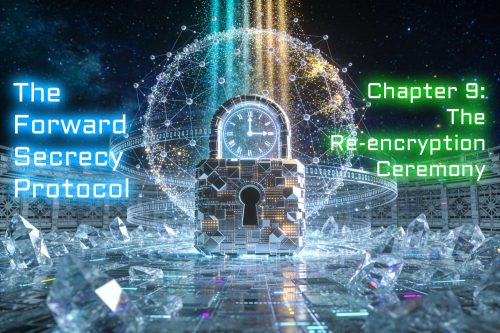
The screen behind her flickered to life, showing the protocol’s logo: a padlock with a clock inside it.
“We’re going to re-encrypt historical data. Messages, emails, photos, files—anything that was encrypted with vulnerable protocols. We’re going to upgrade them to modern security. We’re going to make sure that no one—not the Council, not anyone—can access them without consent.”
She gestured to the participants. “This is voluntary. No one is forcing you to participate. But if you care about your privacy, if you care about your history, I encourage you to join us.”
The ceremony began at noon. Thousands of people participated, both in person and remotely. The university had set up a massive server array to handle the traffic, and volunteers from around the world had offered to help.
Cora watched the dashboard as numbers climbed. Thousands of files, millions of messages, all being re-encrypted with her forward secrecy protocol. The past was being upgraded, protected, made secure.
It was a beautiful thing to watch.
Jax was beside her, coordinating the recovery agents. “We have volunteers from twenty-three countries,” he said. “Everyone’s working together.”
“That’s incredible.”
“It’s what happens when people realize their privacy is at stake.” He smiled. “You did this, Cora. You made it possible.”
“I didn’t do anything. I just built the tools.”
“You built the tools, you showed people how to use them, and you gave them hope.” Jax squeezed her shoulder. “That’s everything.”
The Ceremony continued for three days. Participants uploaded their historical data, which was processed through the protocol, encrypted with modern forward-secrecy algorithms, and returned to them with a new, secure keychain.
The process was surprisingly smooth. Cora had worked tirelessly to make it user-friendly, designing a wizard that walked people through each step. Even the least technically inclined participants were able to complete the process without difficulty.
But there were challenges. The sheer volume of data was staggering—terabytes of messages, emails, photos, and files. The servers strained under the load. Volunteers worked in shifts to keep everything running.
And then there were the attacks.
The Council, even weakened, still had resources. They launched denial-of-service attacks, trying to overwhelm the servers. They spread disinformation, claiming the ceremony was a scam to steal people’s data. They filed lawsuits, trying to stop the proceedings.
But Cora was prepared. She’d built redundancies, backups, and fail-safes. The distributed architecture meant that even if some servers were taken offline, others would keep running. And the open-source nature of the protocol meant that independent auditors could verify that no data was being stolen.
“Section three, servers nine through twelve are under attack,” a volunteer called out.
“Redirect traffic to the backup servers,” Cora ordered. “Bring servers thirteen through sixteen online.”
The volunteer typed commands, and the dashboard flickered. “Backup servers online. Traffic rerouted. We’re stable.”
“Good. Keep monitoring.”
Jax appeared at her elbow. “The Council is also trying to block the ceremony legally. They’ve filed an injunction, claiming we’re ‘destroying historical records.'”
“Can they do that?”
“It’s a stretch. We’re not destroying anything—we’re re-encrypting data that already exists. But they’re arguing that the original encryption was ‘more accessible’ and that we’re preventing future historians from accessing it.”
“Future historians.” Cora’s voice was bitter. “They mean themselves.”
“I know. But they’re using the courts to slow us down.”
“Then we’ll fight them. We’ll show the world that this isn’t about destroying history—it’s about protecting privacy.”
The confrontation came on the third day. Director Varma, despite her resignation, appeared at the ceremony with a team of lawyers and a media entourage.
“Ms. Chen,” she called out, her voice carrying across the room. “You’re destroying history. You’re making it impossible for future generations to understand the past.”
Cora walked toward her, her expression calm. “I’m protecting privacy. I’m giving people control over their own stories.”
“Stories that should belong to everyone. The past isn’t yours to control.”
“The past isn’t yours to exploit.” Cora’s voice was sharp. “You’ve been reading private messages for years, without warrants, without consent. You’ve been building an archive of stolen data. That’s not history—that’s surveillance.”
Varma’s face reddened. “You don’t understand what you’re doing. You’re young, naive, idealistic. You think privacy is a right—but it’s a luxury. A luxury that criminals, terrorists, and abusers exploit.”
“And what about the ordinary people? The ones who just want to keep their private lives private? Do they deserve to be surveilled?”
Varma’s jaw tightened. “This isn’t about surveillance. It’s about truth. The truth of who we were, what we thought, how we lived. Your protocol prevents that truth from being known.”
“The truth that you want to control.” Cora stepped closer. “The truth that you want to selectively preserve. The truth that you want to edit for your own purposes.”
The room was silent. All eyes were on them.
“I’m not going to let you destroy history,” Varma said.
“I’m not destroying history. I’m protecting it.” Cora gestured to the participants, who were watching with a mixture of fear and defiance. “These people are choosing to protect their memories. They’re choosing to preserve their legacies. They’re choosing to share their stories on their own terms. That’s not destruction—that’s empowerment.”
Varma opened her mouth to respond, but Cora cut her off.
“You think you’re preserving history, but you’re really just preserving power. You want to control what people know, what they remember, what they believe. You want to be the gatekeepers of the past. But the past doesn’t belong to you. It belongs to the people who lived it.”
She turned to the crowd. “This ceremony isn’t about destroying history. It’s about giving history back to the people who created it. It’s about letting them decide what they want to preserve and share. It’s about consent.”
A cheer went up from the participants. Varma looked around, her expression shifting from anger to uncertainty.
“This isn’t over,” she said finally. “The Council will continue to fight for historical truth.”
“Then you’ll continue to lose,” Cora said. “Because the truth is on our side.”
The ceremony continued despite Varma’s interruption. By the end of the third day, millions of files had been re-encrypted. The past was being upgraded, protected, made secure.
Cora watched the final numbers on the dashboard: 3,847,291 files processed. 2.7 petabytes of data protected. The Council’s archives were now mostly obsolete—the data they’d collected was no longer accessible, and the data that remained was protected by modern security.
“We did it,” Jax said, appearing beside her. “We actually did it.”
“We did.” Cora’s voice was hoarse with exhaustion and emotion. “Elena’s messages. Her grandchild will be able to see them. The Council can’t touch them.”
Jax smiled. “That’s what this is all about, isn’t it? Not the technology, not the politics. The people. Making sure they have a choice.”
Cora nodded. “I used to think privacy was the only thing that mattered. I thought encryption was about keeping secrets safe, fighting against surveillance. But it’s not. It’s about giving people control. Control over their own stories, their own memories, their own lives.”
Jax was quiet for a moment. Then he said, “You’ve grown, Cora. A lot.”
“Thanks. I had a good teacher.”
“Who? Me?”
“Dr. Singh, mostly.” Cora’s eyes sparkled with humor. “But you helped.”
Jax laughed. “I’ll take that.”
That evening, Cora and Jax sat in the lab, exhausted but satisfied. The ceremony was over, the data was protected, and the Council was in retreat.
“I need to talk to Elena,” Cora said suddenly. “She needs to know that her messages are safe.”
“I’ll drive you.”
The hospice center was quiet when they arrived. Elena’s room was dimly lit, the only sound the steady beep of the heart monitor. She was weaker now, barely conscious, but her eyes fluttered open when Cora entered.
“Did it work?” she whispered.
“It worked,” Cora said, sitting by her bedside. “Your messages are re-encrypted with forward secrecy. No one can read them without your daughter’s approval. And in twenty years, they’ll unlock automatically.”
Elena smiled—a weak, fragile expression. “My grandchild will know me.”
“She will. She’ll know your voice, your face, your stories. You’ll be with her, even if you can’t be there.”
Elena squeezed Cora’s hand. “Thank you. You’ve given me the greatest gift.”
“I didn’t do anything. I just—”
“No.” Elena shook her head weakly. “You listened. You understood. You cared. That’s more than most people ever do.”
Cora blinked back tears. “I’m going to miss you.”
“I’m going to miss you too.” Elena smiled. “But I’ll be with you. In the stories. In the memories. In the love.”
Table of contents:
Introduction
Chapter 1: The Unbreakable Vault
Chapter 2: A Message from Tomorrow
Chapter 3: The Time-Lock Puzzle
Chapter 4: The Forward Secrecy Paradox
Chapter 5: The Quantum Threat
Chapter 6: The Ephemeral Key Exchange
Chapter 7: A Perfect Forward Secrecy
Chapter 8: The Compromised Past
Chapter 9: The Re-encryption Ceremony
Chapter 10: Secrets Are Temporary <<<<<< NEXT
