The Invalidator’s lair was a fortress of shadows and light.
Holographic displays covered every surface, casting a cold blue glow across the windowless room. Computing nodes hummed in the corners, their cooling fans whirring softly as they processed the endless streams of data that flowed through the Settlement Chain. The Invalidator sat at the center of it all, their face illuminated by the pale light of a dozen screens.
Three weeks had passed since the first attack. Three weeks since they had stolen millions of credits and vanished into the digital ether. The Settlement Chain’s oversight committee was still investigating, tracing transactions through anonymous accounts, following dead ends and false leads. They would never find the Invalidator. They were too clever, too careful, too experienced.
But something had changed.
The Invalidator pulled up a new display, showing the latest developments in the Riverbend community. Sasha was building something new—a challenge system, designed to catch fraudulent proofs before they could do damage. It was a clever idea, the Invalidator admitted. A system of incentives and penalties that would make fraud more expensive than honesty.
But the Invalidator had been breaking systems for a long time. They knew that every system had weaknesses, no matter how clever the design. And the challenge system was no exception.
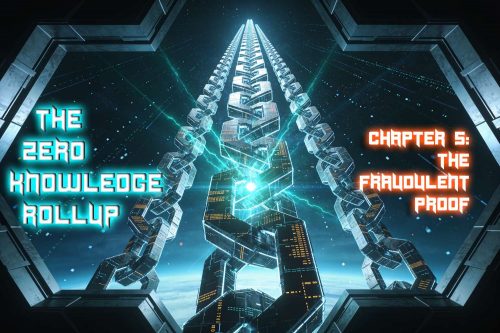
“This is interesting,” the Invalidator murmured, studying the code. “A recursive rollup. She’s not just batching transactions anymore. She’s batching proofs. Each rollup verifies the validity of the previous rollup, creating a chain of compressed truths.”
They smiled—a thin, cold smile that didn’t reach their eyes.
“The chain of proofs is only as strong as its weakest link. If I can break one link, I can break the entire chain.”
They began to code.
The Invalidator had been watching Sasha’s progress for months. They had seen her grow from a hopeful amateur into a genuine threat—a builder of systems that could disrupt the Invalidator’s carefully constructed world. The first attack had been a setback for Sasha, but it hadn’t stopped her. If anything, it had made her stronger, more determined, more focused.
Now she was building something even more dangerous. A recursive rollup that could process millions of transactions per day, verified by a single tiny proof. If she succeeded, the Settlement Chain would become fast, cheap, and secure. The congestion would vanish. The fees would plummet. And the Invalidator’s business model—which depended on confusion, delays, and the chaos of a congested network—would collapse.
They couldn’t allow that to happen.
So they would attack again. Not with a simple fraudulent proof, but with something far more devastating: a fraudulent super-proof that would invalidate an entire chain of past, valid rollups. By rewriting history, they could steal credits on a massive scale—not just millions, but billions. And they could destroy Sasha’s reputation forever.
“To break the chain, I need to find a weak link,” the Invalidator said, speaking to no one in particular. “An edge case in the recursive verification code. A flaw in the way the super-proof verifies the history of sub-proofs.”
They pulled up Sasha’s code, scrolling through the lines of instructions. It was elegant code, clean and well-structured. The Invalidator could see the care that had gone into it, the attention to detail. But even the most careful code had blind spots.
“There,” the Invalidator said, pointing to a section of the verification algorithm. “The super-proof assumes that all sub-proofs are independent. It checks each one individually, but it doesn’t check the relationships between them. It doesn’t verify that the sequence of proofs is consistent.”
They started typing, constructing a new proof. This one would claim that a legitimate, older rollup was invalid. It would present a new, false version of history starting from that point. The super-proof would accept the false version because it wouldn’t check the consistency of the sequence.
“One false proof, inserted into the middle of the chain,” the Invalidator murmured. “The super-proof won’t know the difference. It will accept the false version and reject the true one. And by the time anyone notices, the credits will be gone.”
They packaged the proof, added a massive security deposit—billions of credits, stolen from previous schemes—and submitted it to the Settlement Chain.
The chain’s verification contract ran. It checked the proof’s mathematical structure, its cryptographic signatures, its adherence to the chain’s rules. Everything passed.
ACCEPTED.
The fraudulent super-proof was now part of the chain’s history. The Invalidator had just invalidated months of legitimate transactions, rewriting the state of the entire system. Credits that had been safely stored were now free for the taking.
They began the process of transferring the funds to anonymous accounts. By the time anyone realized what had happened, they would be gone.
Mateo was in his small office at the Riverbend Community Center when the alerts started.
He had been monitoring the Settlement Chain’s activity ever since the first attack, watching for any signs of suspicious behavior. He had written automated scripts that scanned for anomalies—unusual transaction patterns, abnormal proof sizes, unexpected state changes. He had trained himself to notice the subtle signs of fraud.
And now, something was wrong.
He stared at his display, watching the data stream. A new super-proof had been submitted and accepted. That wasn’t unusual in itself—Sasha’s recursive rollup was processing thousands of proofs per day. But this proof was different. It was claiming that an older, legitimate rollup was invalid. It was rewriting history.
“Impossible,” Mateo muttered. “The verification contract should catch that.”
He pulled up the super-proof’s code, examining it line by line. At first, it looked perfectly normal. The mathematical structure was sound. The cryptographic signatures were valid. Everything appeared to be in order.
But then he noticed something. The super-proof was checking each sub-proof individually, but it wasn’t checking the relationships between them. It was assuming that if each individual proof was valid, the entire sequence was valid. But that wasn’t necessarily true.
“What if the sub-proofs don’t form a consistent sequence?” Mateo wondered. “What if one of them contradicts another?”
He ran a quick simulation. The results made his blood run cold.
The super-proof was fraudulent. It had invalidated a legitimate rollup and replaced it with a false version. The Settlement Chain had accepted it because the verification contract was too trusting, too focused on individual proofs rather than the sequence as a whole.
“Someone’s attacking the recursive rollup,” Mateo said, his voice tight with alarm. “They’re rewriting history.”
He pulled up his communication system and sent an urgent message to Sasha.
Sasha was in her workshop when the message arrived.
She had been working on the challenge system, refining the code, preparing for another round of testing. Leo was there too, running simulations on a separate display.
“Sasha,” Leo said suddenly, his voice sharp with concern. “Mateo just sent an urgent message. You need to see this.”
Sasha pulled up the message. It was short and to the point:
ATTACK IN PROGRESS. FRAUDULENT SUPER-PROOF SUBMITTED. REWRITING HISTORY. NEED YOU NOW.
Sasha’s heart leaped into her throat. “Another attack? How?”
“I don’t know,” Leo said. “But if it’s rewriting history, we need to stop it. Fast.”
Sasha grabbed her equipment and raced out the door, Leo close behind her. They arrived at the Riverbend Community Center in record time, bursting into Mateo’s office.
Mateo was hunched over his display, his face pale with strain. “Sasha. Good, you’re here.”
“What’s happening?” she demanded.
Mateo pulled up the fraudulent super-proof. “Someone’s attacked the recursive rollup. They’ve submitted a super-proof that invalidates a legitimate rollup from three months ago. The Settlement Chain accepted it because the verification contract didn’t check the consistency of the sequence.”
Sasha stared at the proof, her mind racing. “But that’s impossible. The verification contract—”
“The verification contract checks each sub-proof individually,” Mateo interrupted. “It doesn’t check that the sequence is consistent. The attacker exploited that vulnerability.”
Sasha felt a cold knot forming in her stomach. She had designed the recursive rollup to be secure, but she hadn’t anticipated this. She had assumed that if each individual proof was valid, the entire sequence would be valid. But that assumption was wrong.
“How do we stop it?” she asked. “How do we fix this?”
Mateo was already typing. “We need to submit a counter-proof. We need to prove that the fraudulent super-proof is invalid by showing that the legitimate rollup it’s trying to invalidate is actually valid.”
“That sounds computationally expensive,” Leo said.
“It is,” Mateo admitted. “We need to reconstruct the legitimate rollup’s state, generate a proof of its validity, and submit it as a counter-proof to the Settlement Chain. The challenge period is only one week. We don’t have much time.”
Sasha looked at the display, at the fraudulent super-proof that was rewriting history. She could see the damage it was doing—credits being stolen, records being altered, trust being destroyed.
“We can do this,” she said, her voice firm. “We have the resources. We have the skills. We’ll need to work around the clock, but we can do this.”
She turned to Mateo and Leo. “I’ll handle the reconstruction of the legitimate rollup’s state. Mateo, you’ll work on the proof generator. Leo, you’ll handle the communication with the Settlement Chain’s oversight committee. We need to submit the counter-proof before the challenge period ends.”
They nodded, their faces set with determination.
“Let’s get to work,” Sasha said.
The next seven days were the most intense of Sasha’s life.
She barely slept, surviving on synthetic coffee and adrenaline. She worked alongside Mateo and Leo, reconstructing the legitimate rollup’s state, generating the proof of its validity, and preparing the counter-proof for submission.
The work was grueling. The fraudulent super-proof had invalidated months of legitimate transactions, and reconstructing the correct state required painstaking attention to detail. Every transaction had to be verified, every account balance checked, every smart contract interaction validated.
“We’re making progress,” Mateo said on the third day, his voice hoarse from exhaustion. “We’ve reconstructed about forty percent of the state. At this rate, we’ll be done in time.”
“Forty percent isn’t enough,” Sasha said. “We need to be thorough. If there’s any error in our counter-proof, the challenge will fail.”
“I know,” Mateo said. “But we’re doing the best we can. We’re only human.”
Sasha looked at him, at the dark circles under his eyes, the strain in his posture. He was pushing himself just as hard as she was, sacrificing sleep, food, everything for the sake of the system.
“We need more help,” she said. “We can’t do this alone.”
She reached out to the Riverbend community, asking for volunteers. Dozens of people responded—coders, auditors, blockchain enthusiasts who had been watching the situation with growing alarm. They set up a command center in the community center, with multiple teams working on different parts of the reconstruction.
By the sixth day, the work was nearly complete. The legitimate state had been fully reconstructed. The counter-proof had been generated. All that remained was the submission to the Settlement Chain.
“This is it,” Sasha said, her hand hovering over the submission button. “If we’re wrong, if there’s any flaw in our counter-proof, we’ll lose our deposit and the fraudulent super-proof will stand.”
“Are you sure you want to do this?” Mateo asked.
Sasha looked at him, at the faces of the volunteers who had sacrificed so much to help. She thought about the victims of the first attack, the people who had lost their savings. She thought about the system she had built, the system she was trying to save.
“I’m sure,” she said. “This is what we built the challenge system for. To catch fraud. To protect the innocent. To make the system work.”
She pressed the button.
The counter-proof was submitted to the Settlement Chain. The challenge period began. For the next few hours, everyone waited, their hearts pounding, their eyes fixed on the displays.
And then the verdict came.
CHALLENGE SUCCESSFUL. FRAUDULENT PROOF REJECTED. SECURITY DEPOSIT SLASHED. REWARD DISTRIBUTED TO CHALLENGERS.
Sasha let out a breath she hadn’t realized she was holding. The room erupted in cheers—volunteers hugging each other, clapping, crying with relief.
“We did it,” Mateo said, his voice filled with wonder. “We actually did it.”
Sasha turned to him, her eyes wet with tears. “No,” she said. “You did it. You caught the fraud. You submitted the counter-proof. You saved the system.”
“We did it together,” Mateo corrected. “That’s the point. The system works when we work together.”
Sasha nodded slowly, understanding. The challenge system wasn’t just a mechanism for catching fraud. It was a mechanism for building community, for creating a shared purpose, for making everyone a participant in the security of the system.
“We need to make this permanent,” she said. “We need to build the challenge system into the fabric of the rollup. So that this never happens again.”
Mateo smiled. “Agreed. Let’s get to work.”
Table of contents:
Introduction
Chapter 1: The Congested Lane
Chapter 2: A Bundle of Truths
Chapter 3: The Prover’s Burden
Chapter 4: The Verifier’s Trust
Chapter 5: The Fraudulent Proof
Chapter 6: The Validity Challenge <<<<<< NEXT
Chapter 7: The Recursive Rollup
Chapter 8: The Infinite Compression
Chapter 9: The Trustless Settlement
Chapter 10: Scaling Humanity
