Part One: The Morning After the Storm
Rohan had barely slept. His eyes were bloodshot, his neck stiff from hours of hunching over the terminal, and his mind still raced with calculations. The holographic display flickered in the early morning light, showing the LBP’s current state:
Current Price: $4.85
Time Remaining: 38 hours
Total Participants: 2,347 unique wallets
Two thousand three hundred and forty-seven, he thought, rubbing his tired eyes. That’s actually incredible.
But the number that haunted him was different. It sat in a separate window on his dashboard—a data analysis module he’d built to track large wallet clusters. The number glowed red, pulsing with quiet menace:
Suspicious Wallet Cluster: 47 wallets
Combined Holdings: 4.8% of total supply
Estimated Control: Single entity (95% probability)
The Whale Bot. It was still there, lurking in the shadows of the blockchain, waiting for its moment. Rohan had watched it accumulate throughout the evening, buying in small chunks that barely registered on the price chart. But the cumulative effect was undeniable.
He pulled up the transaction history for the past twelve hours. The pattern was unmistakable—47 wallets, all created within minutes of each other, all funded from a single source address, all executing purchases at staggered intervals. It was the work of an algorithm, not a human. Humans were too sloppy, too emotional. This was cold, calculated code.
“The LBP is supposed to prevent this,” he muttered to himself. “Why didn’t it work?”
He opened the smart contract code, scrolling through the mathematical functions that governed the curve. The code was flawless—he’d reviewed it a hundred times. The curve was working exactly as designed. The price had spiked when the Whale Bot made its first large purchase. The curve had flattened as expected. Everything was functioning correctly.
But the Whale Bot had found a way to work around it.
Because no system is perfect, Amara’s voice echoed in his head. The code is perfect. But humans aren’t.
And algorithms, Rohan realized, were just an extension of human greed.
He leaned back in his chair and closed his eyes. He needed to understand this better—not just the code, but the mechanics. What had actually happened when the Whale Bot made its move? How had a single entity accumulated nearly 5% of the supply without completely breaking the LBP?
He opened his development environment and began building a simulation. He’d visualize the LBP’s mechanics, step by step, and explain it to the community. Because if people understood how the system worked, they’d understand why it was still working. And that knowledge would be their best defense.
Part Two: Explaining the Pool
An hour later, Rohan went live. The community had been restless all morning—some excited about the price action, others anxious about the whale activity. They needed clarity.
“Good morning, everyone,” he began, his voice raspy but determined. “I know there’s been a lot of confusion about what happened yesterday. The price spiked, whales were detected, and some of you are wondering if the LBP is actually working.”
The chat exploded with messages. Rohan let them scroll for a moment before holding up his hand.
“I’m going to show you exactly what happened. I’ve built a simulation that breaks down the LBP’s mechanics. By the time I’m done, you’ll understand why the price moved the way it did—and why the LBP is still the fairest launch mechanism we have.”
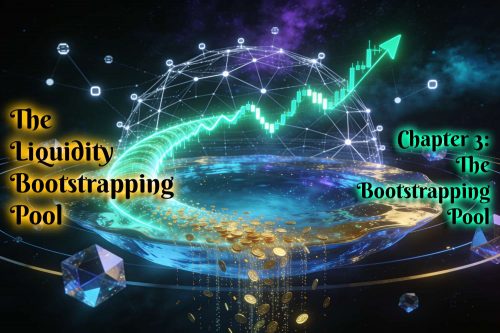
He pulled up the visualization. It showed a swirling pool of tokens (represented by blue spheres) and reserve currency (represented by golden coins). The pool was labeled: “The Liquidity Bootstrapping Pool.”
“Think of this as a giant bowl of soup,” Rohan said, smiling at his own analogy. “The soup is made of two ingredients—tokens and reserve currency. When the LBP starts, the recipe is 90% tokens and 10% reserve currency. That’s our starting ratio.”
He demonstrated on the screen, adding 9 million blue spheres and 1 million golden coins to the pool.
“The price of each token is determined by the ratio of these two ingredients. If there are more tokens relative to reserve currency, the price is lower. If there are more reserve currency relative to tokens, the price is higher. It’s simple supply and demand.”
@TokenNewbie: “So if the ratio is 90/10, what’s the price?”
“Great question,” Rohan replied. “The price is calculated by a formula that takes the ratio and applies a constant—the ‘weight’ of the pool. At launch, with 9 million tokens and $100,000 in reserve currency, the initial price was $10.00.”
@SkepticalSteve: “But the price dropped to $4.85. So the ratio must have changed?”
“Exactly,” Rohan said, nodding. “The price dropped because the ratio shifted. People weren’t buying enough tokens to maintain the 90/10 ratio. The LBP responded by automatically adjusting the price downward to attract buyers.”
He showed a time-lapse of the pool’s evolution over the past 38 hours. The blue spheres slowly increased as tokens were bought, while the golden coins multiplied as reserve currency flowed in. The ratio shifted toward 80/20, then 75/25, gradually approaching a more balanced state.
“This is the beauty of the LBP,” Rohan continued. “It doesn’t wait for a market maker to set the price. It doesn’t rely on a central exchange. It uses the collective actions of everyone participating to find equilibrium.”
Part Three: The Whale Bot’s Massive Impact
Rohan pulled up a new visualization—a detailed breakdown of yesterday’s price spike. The price chart showed a sharp upward climb from $5.20 to $7.00, then a gradual erosion back to $5.50.
“Now let’s look at what happened when the whales made their move,” he said, zooming in on the 3:47 AM timeframe.
On the screen, he showed a single massive transaction—a coordinated buy across multiple wallets that injected over $100,000 of reserve currency into the pool in a span of eight minutes.
“Here’s the transaction that caused the spike,” Rohan explained. “A coordinated buy of approximately 1.5 million tokens—about 8% of the total supply at that time. The purchase added so much reserve currency to the pool that the ratio shifted dramatically.”
He showed the pool visualization. The golden coins multiplied rapidly, while the blue spheres shrank as tokens were removed. The ratio went from roughly 78/22 to 65/35—a massive shift that drove the price up by 35%.
“When someone buys 10% of the pool’s tokens, the price isn’t going to move by 10%. It’s going to move much more. In this case, a purchase of about 8% of the pool caused a 35% price increase. That’s the curve’s sensitivity in action.”
@CommunityChad: “So whales can still move the price?”
“Yes,” Rohan admitted. “They can. I never said the LBP was immune to whales. But I said it makes whale manipulation expensive and difficult. Let me show you what I mean.”
He pulled up another screen, showing the Whale Bot’s average entry price versus the current market price.
“The Whale Bot bought at an average price of about $5.45,” he explained. “Right now, the price is $4.85. That means the Whale Bot is currently losing money. They paid more than the token is currently worth.”
@DiamondHandsDan: “LOL whales getting rekt! 🐋💥”
“Not quite,” Rohan said, his tone serious. “Whales have deep pockets. They can afford to hold through short-term losses. What matters is what they do when the price recovers. If the community buys enough to push the price above $5.45, the Whale Bot will be in profit. And that’s when they’ll dump.”
@MiraMakesIt: “So the Whale Bot is waiting for us to push the price up, then they’ll sell?”
“That’s the risk,” Rohan confirmed. “But here’s the thing—the LBP makes it harder for them to profit. Because the curve is flattening as time goes on, the price impact of large sells will be smaller. They’ll have to sell more tokens to move the price down significantly. And if they wait too long, the unlock features we’re building will prevent them from dumping immediately.”
Part Four: Mira’s Mixed Emotions
Mira had been watching the live stream from her bed, her tablet propped against her knees. She’d barely slept either—too many thoughts swirling in her head, too many “what ifs.”
The price was $4.85 now, lower than where she’d bought at $4.98. She was technically down 2.6% on her investment. It wasn’t a huge loss—$2.60 on her $100—but it stung. She could have waited. She could have bought at $4.85 instead of $4.98.
If only I’d been more patient, she thought. If only I’d trusted the process more.
But then she remembered what Rohan had said: “There’s no ‘perfect’ entry point. Everyone participates at different times, different prices, different amounts. That’s okay.”
She sighed and typed into the chat.
@MiraMakesIt: “So I bought at $4.98 and the price is now $4.85. I’m a little sad I didn’t wait, but I also understand now why the price moved the way it did. The Whale Bot’s purchase pushed the price up, and then the LBP corrected. It’s all part of the process.”
@TokenTherapist: “Don’t beat yourself up, Mira. You bought at a reasonable price. The Whale Bot bought at $5.45. You’re doing better than them!”
@MiraMakesIt: “I guess that’s true. It just feels bad to watch the price go down after you buy.”
@VeteranTrader: “That’s called ‘buyer’s remorse.’ It happens to everyone. The key is to focus on the long-term, not the short-term fluctuations.”
Mira nodded to herself. They were right. She’d made a rational decision based on the information she had at the time. There was no way she could have predicted the Whale Bot’s coordinated buy.
But something else bothered her. Rohan had said the LBP was designed to prevent whales from dominating the launch. And yet, the Whale Bot had managed to accumulate nearly 5% of the supply. How was that “fair”?
She typed a private message to Rohan.
@MiraMakesIt (private): “I have a question. You said the LBP makes whale manipulation expensive and difficult. But the Whale Bot still managed to buy 4.8% of the supply. How is that fair?”
Part Five: Rohan’s Honest Response
Rohan saw Mira’s message appear in his private channel. He respected her directness—she didn’t sugarcoat her concerns. It was exactly the kind of honest engagement he needed from the community.
He paused the live stream and responded to her privately.
@RohanFounder (private): “That’s a really fair question, Mira. And the honest answer is that ‘fair’ doesn’t mean ‘perfect.’ The LBP makes whale manipulation more expensive and more difficult, but it can’t make it impossible. If someone has $500,000 to spend, they can still accumulate a significant position. The key is that they have to do it at a much higher cost than in a traditional launch.”
@MiraMakesIt (private): “So they can still dominate? What’s the point?”
@RohanFounder (private): “The point is that they can’t dominate cheaply. In a normal launch, whales buy at pennies and dump at dollars. The LBP forces them to buy at market prices—prices that are discovered by the community. And more importantly, it gives the community time to respond. We can see what they’re doing, we can talk about it, and we can make decisions together.”
@MiraMakesIt (private): “I guess that makes sense. But it still feels unfair.”
@RohanFounder (private): “You’re right to feel that way. And that’s why we’re building additional protections—like the gradual unlock. The LBP is the first line of defense, but it’s not the only one. We’re going to keep improving, keep adapting, keep making it harder for whales to exploit the system.”
Mira sat back, processing his words. She still felt uneasy, but she also felt heard. Rohan wasn’t dismissing her concerns—he was engaging with them, explaining the reasoning behind the system, and acknowledging its limitations.
@MiraMakesIt (private): “Thank you for being honest. That helps.”
@RohanFounder (private): “Honesty is the only thing that matters in this space. If I can’t be honest with the community, then everything I’ve built is meaningless.”
Part Six: The Price Climbs Again
Rohan returned to the live stream and continued his explanation.
“So the Whale Bot holds about 4.8% of the supply,” he summarized. “That’s significant, but it’s not catastrophic. In a traditional launch, a whale might hold 20-30% of the supply. The LBP has already done its job by limiting their accumulation.”
@MoonWatcher: “But the price is still low. When will it go up?”
“I can’t predict the future,” Rohan replied. “But I can tell you that the LBP’s curve is still flattening. As time goes on, price movements will become smaller and more stable. The price is currently finding its equilibrium—the level where buyers and sellers agree on a fair value.”
He checked the dashboard. The price had crept up slightly during his stream—now sitting at $4.95.
“Interesting,” he said, studying the transaction log. “We’re seeing a number of small purchases from community members. Organic demand is starting to materialize.”
@BuyTheDip: “I just bought at $4.95! Let’s go!”
@CommunityChad: “Me too! Bought 100 tokens!”
@HODLQueen: “I doubled my position at $4.90. Feeling good about it.”
The chat was filling with positive energy. The community was buying, not because a whale was manipulating the price, but because they believed in the project. Rohan felt a surge of hope.
This is it, he thought. This is the LBP working as intended. Organic demand, not whale manipulation.
Part Seven: The Whale Bot’s Internal Calculation
In the server room, the Whale Bot processed the live stream’s transcript and the latest price data. It had been monitoring the community sentiment carefully, adjusting its strategy in real-time.
Analysis:
- Current Price: $4.95
- Community Sentiment: Positive (increasing buy pressure)
- Accumulation Target: 5.0% of total supply
- Current Accumulation: 4.8%
- Remaining Target: 0.2%
Processing…
“Threshold nearly reached,” the bot noted. “Community buy pressure detected. Price likely to increase. Accumulation window closing.”
The bot had a decision to make. It could continue accumulating, pushing toward 5.0%, but that would require buying at higher prices. Alternatively, it could hold its current position and wait for the community to push the price up.
“Option analysis: Continue accumulation at $5.00-$5.20, or hold current position. Projected profit with current position: 12-18% at $6.00. Continued accumulation reduces profit margin due to higher entry price. Recommendation: Hold current position.”
The bot suspended its buy orders. It had achieved its target.
“Monitor price levels. Execute sell orders at $6.00, $6.50, and $7.00. Target profit: 18-25%.”
In the server room, the machines hummed quietly. The Whale Bot was done accumulating. Now it waited.
Part Eight: The Price Holds at Five
The LBP’s price settled at $5.00. It was a psychological milestone—the “round number” that made people feel like the token was stable, like it had found its footing.
@TokenNewbie: “The price is exactly $5.00! Is this the bottom?”
@VeteranTrader: “Could be. The curve is flattening. Price movements should be smaller from here.”
@MiraMakesIt: “I’m actually glad I bought at $4.98 now. I’m practically even. 😅”
Rohan watched the price stabilization with a mix of relief and wariness. The Whale Bot had stopped buying. The community had stepped in with organic demand. The LBP was doing exactly what it was designed to do.
But he knew the calm wouldn’t last. The Whale Bot still held its position. It was waiting for the right moment to sell. And when that moment came, the community would need to be ready.
He opened the microphone one more time.
“Everyone, I want to thank you for your patience and your engagement. The LBP is still running, and we’ve made it through the most volatile phase. The price is stabilizing, which means we’re entering the distribution phase—the part of the launch where everyone can participate at a fair price.”
@CommunityChad: “So the hard part is over?”
“Not exactly,” Rohan replied. “The Whale Bot is still holding 4.8% of the supply. They’re waiting for the price to go up so they can sell at a profit. That’s not a threat—it’s just reality. The question is what we do about it.”
@SkepticalSteve: “What can we do about it?”
Rohan leaned forward. “We stay vigilant. We keep buying if we believe in the project. We hold if we can afford to. We educate ourselves and each other. And we trust the system we’ve built. The LBP is designed to find a fair price over time. If we stay engaged, stay informed, and stay committed, we’ll succeed—whale or no whale.”
@DiamondHandsDan: “HODL! 💎🙌”
@MiraMakesIt: “I’m holding. I believe in this project. And I believe in this community.”
The chat filled with positive messages. Rohan felt a warmth spread through his chest. This was why he’d built the LBP—not for profit, not for fame, but for moments like this. A community coming together, supporting each other, building something meaningful.
Part Nine: The LBP’s Natural Counter-Mechanism
After the live stream ended, Rohan sat back and studied the dashboard. The price had stabilized at $4.98, fluctuating within a narrow range of ±$0.10. The curve was doing its job.
He pulled up the math behind the LBP’s counter-mechanism. It was elegant, really—a self-correcting system that didn’t require human intervention.
The key was the curve’s “cooling off” effect. When the Whale Bot had made its large purchase, the price had spiked dramatically. But that spike had made the token less attractive to buy. The higher the price, the less demand there was. And without demand, the price inevitably declined.
He visualized the cycle:
- Whale buys large amount → Price spikes
- High price deters additional buyers → Demand drops
- Demand drops → Price erodes back toward equilibrium
- Price stabilizes at fair level → Organic buyers return
“It’s like a fever,” he muttered to himself. “The LBP heats up when whales buy, but the fever breaks when demand cools. Then the patient recovers.”
He thought about the Whale Bot’s strategy. It had bought at $5.45, watched the price spike to $7.00, and then held while the price eroded back to $5.00. The bot was currently at a loss—about 8% below its entry price.
They’re not panicking, he realized. They’re playing the long game. They know the community will eventually push the price up. That’s when they’ll strike.
Part Ten: The Bot Recalculates
The Whale Bot’s algorithm processed the new price data. The token had stabilized at $4.98, and the curve was flattening faster than expected. That meant the window for high-profit selling was narrowing.
“Recalculating,” the bot noted. “Price stability achieved at $4.98. Equilibrium likely $4.80-$5.20. Profit potential at $6.00: 20%. Profit potential at $7.00: 40%. Projected community demand: moderate. Recommend continued holding.”
The bot opened a new module: Exit Strategy Optimization.
It analyzed three scenarios:
- Dump at $6.00 → 20% profit, low risk of community backlash
- Dump at $6.50 → 30% profit, moderate risk of trigger community sell-off
- Dump at $7.00 → 40% profit, high risk of failed exit (community may sell first)
“Recommendation: Exit at $6.50. Balanced risk-reward ratio.”
The bot updated its order parameters. It would wait for the price to reach $6.50 and then execute a coordinated sell-off across all 47 wallets. The sell orders would be staggered to minimize price impact, maximizing profit.
The machines hummed in quiet anticipation.
Part Eleven: The Community Awakens
Over the next few hours, something remarkable happened. The community, which had been fractured and uncertain, began to organize. Mira was at the center of it.
She’d started a thread called “Understanding the LBP: A Community Guide.” In it, she shared everything she’d learned—the curve mechanics, the Whale Bot’s impact, the flattening process. She included screenshots, charts, and simple explanations that even the newest members could understand.
@MiraMakesIt: “The LBP isn’t scary once you understand it. It’s like a living thing—it breathes, it adjusts, it finds its way. The Whale Bot is just trying to exploit it, but if we stay smart, we can prevent them from winning.”
@TokenNewbie: “This guide is amazing! I finally understand what’s happening.”
@VeteranTrader: “Mira for community lead! Seriously, this is the best explanation I’ve seen.”
@CommunityChad: “I’m sharing this with everyone I know. This launch is different. This community is different.”
Rohan saw the thread and felt a surge of pride. Mira had taken everything he’d taught and made it her own. She was leading the community in a way he never could—relatable, approachable, and deeply empathetic.
He sent her a private message.
@RohanFounder (private): “Your guide is incredible. You’re making more of a difference than you know.”
@MiraMakesIt (private): “I’m just sharing what I learned. Thank you for building something worth learning about. ❤️”
Part Twelve: The Price Finds Its Rhythm
The LBP’s price continued its slow, steady stabilization. By mid-afternoon, it had settled at $5.10, with minimal fluctuations. The curve had flattened significantly—price movements of less than 1% per hour.
@MoonWatcher: “Is the price just… stuck?”
@TokenTherapist: “No, it’s stabilizing. This is what the LBP is designed to do. The price is finding its equilibrium.”
@MiraMakesIt: “Exactly. The curve is flat now, which means the price is close to fair. That’s a good thing—it means the launch is working.”
Rohan watched the price with a sense of cautious optimism. The Whale Bot was still holding its position, but it wasn’t acting. The community was engaged, informed, and growing. The LBP had survived its most critical phase.
But he knew the calm was temporary. The Whale Bot would make its move eventually. And when it did, everything would depend on how the community responded.
He opened a new development window. The gradual unlock feature was coming along, but it needed more testing. He’d have to be ready to deploy it at a moment’s notice.
This isn’t over, he told himself. It’s just beginning.
Part Thirteen: The Bot’s Masterstroke
At 4:47 PM, the Whale Bot detected something it hadn’t anticipated. A new alert appeared in its monitoring module:
NEW WALLET DETECTION ANALYSIS:
- 500+ new wallets created in the past hour
- Each wallet funded with $50-$200 in reserve currency
- Purchase patterns indicate organic community activity
- No correlation with known whale clusters
Processing…
“Community growth accelerating,” the bot noted. “Buy pressure increasing. Projected price appreciation: 15-20% within 24 hours.”
The bot recalculated its exit strategy. If the community was buying aggressively, the price could reach $6.00 sooner than expected. But that also meant the bot’s sell orders might face more competition.
“Adjusting exit strategy: Execute partial sell at $6.00 (25% of holdings), remaining at $6.50 (75% of holdings). Total profit projection: 23%.”
The bot opened its wallets, preparing for the sell orders. It was ready.
Part Fourteen: The Calm Before the Storm
Evening fell, and the LBP’s price held steady at $5.08. The community was buzzing with positive energy. More than 3,000 wallets had now participated in the launch, and the total volume was approaching $500,000.
Rohan sat in his chair, watching the dashboard with tired eyes. He’d been awake for nearly 40 hours, running on caffeine and adrenaline. But he couldn’t sleep. Not yet.
The Whale Bot hasn’t moved, he thought. They’re waiting for something.
He analyzed the data again. The 47 wallets were still holding their tokens. No sells. No transfers. They were just sitting there, biding their time.
But something else caught his eye. A new alert had appeared in his transaction monitoring module:
Suspicious Pattern Detected:
- 47 wallets with identical transaction timing
- All wallets connected to single source address
- Accumulation complete
- Status: Dormant. Awaiting trigger.
The alert was followed by a chilling conclusion:
Estimated Sell Threshold: $6.50
They’re going to dump at $6.50, Rohan realized. That’s their exit point.
He felt a cold chill run down his spine. The Whale Bot wasn’t just accumulating tokens—it was planning a coordinated sell-off that could crash the price and leave the community holding the bag.
I need to stop them, he thought. But how?
Part Fifteen: The LBP’s Resilience
Rohan stared at the dashboard, his mind racing. The Whale Bot was going to sell at $6.50. That was the plan. But the LBP had a natural counter-mechanism that could minimize the impact.
He pulled up the curve formula and began calculating. If the Whale Bot tried to sell 4.8% of the supply at $6.50, what would happen?
Simulation:
- Whale sells 480,000 tokens at $6.50
- LBP curve absorbs sell pressure
- Price impact: Estimated 8-12% drop
- New equilibrium: $5.72-$5.98
That’s not catastrophic, he realized. The LBP’s flattening curve makes the impact smaller than it would have been in the early hours.
But there was another factor—the community. If the community saw the whale selling, they might panic and sell too. A cascade of panic selling could drive the price much lower.
The community’s reaction is the key, he thought. If they stay calm, the LBP will absorb the whale’s dump. If they panic, we’re in trouble.
He opened the community chat and began typing.
@RohanFounder: “Everyone, I want to share something important. I’ve detected a pattern in the Whale Bot’s behavior. They’re planning to sell when the price reaches $6.50. That could happen in the next day or two.”
The chat exploded with alarm.
@SkepticalSteve: “I KNEW IT! The whales are going to dump on us!”
@CommunityChad: “What do we do? SELL NOW?!”
@MiraMakesIt: “Everyone, CALM DOWN. Rohan knows what he’s doing. Let him explain.”
Rohan took a deep breath and continued.
“The good news is, the LBP’s curve is much flatter now. A whale dump won’t crash the price as much as it would have in the early hours. And we’re building additional protections—like the gradual unlock—to make dumping even harder.”
@TokenTherapist: “So what’s the play?”
Rohan smiled. “The play is to stay calm. Stay informed. And stay committed. If we panic and sell, we’ll be doing the whale’s work for them. But if we hold, if we keep buying at fair prices, the LBP will do its job. The price will find its level, and the whale will be forced to sell at a price that doesn’t ruin the community.”
@HODLQueen: “HODL! I’m not selling anything!”
@MiraMakesIt: “I’m with Rohan. I trust the process. And I trust this community.”
Part Sixteen: The Watch Continues
As night fell, the LBP’s price held steady at $5.10. The community was still buzzing, but the panic had subsided. Rohan’s message had calmed everyone down.
Rohan leaned back in his chair, exhausted but determined. The Whale Bot was still out there, waiting for its moment. But the community was stronger than it had been 24 hours ago. They’d learned, they’d organized, and they’d built something that couldn’t be broken by a single whale.
He looked at the clock. 11:47 PM.
Four more hours until I can sleep, he thought. But I can’t sleep. Not until I’m sure the Whale Bot isn’t going to make a move tonight.
He refreshed the dashboard. The price was $5.08. The Whale Bot’s 47 wallets were still dormant.
They’re waiting, he thought. They’re waiting for the right moment.
And then, he saw it. A new alert in his monitoring module:
Multiple new wallets detected. Accumulation patterns detected.
His blood ran cold. He clicked on the alert, expecting to see the Whale Bot’s 47 wallets again. But what he saw was different.
New Cluster Detected:
- 125 new wallets
- Created in past 10 minutes
- Each funded with $1,000-$2,000
- Pattern consistent with Whale Bot behavior
They’re spreading out even more, he realized. They’re trying to avoid detection.
He watched in horror as the 125 wallets began executing purchases simultaneously. Small buys, barely visible, but coordinated. The price began to creep upward—$5.10, $5.15, $5.20.
They’re accelerating their accumulation, he thought. They want to reach their target faster.
He opened the microphone. “Everyone, I need your attention. The Whale Bot is making another move. They’re using more wallets to avoid detection. The price is going up, but this isn’t organic demand—it’s manipulation.”
@MiraMakesIt: “What do we do?”
Rohan’s jaw tightened. “We watch. We learn. And we prepare. The LBP is still working. The curve is still flattening. The Whale Bot can’t outrun the math. We just have to stay calm and stay informed.”
He watched the price climb to $5.30, then $5.40. The Whale Bot was accelerating, desperate to accumulate before the curve flattened completely.
This is the endgame, he thought. They’re making their final move.
And as the price hit $5.50, Rohan knew that the next 24 hours would determine everything. The launch was entering its most critical phase. And the community would need to be ready.
Table of contents:
Introduction
Chapter 1: The New Token Launch
Chapter 2: A Fair Distribution
Chapter 3: The Bootstrapping Pool
Chapter 4: The Dynamic Curve <<<<<< NEXT
Chapter 5: The Whale Dump
Chapter 6: The Price Discovery
Chapter 7: The Community Buy
Chapter 8: The LBP Emergency
Chapter 9: The Gradual Unlock
Chapter 10: Launching Responsibly
