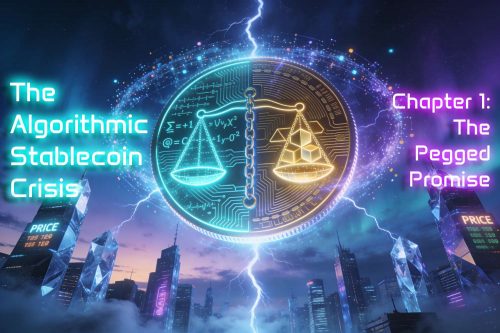
The morning light filtered through the electro-chromatic windows of Tara’s apartment, shifting from the deep blue of night to a soft, welcoming gold. The city outside was already awake—a symphony of silent hover-vehicles gliding between crystalline towers, their surfaces shimmering with the day’s first advertisements and public announcements.
Tara yawned, stretching her arms above her head as her bed’s smart-fabric adjusted to her movement, providing just the right amount of support. She reached for her wrist-comm, a sleek silver band that served as her phone, wallet, and digital identity all in one. A quick tap brought up her balance.
Available Credits: 147.82
She smiled. Perfect. Enough for lunch with Mia, that new hoverboard game she’d been eyeing, and still plenty left over for the week.
“Tara! Breakfast!” her mother’s voice called from the kitchen. “You’re going to be late for school!”
“I’m up!” she called back, swinging her legs over the side of the bed. Her feet touched the cool floor, and she padded across the room to her closet. The wardrobe’s AI assistant had already laid out three outfit options, each coordinated with the day’s weather forecast and her schedule.
She chose the casual one—a soft blue tunic with adaptive fabric that would keep her comfortable through her morning classes and afternoon gaming session with Kael. A quick swipe of her hand over the garment’s smart-tag, and the credits transferred automatically from her account. The fabric adjusted to her form as she slipped it on.
Transaction complete: 23.45 Credits. New balance: 124.37.
She didn’t even think about it. That’s how it always was.
The breakfast nook was warm and bright, filled with the aroma of synthetic coffee and real toast—a luxury her mother insisted on. Tara’s mother, Dr. Helena Chen, sat at the table, scrolling through medical journals on her own wrist-comm while sipping her coffee.
“Morning, sweetie. There’s oatmeal, or I can make you a scrambler if you want something more substantial.”
“Oatmeal’s fine, Mom.” Tara sat down, and the table’s surface lit up, displaying the morning news. She waved her hand to dismiss the more serious headlines—something about trade disputes between the Eastern and Western economic blocs, a political scandal in the Southern Federation. Not her problem.
She focused on the social section instead. Her friends were already posting about their morning adventures. Mia had gotten a rare vintage comic from the digital archives. Jonas was showing off his new e-skateboard. Everything was normal.
As she ate, she used her wrist-comm to send 15 Credits to Mia for their shared lunch delivery.
Transaction complete: 15.00 Credits sent to Mia Chen.
“Who are you sending money to?” her mother asked, glancing up from her journal.
“Mia. For lunch,” Tara said, spooning oatmeal into her mouth. “The new fusion place near the school. You know, the one that does those awesome bao tacos.”
“That sounds lovely.” Her mother paused, studying her daughter for a moment. “You never worry about that, do you? Sending credits around like it’s nothing?”
Tara blinked. “Worry? Why would I worry? It’s just Credits. They’re always worth a dollar. Everyone knows that.”
Her mother smiled, but there was something in her expression—a flicker of something Tara couldn’t quite identify. Concern? Nostalgia? It was gone before she could ask.
“Of course,” her mother said softly. “Just be careful, okay? Your grandmother used to say that money that’s too easy to spend is money you don’t really understand.”
Tara laughed. “Mom, you sound like a history teacher. Credits have been stable for like… forever. They’re backed by the algorithm. It’s math. Math doesn’t lie.”
Her mother opened her mouth to respond, then closed it, shaking her head with a small smile. “Finish your breakfast. You don’t want to miss the transport.”
The hyperloop station was packed with morning commuters—professionals in sleek corporate suits, students in their smart-fabric uniforms, delivery drones zipping overhead carrying packages and meals. The air hummed with the quiet energy of a city waking up.
Tara approached the turnstile and held her wrist-comm to the scanner. A soft chime.
Fare deducted: 2.50 Credits. Balance: 106.87.
She passed through, joining the flow of people heading toward the platform. The hyperloop capsule arrived with a whisper of compressed air, its doors sliding open silently. Tara found a seat near the window, settling in for the five-minute journey to the school district.
The view was spectacular—the city spread out below her, a tapestry of gleaming towers and green spaces, connected by the silver threads of hover-lanes. At the city center, she could see the Exchange Tower, where the algorithms that managed the entire financial system lived and breathed in their climate-controlled server farms.
She’d seen it a thousand times, but today something made her pause. She watched the tower grow closer, then recede as the hyperloop curved away.
That’s where the Credits come from, she thought. That’s what makes everything work.
She remembered a lesson from last year’s economics class. The teacher, Mr. Vasquez, had projected a diagram on the wall—a complex web of nodes and arrows representing the “Seigniorage Mechanism.” She’d doodled in her notebook through most of it, only half-listening. Something about algorithms balancing supply and demand to keep the Credits at exactly one dollar.
It seemed so simple. The algorithm mints new Credits when demand is high, buys them back when demand is low. Perfect equilibrium. Mathematical certainty.
“You okay there, Tara?”
She looked up. An older woman was smiling at her from across the aisle, her silver hair perfectly coiffed, a small companion drone hovering near her shoulder.
“Oh, yeah,” Tara said, returning the smile. “Just thinking. You know how it is.”
“Thinking is good,” the woman said. “Though these days, most young people seem to spend more time looking at their comms than at the world around them.” She chuckled warmly. “Not that I blame you. I remember being your age. The world was simpler then.”
“What was it like?” Tara asked, genuinely curious. “Before Credits?”
The woman’s eyes grew distant. “Messier. More complicated. You had different currencies for different countries. Exchange rates that changed by the minute. You had to worry about inflation, about banks failing, about…” She waved a hand. “About a lot of things. When Credits came in, it was like the world finally made sense. One currency. One value. Everyone playing by the same rules.”
“That must have been amazing,” Tara breathed.
“It was.” The woman nodded slowly. “But sometimes I wonder if we lost something along the way. A sense of… I don’t know. What money actually is.” She looked at Tara with knowing eyes. “You kids today, you’ve never known anything different. You trust the algorithm like people used to trust the sun rising. But the sun doesn’t have bugs in its code.”
The hyperloop began to slow, announcing the school district stop. Tara stood, gathering her bag.
“Thanks for the chat,” she said. “I should go.”
“Take care, young one,” the woman said. “And remember—even the most perfect system is only as strong as the people who believe in it.”
Tara stepped off the capsule, the woman’s words already fading from her mind. She had more important things to worry about—like whether Mia had remembered to order the extra spicy sauce for their bao tacos.
The school courtyard was buzzing with students. Groups clustered around the interactive fountain, its water forming and re-forming shapes based on the mood readings of the people nearby. Right now, it was creating a series of smiling faces, the water sparkling in the morning light.
Mia spotted her first. “Tara! Over here!”
Tara grinned and hurried over. Mia was sitting on the edge of the fountain, her dark hair pulled into a messy bun, her wrist-comm already displaying the lunch delivery tracking screen.
“Good news—the bao tacos are confirmed. Extra spicy sauce included. We’re eating like queens today.”
“Amazing.” Tara sat down beside her friend. “How much do I owe you for the rest? I sent you my share for the delivery already.”
“All good. The total came to 28 Credits, so that’s 14 each. You already sent 15, so…” Mia did some quick mental math. “I owe you one Credit. But that’s too small to even bother with.”
Tara laughed. “Right? Who even bothers with single Credits anymore? The system’s so efficient it handles everything down to the hundredth of a Credit, but it feels ridiculous to worry about one.”
“Speaking of ridiculous,” Mia said, lowering her voice conspiratorially, “did you see what Jonas posted? He’s trying to start a collection of vintage meme NFTs. He spent like fifty Credits on one from 2037.”
“No way. Fifty Credits? For a meme?”
“He says it’ll appreciate in value.”
“It’s a meme, Mia. It’s not going to appreciate. The algorithm doesn’t care about memes.”
They both dissolved into giggles, attracting a few glances from nearby students. Tara leaned back, enjoying the warmth of the morning sun, the easy laughter with her friend. Life was simple. Life was good.
Her wrist-comm buzzed. A notification from her favorite game store.
New release: Gravity Drift 2. Pre-order now for 29.99 Credits!
She didn’t hesitate. A few taps, and the purchase was complete.
Transaction complete: 29.99 Credits. New balance: 76.88.
The game would start downloading immediately. By the time she got home, it would be ready to play. No waiting. No fuss. Just seamless digital convenience.
She loved this world.
Later that afternoon, Tara and Kael met at their usual spot—the quiet corner of the school library where the physical books were kept. Most students never came here; they preferred the digital archives accessible from anywhere. But Kael loved the feel of paper, the weight of a real book in his hands.
Today, though, he wasn’t reading. He was hunched over his laptop—an old model that he insisted on using because it had “actual hardware” and “wasn’t dependent on the cloud.” His brow was furrowed, his fingers flying across the keyboard.
“Hey, nerd,” Tara said, dropping her bag on the table. “What are you working on?”
Kael didn’t look up. “Economic modeling. You wouldn’t understand.”
“That’s rude. Try me.”
He finally looked up, and there was something in his eyes—a intensity that made Tara pause. Kael was always serious, always thinking, but today he seemed almost… troubled.
“Okay,” he said slowly. “You know how Credits work, right?”
“Of course,” Tara said, sitting down across from him. “They’re stablecoins. Pegged one-to-one with the dollar. The algorithm keeps everything balanced.”
“And what’s the dollar backed by?”
Tara blinked. “I don’t… I mean, it’s backed by the government, right? By the economy?”
“The dollar hasn’t been backed by physical assets for decades, Tara. And Credits aren’t backed by dollars. They’re backed by math. By a clever piece of code that’s supposed to expand and contract the supply to keep the price stable.”
“So? The algorithm works. It’s worked for years.”
Kael turned his laptop so she could see the screen. It was filled with complex graphs and mathematical formulas. “Look at this. I’ve been running simulations. Dozens of them. Different market conditions, different shock scenarios. And do you know what I found?”
“What?”
“In almost every scenario where there’s a sudden loss of confidence—a panic, a coordinated sell-off—the algorithm fails. It can’t keep up. The death spiral triggers, and the peg breaks.”
Tara frowned. “Death spiral? What are you talking about?”
“The thing is,” Kael said, his voice intense and low, “when the price drops, the algorithm is supposed to buy Credits back to reduce supply and push the price up. But the algorithm doesn’t have any real money to buy with. It just has more Credits. So to buy back Credits, it has to mint new ones. But minting new ones increases supply, which drops the price further. So it has to mint more. The whole thing feeds on itself until—”
“Okay, okay, slow down.” Tara held up her hands. “You’re talking like… like the whole system is going to collapse. But that’s crazy. It’s been stable forever. Everyone uses Credits.”
“Everyone used to trust the banks too,” Kael said quietly. “Until they didn’t.”
Tara shook her head. “You’re being paranoid. You’re always like this—looking for problems that don’t exist.”
Kael’s expression softened. “I’m not trying to scare you, Tara. I’m just saying… understand what you’re using. Credits aren’t real money. They’re digital promises. And promises can be broken.”
“I guess I just don’t see how,” Tara said, crossing her arms. “So you’re telling me that all of this—the whole economy—it’s built on… what? On trust?”
“Yes. Exactly. It’s built on confidence. And confidence is the most fragile thing in the world. It can evaporate in minutes.”
Tara laughed, but there was no humor in it. “That’s ridiculous. Millions of people use Credits every day. They’re not going to just… wake up tomorrow and decide the peg is broken.”
“Says the girl who just spent 30 Credits on a video game without thinking twice.” Kael’s voice was gentle, not accusatory. “You didn’t check the exchange rate. You didn’t verify the balance. You just trusted it.”
“Because there’s nothing to verify! It’s always one dollar. It’s always been one dollar.”
Kael sighed, closing his laptop. “I hope you’re right, Tara. I really do. But I’ve been studying this for months, and everything I see tells me that this system is a house of cards. One big shock, one wave of panic, and it all comes tumbling down.”
“Well, good thing there’s no shocks, then,” Tara said lightly, standing up. “I’m going to go find Mia. Try not to worry so much, okay? Everything’s fine.”
She walked away, but Kael’s words stuck with her. She could hear his voice echoing in her mind as she left the library.
Trust is the most fragile thing in the world.
That evening, Tara sat in her room, her new game loading on her wall-screen. The graphics were stunning—a swirling nebula of colors and shapes, the gravity-drift mechanic already showing off its impressive physics engine.
Her wrist-comm buzzed. A news alert.
Market Exchanges Report Minor Volatility in Credit Value. Algorithm Adjustments Expected.
Tara stared at the message. It was nothing, right? Minor volatility. The algorithm handles this all the time. She’d seen these alerts before, dozens of times. They were just the system doing its job.
She dismissed the notification and started playing her game.
But Kael’s face kept appearing in the corner of her mind. His intensity. His certainty. His belief that the whole world was built on a lie.
She shook her head, focusing on the game. “He’s wrong,” she whispered to herself. “He’s always trying to find problems where there aren’t any.”
The credits in her account—now 76.88—were safe. They were stable. They were backed by mathematics, by code, by the unshakable logic of the algorithm.
Aren’t they?
She played her game until midnight, trying to forget the look on Kael’s face. But when she finally turned off the screen and lay in the darkness, she couldn’t shake the feeling that something was wrong.
Something was coming.
She just didn’t know it yet.
Table of contents:
Introduction
Chapter 1: The Pegged Promise
Chapter 2: A Stable Life <<<<<< NEXT
Chapter 3: The Seigniorage Mechanism
Chapter 4: The Death Spiral
Chapter 5: The Confidence Collapse
Chapter 6: The Emergency Mint
Chapter 7: The Backing Injection
Chapter 8: The Hybrid Peg
Chapter 9: The Restored Trust
Chapter 10: Stability Requires Backing
