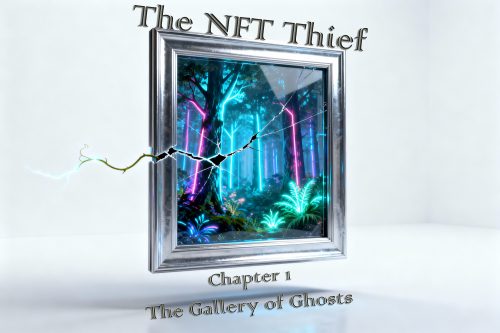
The silence of the Veritas Gallery was its most expensive feature.
Maya floated through its pristine white expanse, the only sound the faint, proprietary hum of the platform—a sound designed to be almost subliminal, suggesting stability, wealth, and absolute purity. Before her, suspended in the void, were the masterpieces of the digital age. *Neo-Mona Lisa 2.1*, a dynamic portrait that shifted through every historical artistic interpretation every minute. Cryptic Cascade, a waterfall of living, calculating code. The Last Tweet, a monumental, melancholic sculpture forged from the last public social media post before the Great Hiatus.
Each was breathtaking. Each was worth more than her entire city block. And each felt, to Maya, deader than a fossil.
She adjusted her haptic gloves, the sensitive fabric whispering against her skin. Her immersion headset—a second-hand “NeuraLite” model she’d heavily modified with scavenged emotion-driver chips—projected the gallery onto her retinas with painful clarity. She willed herself to feel something, anything, as she drifted towards the week’s featured exhibit: Neon Bloom by the legendary artist Kael.
It was stunning. A colossal, intricate flower forged from solidified light and neon filaments, its petals slowly unfurling in a perpetual, elegant dance. The public ledger scrolled beside it in a tasteful holographic font, listing its provenance: minted 3 years ago, last purchased for 750 Ethereum by the collector “AestheticaPrime,” currently on loan to Veritas. A perfect, untouchable history.
Maya engaged her modified scanner. A delicate, spider-web-thin interface, invisible to standard users, overlay her vision. She tuned it to look beyond the visual data, probing the metadata layers—the creation logs, the timestamped edits, the energy signatures of the artist’s tools. This was her secret ritual, her hopeless search for a pulse in the digital graveyard.
Most times, she found nothing but cold, efficient code. But sometimes… sometimes there were echoes.
She focused on Neon Bloom. The public saw beauty. Maya’s tools sought a signature. And then, it happened.
A system glitch. A hiccup in Veritas’s flawless server stream. For less than a second, the defensive firewalls around the artwork’s raw data flickered.
And a wave of emotion, raw and unbidden, crashed into Maya.
It wasn’t an image or a sound. It was a feeling. A profound, hollowing loneliness, so sharp it stole her breath. It was tied to a data packet—a work log from 3:14 AM on the day of Kael’s final edit. A note, buried and forgotten: “Tried the new diffusion algorithm. It’s perfect. And no one is here to see it.”
The glitch sealed. The firewalls snapped back. The sterile silence of the gallery returned, now feeling like a lie.
Maya ripped the headset off, gasping as if surfacing from deep water. The cool, slightly dusty air of her bedroom was a shock. The immersive void of Veritas was replaced by comforting clutter: tangles of wires on her desk, holographic sketches hovering over her tablet, the gentle glow of her aging desktop PC, and the vibrant, real life of the spider plants tumbling from her shelves.
She sat on the edge of her bed, the haptic gloves lying limp in her lap like shed skins. Her heart hammered against her ribs. That loneliness… it had been so specific, so human. It was a fossilized moment of an artist’s soul, trapped in a crypt of transactional data.
This was why she came to these cold galleries. Not to admire the trophies, but in the desperate, quiet hope of hearing a ghost whisper. Most of the time, the ghosts were silent. Today, one had screamed.
She was a spectral artist. That’s what she called herself when she had to put a name to it. While other kids in her class crafted physical art or polished hyper-realistic digital renders for social cred, Maya built experiences in the Augmented Reality layers of the city. She’d spend weeks coding intricate murals of light and story that would bloom on the side of the old library at dusk, interact with the passing weather, and then fade forever with the dawn. They were beautiful. They were ephemeral. To everyone else, they were practically imaginary.
“Why do you make something that just disappears?” her best friend, Zara, had asked once, not unkindly.
“Maybe because it’s honest,” Maya had replied, not fully understanding her own answer. “Everything online is forever, even the stuff that should fade. It feels… heavy.”
Now, cradling her headset, she understood better. Her art was a ghost from the moment of its creation. The emotions in Veritas were ghosts trapped in a gilded cage. Which was worse?
Driven by a new urgency, she pulled the headset back on. She wouldn’t return to Neon Bloom. That ghost had been heard. She navigated to a different sector: “Acquisitions – Contemporary Power.” The art here was sharper, colder, often commentary on the system that sold it. Her eyes landed on one piece: “The Gilded Cage” by an anonymous artist known only as Spectre. It was a simple, brutalist cube of shifting gold and platinum algorithms, inside which a faint, bird-like shape of pure data fluttered against the walls. The description read: “A meditation on value and constraint.” It was one of The Curator’s earliest known acquisitions, bought for a record sum and rarely displayed.
Maya initiated her scanner. The standard metadata was impeccable, boring. She pushed deeper, using an illicit filter she’d coded herself to map emotional residue. As she focused on the fluttering data-bird, she expected to feel frustration, desperation.
What she felt was nothing. A perfect, chilling void. No artist’s struggle, no passion, no pain. Just… blank.
But when she shifted her focus to the cold, golden bars of the cage itself, a different sensation seeped through. It was a slow, cold, and insatiable hunger. Not for food, but for possession. A need to own, to lock away, to have one’s name on the ledger as the final, absolute owner. It was the feeling of a vault door closing. It was the signature of every collector who had owned this piece, but the last one—The Curator—was overwhelming, staining the digital artifact with his void-like desire to consume and remove.
This wasn’t a ghost of creation. It was a ghost of consumption. And it was actively malevolent.
A shiver, unrelated to the room’s temperature, traced Maya’s spine. She saved the coordinates of The Gilded Cage, bookmarking it with a red, private flag only she could see.
She disconnected fully this time, the weight of the virtual world lifting to be replaced by the heavier weight of understanding. The internet wasn’t just a place where things lasted forever. It was a place where feelings could be imprisoned, where the human trace behind a masterpiece could be walled up behind firewalls and ledgers, and where the act of owning something could be more powerful than the thing itself.
She looked at her own hands, the tools that made ghosts. She thought of the hollow cage and the hungry silence that surrounded it. And for the first time, her own fleeting art didn’t feel like a failure. It felt like a rebellion.
But a rebellion against what? A system she didn’t fully understand. A foe with no face. She needed a map to this hidden layer of reality. She needed to understand the rules of this ghost-filled world before she could decide how to live in it.
On her desk, her tablet pinged—a notification from the public art feed about a high-profile auction happening now on Veritas. A “historic NFT” was going on the block. On impulse, and with the image of the gilded cage burning in her mind, she put her headset back on. She had to keep looking. The ghosts were talking. She had to learn to listen.
Table of contents:
Introduction
Chapter 1: The Gallery of Ghosts
Chapter 2: A Sentimental Steal
Chapter 3: The Memory in the Metadata
Chapter 4: The Curator’s Hunt
Chapter 5: The Artist’s Legacy
Chapter 6: DAWN – The Decentralized Art World Network
Chapter 7: The Forked Gallery
Chapter 8: Provenance is Everything
Chapter 9: The Living Exhibit
Chapter 10: A New Canvas
NEXT >>> Chapter 2: A Sentimental Steal
