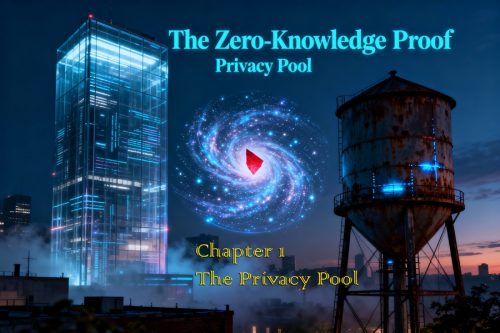
The air in the water tower was cool and dry, humming with a melody of electrons and spinning drives. Zed’s kingdom was a five-meter-wide cylinder of rust-streaked steel, now lined from floor to ceiling with matte black server racks. Glowing filaments of fiber-optic cable traced paths like neon vines between them. In the center, on a throne of repurposed packing crates, Zed watched the dance of secrets on his main holoscreen.
He wasn’t moving money. Money was traceable, a concept for the naive. He moved truths.
A new request blinked into his queue, tagged URGENT – MEDICAL. Zed’s fingers, thin and agile, danced across the haptic interface. The request was from a clinic in the flooded Low-City. They needed to verify a patient’s allergy to a specific synthetic protein for emergency surgery. The patient’s full medical record was a treasure trove for data-harvesters, but the clinic only needed one binary answer: Yes or No.
Zed initiated the sequence.
“Privacy Pool running. User query isolated,” a neutral synthetic voice stated. On screen, a complex, shimmering knot of data—the patient’s encrypted medical history—entered the swirling vortex of the Pool. It joined thousands of other data-points: identity verifications, financial histories, personal correspondence. They all churned together, a digital blizzard where no single flake could be traced back to its cloud.
“Generating zero-knowledge proof,” Zed murmured, more to himself than the machine.
The system went to work. It didn’t extract the allergy data. Instead, it performed a cryptographic ballet around it. On a secondary screen, a simplified visualization played out for Zed’s own audit trail. It showed two cartoon figures: a Verifier (the clinic) and a Prover (the patient’s data).
- Step 1: The Verifier asks: “Is Statement X (allergy to Synth-Protein Gamma) true?”
- Step 2: The Prover performs a series of complex, unique challenges on the encrypted data. It never decrypts it. It’s like proving you know the combination to a lock by having someone shake the lock and listening to the tumblers, without ever opening it.
- Step 3: After multiple rapid rounds, the system outputs a proof: a tiny, unique string of code called a zk-SNARK.
Zed watched the string generate: a387f2e1c05b…. It was elegant. It was bulletproof.
He routed the proof back to the clinic. A moment later, his confirmation pinged. The clinic received their answer: “STATEMENT X IS TRUE. VERIFICATION: 100%.” They knew the allergy existed. They knew nothing else—not the patient’s name, genome, other conditions, or history. The surgery could proceed. A life saved, a secret kept.
A faint, rare smile touched Zed’s lips. This was the world as it should be. A world of verified truths and intact privacies.
His console chimed again, a different tone—lower, more consequential. A new client was requesting a bulk transaction. The tag read: THE BENEFACTOR – HUMANITARIAN AID.
Zed’s smile vanished. High-volume clients were risk vectors. He pulled up the specs. The Benefactor wanted to move a substantial amount of Resource Credits—the city’s unified currency—earmarked for “disaster relief and refugee settlement.” The credits were already cryptographically tagged with a donor seal from a reputable charity.
The Privacy Pool’s protocol was clear. It could ask specific questions of the data, but only those with objective, ledger-based answers. Zed input the standard query for financial transfers: “Prove that the source credits are not listed on the Public Stolen Asset Ledger.”
The Pool churned. The Benefactor’s massive data bundle dissolved into the anonymity set. Zed imagined them out there somewhere, this shadowy philanthropist, trusting his system with their virtue. The process took longer due to the volume. Lights flickered across the server racks, casting dancing blue shadows.
Finally, the result flashed, stark and green:
PROOF VALID. STATEMENT IS TRUE. SOURCE CREDITS ARE CLEAN.
Zed let out a breath he didn’t know he was holding. The system had done its job. It proved a negative without exposure. He authorized the transfer. The credits would emerge from the Pool minutes later, washed clean of their transactional history, ready to be disbursed anonymously to the needy. It was efficient. It was ethical.
Wasn’t it?
A sudden, piercing memory shattered his focus. Not a coherent narrative, but a sensory blast: the acrid smell of burnt circuitry in his old apartment, the blue flicker of a news hologram, his father’s face—pale and shattered—reflected in the screen. The newscaster’s voice, slick and pitiless: “…the data breach exposed not only financial records, but private communications, medical histories… The family has declined to comment…”
Declined to comment. Because they were broken. His father, a mid-level bureaucrat, had misplaced a single encryption key. Not for malice, for haste. And the Data Leviathans had swallowed them whole. Debt collectors morphing into blackmailers. “Friends” dissolving into silence. The slow, choking erosion of everything they were, laid bare for the world to pick over.
Zed’s hands clenched into fists. His nails bit into his palms. The hum of the servers seemed to morph into a whisper: Never again. Expose nothing.
Privacy wasn’t a preference; it was the very membrane of self. Without it, you ceased to be a person. You became a public file.
He stabilized his breathing, forcing the ghosts back into their lockbox. He focused on the console. The Benefactor’s transaction was complete. The Privacy Pool hummed with serene, encrypted silence. All was in order. He had built a sanctuary in a world of glass.
As he reached to power down his main display, a secondary news feed he kept muted in the corner of his eye erupted with a breaking news banner, flashing urgent crimson. The headline auto-scrolled:
PANOPTICON BUREAU INVESTIGATES MASSIVE AID FRAUD. MILLIONS IN REFUGEE CREDITS DIVERTED. CITYWIDE AUDIT AUTHORIZED.
Zed’s blood ran colder than the air in the tower. His eyes flicked from the screaming headline to the now-quiet log of the Benefactor’s transaction. HUMANITARIAN AID.
A coincidence. It had to be.
But in a world without privacy, there were no coincidences. And in a world built on absolute privacy, doubt was a worm that never slept. He stared into the swirling visualization of the Pool, the beautiful, impenetrable blizzard of secrets, and for the first time, wondered what else, besides truth, it might be hiding.
Table of contents:
Introduction
Chapter 1: The Privacy Pool
Chapter 2: The Data Leviathan <<<<<< NEXT
Chapter 3: zk-SNARKs and Suspicions
Chapter 4: The Anonymity Set
Chapter 5: A Trace of Blood
Chapter 6: To Reveal or to Shield?
Chapter 7: The Ultimate Audit
Chapter 8: Trustless, But Not Heartless
Chapter 9: Proof of Personhood
Chapter 10: Verified, Not Exposed
