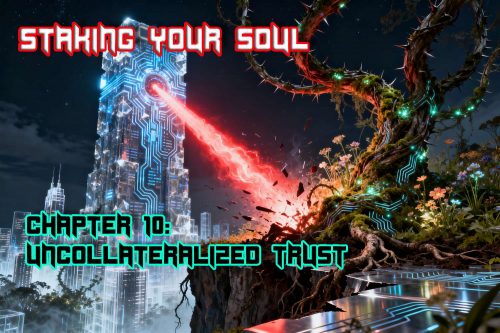
The vacant lot on Cypress Street no longer looked vacant. It looked like a promise. Where there had been rubble, weeds, and the ghostly shells of discarded smart-packaging, there were now twelve neat, rectangular garden beds built from reclaimed lumber. Soil, dark and rich, filled them. Tiny green shoots—kale, lettuce, carrots, beans—broke the surface in orderly rows. It was the most analog, unoptimized thing in all of Aethel: food you had to wait for, that could fail, that would get dirty under your fingernails.
Lena knelt at the edge of Bed 4, thinning carrot seedlings. The morning sun was warm on her back, a sensation she noted not for a potential post about #Mindfulness, but simply because it felt good. Her hands were permanently stained with earth, her nails short and practical. She wore Marcus’s old canvas jacket over a faded shirt.
Marcus was across the lot, wrestling with the drip irrigation system they’d cobbled together from donated hoses and timers. He muttered at a stubborn connector, his face a portrait of focused irritation that was utterly, endearingly real.
The garden was their new ledger. Their consensus mechanism. You didn’t stake reputation here; you stewarded life. Trust wasn’t verified by an algorithm; it was proven by showing up, by remembering to water your neighbor’s plot when they were sick, by sharing the first ripe tomato.
A shadow fell across the bed. Lena looked up, shielding her eyes.
A man in the crisp, blue-trimmed uniform of the City Parks and Reclamation Department stood there, a sleek tablet in his hand. He looked from the thriving garden to the crude, hand-painted sign at the entrance: CYPRESS COMMONS – A COMMUNITY FOOD PROJECT. ALL WELCOME. NO STAKE REQUIRED.
“This is unauthorized cultivation on municipal land,” the official said, his voice not unkind, but procedural. He tapped his tablet. “There’s no permit here. No registered Validator organization attached for liability. No yield-impact assessment for local agri-business.” He glanced at Lena’s dirty hands, her lack of interface. “Who’s in charge here?”
Lena stood, wiping her hands on her pants. “No one’s in charge. We’re a collective.”
The official’s lips thinned. “The city requires a validated entity for coordination. Insurance. You understand.” He brought up a form on his tablet. “I can initiate a fast-track application for a Community Beautification validator license. You’d need a principal with a minimum stake of 1,000 SY to sponsor, and of course, 30% of any produce would need to be logged and validated for distribution through city channels to ensure equity…”
He was speaking the only language he knew: the language of systems, permissions, and quantified value.
Before Lena could answer, a new voice cut in.
“Excuse me.”
Mrs. Gable, leaning on her cane, had emerged from her apartment next to the lot. She walked slowly but purposefully to stand beside Lena. She fixed the official with a stare that had seen decades of bureaucrats come and go.
“This garden,” she said, her voice clear and firm, “is on the land. But it’s our place. Lena and Marcus there, and Mira from the library, and Arlo from the café, and my granddaughter Chloe—they built these beds. They carried the soil. When my arthritis was bad last week, young Kiri from the clinic weeded my square.” She pointed a gnarled finger at a bed bursting with Swiss chard. “That’s my chard. And I decide who gets it.”
The official blinked. “Ma’am, I appreciate the sentiment, but city code—”
“Do you know Arlo?” Mrs. Gable interrupted.
“I… what?”
“Arlo. Runs The Steady Cup. Do you know him? Has he ever served you?”
The official shifted uncomfortably. “I may have gotten coffee there.”
“Then you know his word is good,” Mrs. Gable stated as if it were a universal law. “His word, and Mira’s, and the word of everyone who tends this plot, is our permit. Our yield-impact assessment is that children on this street are eating fresh snap peas for the first time. You can scan that.”
She stood her ground, a tiny, defiant monument to off-chain authority.
The official looked from her, to Lena, to the garden, to his tablet. The system in his hand had no category for this. He could write a citation, but the social calculus had changed. He was facing a different kind of consensus.
He sighed, lowering the tablet. “Just… keep the pathways clear for municipal drones, alright? And maybe… put up a sign about composting regulations.” It was a retreat, cloaked in petty bureaucracy.
As he walked away, Mrs. Gable patted Lena’s arm. “You don’t need their permission to do what’s right, dear.” She winked and ambled back to her apartment.
Lena felt a surge of emotion so potent it tightened her throat. This was the uncollateralized trust they had built. It had just defended its own existence.
Later that afternoon, the garden was full of quiet activity. Chloe was teaching a group of younger kids how to identify pollinators. Ben was setting up a small, solar-charged battery to power the irrigation timer. And in the far corner, under the dappled shade of a young, donated apple tree, Wren had set up an easel.
She was painting the garden. But not as a pristine, aestheticized image. She was capturing the messy, beautiful reality: Marcus’s scowling concentration, the glint of a watering can, the vibrant chaos of new growth against the city’s gray backdrop. She worked with a quiet confidence Lena hadn’t seen in years. Her tablet and stylus were beside her, but she was using physical paints on a canvas.
Lena brought her a cup of water. “It’s beautiful, Wren.”
Wren didn’t jump. She smiled, wiping a smudge of green from her cheek. “It’s just… what I see. I’m not thinking about who will like it. I’m thinking about the light on the bean poles.”
“That’s the only thing that matters,” Lena said softly.
Wren put her brush down. “I’m going to give this one to Arlo. For the café. And the next one to Mira for the library.” She looked at her sister, her eyes clear. “Chloe helped me set up a small, encrypted gallery. Not on Veritas. Just… a place to put them where people can see if they ask. No comments. No validations. Just the art.”
Lena’s heart swelled. Wren wasn’t just creating art for herself; she was learning to give it as a gift, to embed it in the fabric of their real-world community. Her value was becoming intrinsic, untradable.
As the golden hour gilded the garden, the day’s work wound down. People drifted home with small bouquets of herbs or promises to check on the compost. Soon, only Lena and Marcus remained, finishing the irrigation hookup.
Their hands brushed as they both reached for the same tool. A simple, accidental touch. But this time, they both paused. The air between them shifted, charged with all the unsaid things that had built over weeks of shared purpose, silent understanding, and repaired radios.
He looked at her, his usual cynical mask completely gone. He just looked… open. Tired, hopeful, real.
She looked back, seeing not the Ghost, but Marcus. The boy who believed in the dignity of unrecorded life, who had shown her how to see it, who had stood beside her in the dark.
He didn’t ask for permission. He didn’t validate the moment with a query. He simply reached out, his hand still dirty from the soil, and cupped her cheek. His touch was warm, rough, and unequivocally present.
Lena leaned into it, closing her eyes. This was a transaction that would never appear on any ledger. It was a silent, mutual attestation of something that had grown, slowly and surely, in the fertile ground of shared truth.
When they pulled apart, no more needed to be said. They turned off the water, gathered their tools, and walked side-by-side out of the garden, their shoulders just touching.
Under the newly installed, solar-powered light at the lot’s entrance, Lena paused. She looked back at the sleeping plants, the neat rows, the evidence of their collective faith.
“We did this,” she whispered.
“We’re doing it,” Marcus corrected. “It’s never finished.”
That was the point, Lena realized. Veritas had been about reaching a finished state—a high score, a perfected profile. This was about the process. The continual, daily act of building and tending trust.
Her stake was still 2,602.33 SY, a permanent, scarlet monument to her fall. The Fraud Marker would follow her in the digital world for years. She would not go to a prestigious college on a scholarship. Her path was uncertain, muddy, and utterly her own.
But she had a community that knew her, not her score. She had a sister who was finding her voice. She had work that mattered to real people in the real world. And she had a quiet, steadfast boy beside her who saw her, truly saw her, and had not looked away.
She had staked her soul on something no algorithm could measure or slash. And against all logic, in the messy, unquantifiable economy of the human heart, she was richer than she had ever been.
She took Marcus’s hand, their fingers, rough and dirty, intertwining. No transaction was recorded. No stake was earned. Trust, in that moment, was simply, beautifully, presumed.
It was the ultimate, uncollateralized truth.
Final Line: “The most valuable things,” Lena said, looking at their joined hands, then out at their thriving, imperfect garden, “are never on the ledger.”
Table of contents:
Introduction
Chapter 1: The Reputation Protocol
Chapter 2: The Perfect Life Pool
Chapter 3: Slashed
Chapter 4: Ghost in the Feed
Chapter 5: Validators of the Unseen
Chapter 6: The Sybil’s Choice
Chapter 7: Off-Chain Integrity
Chapter 8: The Hard Reboot
Chapter 9: Proof-of-Being
Chapter 10: Uncollateralized Trust
