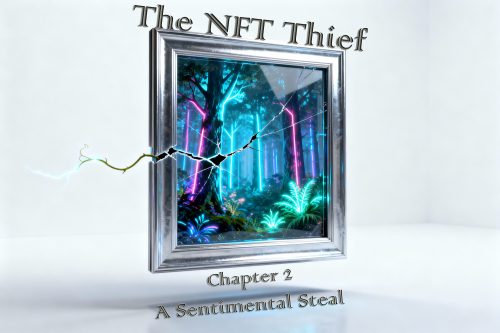
The environment was all edges and whispers. This wasn’t the curated serenity of Veritas; this was a back-alley of the metaverse, a custom-built simulation of a high-security vault. Walls of shimmering, monolithic data-blocks pulsed with defensive code. Invisible tripwires of cryptographic logic hummed in the air, ready to scream at the slightest touch.
In the center of this digital fortress, the target floated: “The Gilded Cage.” Or at least, the token that represented it on the public ledger.
Leo’s avatar—a sleek, silver fox with intelligent green eyes and slightly scuffed digital fur—crouched on a floating platform of raw code. He wasn’t here to steal the asset. Not in the traditional sense.
“Alright, folks, settle in,” he murmured, his voice a confident, warm tenor that echoed slightly in the vault’s expanse. He wasn’t talking to himself. A tiny, encrypted livestream signal was pulsing from him, reaching a handful of trusted contacts and anonymous supporters in the darker corners of the net. “We’re not cracking the vault today. That’s a dragon’s hoard, and we’re not knights. We’re archivists. We’re graffiti artists.”
His paws—dexterous, glowing with interface light—danced in the air. Holographic screens blossomed around him, displaying chains of transactions, ownership histories, and the dense, obfuscated language of the smart contract governing the NFT.
“The Curator bought this piece three years ago for a small fortune,” Leo narrated, his tone part lecturer, part conspirator. “And then it vanished. No more public displays. No loan to galleries. It’s in cold storage. But see this?” He highlighted a line in the provenance chain. “The purchase transaction is flawless. Too flawless. It’s like a story where everyone agrees on every word. Real history is messy.”
He was doing what he was known for in certain hidden circles: a provenance hack. His goal was to expose, not to possess. He began weaving a new thread of code—a parasitic annotation linked irrevocably to the token’s history. It was designed to be a glaring, un-ignorable public flag. When finished, anyone viewing “The Gilded Cage” would see, right below the artist’s name, a line in bold, red, system-level text:
PROVENANCE ALERT: ORIGINAL ARTIST UNCREDITED. CHAIN OF TITLE SUGGESTS WORK-FOR-HIRE EXPLOITATION.
“It’s not about taking his toy,” Leo said, his fox-face set in a sharp grin. “It’s about taking his story. He wants a clean, pretty history? We give him the real one.”
The hack was a delicate, beautiful thing. He was inserting truth into the ledger’s interstices, making the blockchain itself bear witness to its own corruption. He was minutes from completing the weave, from making the lie untenable.
Then, the vault sighed.
It wasn’t an alarm. It was subtler. The humming in the air changed pitch. The monolithic data-blocks on the walls shimmered, and their pattern began to recompile in real-time. Adaptive security. The Curator’s systems weren’t just walls; they were a living immune system.
“Ah,” Leo said, the charm in his voice replaced by focused tension. “He’s awake.”
The platform beneath him dissolved. His connection to the token’s contract began to fray, the threads of his hack unraveling faster than he could weave them. A new, aggressive data-stream—cold and surgical—lashed out, not to delete him, but to tag him. To find the source of the intrusion.
“Abort protocol,” he announced, no longer narrating for an audience but barking commands to his own systems. “Scatter the packets. Obfuscate the exit.”
But the counter-attack was too sophisticated. It bypassed his decoys, homing in on the core signature of his access point—a backdoor he’d forged through a neglected corporate server. He watched, helpless, as the icy code traced its way back, node by node, getting closer to his real location.
He had one last option. A forced, catastrophic disconnect. It would fry the virtual machine he was running this simulation on and might even spike the processors in his physical rig. But it would sever the trace.
“Fine. Keep your trophy,” he muttered, a flicker of genuine anger in his eyes. He initiated the kill switch.
At that exact moment, the vault’s public viewing portal—a rarely-used, read-only window—flickered to life. Someone had clicked the “View Auction” link from the main Veritas page.
And in that frozen millisecond before his avatar disintegrated, Leo’s green eyes met the wide, startled eyes of a girl’s avatar—a simple, unadorned human form with a look of profound shock, not at the art, but at him, caught in the act of digital sabotage.
Then, white noise. Disconnection.
Physical space. The humid, rhythmic thump of a basement laundry room. Leo tore off his own, much more advanced immersion headset, his real hands shaking slightly. He was a lanky sixteen-year-old with messy brown hair, a sharp jaw, and the same intelligent, too-observant eyes as his fox avatar. Around him, servers whirred, stacked on wire racks next to a quietly churning washing machine. A single, dangling bulb illuminated the scene.
“Stupid,” he hissed to himself, running a hand through his hair. He’d been arrogant. The Curator’s defenses were next-gen. And now a witness. A random user. Probably some crypto-bro who’d report the intrusion attempt immediately.
His wrist-comm buzzed. An alert: his abandoned virtual machine had been traced and quarantined. The backdoor was sealed. He’d lost a valuable tool. A bad night.
Another alert pinged. A direct message, routed through an anonymous buffer. He expected a system notification, a warning from Veritas Security.
He read it. And blinked.
The message was text-only. No avatar. It read:I felt it too. The hollow feeling. How did you do that?
Leo stared. It wasn’t an accusation. It was a question. The shock in those avatar eyes… it hadn’t been fear of a criminal. It had been recognition.
His fingers flew over a holokeyboard. He initiated a cascade of trace programs on the message’s path. It was cleverly routed, but not expertly. It led back to a public access node, and from there, after some digging, to a residential subnet. The user’s ID was generic, but the digital fingerprint of the headset model was unusual—an old NeuraLite with non-standard modulation.
A tinkerer. Not a crypto-bro.
Intrigue warred with extreme caution. This was a trap. It had to be. He typed a reply, his words layered in encryption and bounce-routed through three different continents.Do what? Witness a system glitch? You should report it.
The reply came faster this time.It wasn't a glitch. You were putting a label on it. A true one. The Cage feels hungry, not trapped. Who are you?
Feels hungry. The phrasing struck him. She wasn’t talking about market sentiment or rarity. She was talking about the art itself, as if it had an aura. This was… unexpected.
He made a decision. High risk, potential high reward. He sent a packet of data—not a message, but a location. Coordinates for a neutral, peer-to-peer virtual space, the kind that evaporated after one use. A digital dead-drop.If you’re serious, and if you’re alone, meet here in ten minutes. Bring nothing. Tell no one.
He added a final line, the ghost of his fox’s grin in the words.And if you’re with Veritas Security, my lawyers are very bored.
He didn’t wait for a reply. He began the process of scrubbing his systems, moving his critical data to new encrypted partitions. But as he worked, his mind wasn’t on the failed hack anymore. It was on the witness. On her strange question. How did you do that?
He was used to being called a thief, a vandal, an idealist. No one had ever asked him for the how. They either condemned it or demanded he do it for them. This felt different.
Ten minutes later, his avatar—a more neutral, human form now—manifested in the temporary space. It was a plain, white, featureless cube. No doors, no windows. Just infinite blankness.
He waited, poised to disconnect at the first sign of a trap.
With a soft chime, a second avatar resolved. It was the same simple form from the vault. A teenage girl, her expression wary but burning with a determined curiosity that no generic avatar could fully mask.
She looked at him, and her first words in this secure, blank room were not about theft, or hacking, or the law.
“The bird in the cage,” Maya said, her virtual voice quiet but clear in the sterile silence. “It’s not real, is it? It’s a forgery. The real one… the one the artist actually made… is somewhere else. You weren’t trying to steal. You were trying to tell the truth.”
Leo stared, his carefully prepared defenses and cynical scripts momentarily useless. She hadn’t seen a criminal. She’d seen an archaeologist. And she’d understood the dig.
The heist had failed. But something else, something far more unpredictable, had just begun.
Table of contents:
Introduction
Chapter 1: The Gallery of Ghosts
Chapter 2: A Sentimental Steal
Chapter 3: The Memory in the Metadata
Chapter 4: The Curator’s Hunt
Chapter 5: The Artist’s Legacy
Chapter 6: DAWN – The Decentralized Art World Network
Chapter 7: The Forked Gallery
Chapter 8: Provenance is Everything
Chapter 9: The Living Exhibit
Chapter 10: A New Canvas
NEXT >>> Chapter 3: The Memory in the Metadata
PREVIOUS <<< Chapter 1: The Gallery of Ghosts
