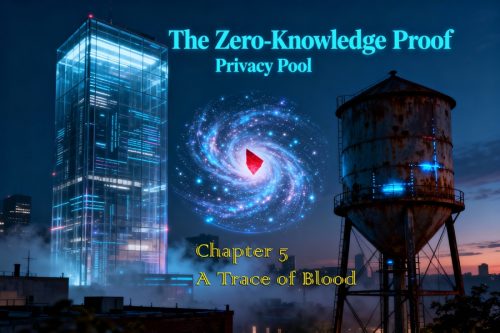
The anomaly hung in the holographic space between them—a ghost in the machine, silent and damning. The data packet didn’t glow with the warm, generic icons of the other points. In Zed’s metadata visualization, it was rendered as a jagged, crimson shard lodged within the smooth, green sphere of the Benefactor’s main transaction.
“It’s a stowaway,” Zed breathed, his voice tight. “A completely separate transaction, using the Benefactor’s bundle as camouflage. Paying the exit fees.”
Lena was already in motion, her auditor’s instincts overriding the shock. She couldn’t decrypt it, but she could analyze its shell. She isolated the crimson shard’s digital signature—the unique combination of formatting protocols, encryption ciphers, and routing headers that acted as its fingerprint.
“Running comparative analysis,” she said, her fingers a blur on her own portable interface. She pulled up the forensic file from Maro: the data-protein “blood trace.” It wasn’t just a biological signature; it was a digital one, encoding the specific software and hardware used by the thief at the crime scene. She set her scanner to compare the two sets of metadata.
The process was agonizingly slow. Percentages crawled across her screen. 15%… 42%… 68%…
Zed watched, his earlier defiance replaced by a sickened fascination. His perfect system hadn’t been broken. It had been used. The Privacy Pool was a subway car, and while he’d been busy checking everyone’s tickets for one specific violation, a passenger had smuggled a weapon aboard, hiding it in plain sight among the crowd.
MATCH CONFIRMED: 99.7% PROBABILITY OF COMMON ORIGIN.
The words glowed on Lena’s screen. She let out a sharp breath. “It’s the same. The formatting of this nested packet was generated by the same system that left the biological trace at the fraud’s point of origin. This isn’t just linked, Zed. This is the payment for the crime.”
A wave of cold nausea washed over Zed. “The Benefactor… they’re not just moving clean aid. They’re a smuggler. Or a client.” The humanitarian cover was a lie. His system, built to protect the vulnerable, had been leveraged by a predator. Ravvi’s lifeline and a criminal’s payoff were traveling in the same encrypted vein.
“We need to follow it,” Lena said, her eyes alight with the chase. “The packet’s final destination. If we can see where it’s headed—”
“Can’t,” Zed interrupted, his tone hollow. “The destination is encrypted with the same finality as everything else. It’s a black hole until it emerges.”
“Then we look backwards! At the shell.” Lena was already diving deeper, using her Panopticon clearance to access the city’s registries of commercial software licenses and hardware manifests. The unique formatting protocols were a clue. “This encryption schema… it’s proprietary. Expensive. Used by mid-tier financial analytics firms for secure client reporting.”
She cross-referenced the signature with a database of known corporate digital footprints. A name flashed, dissolved, then re-formed as the algorithm found a match behind a series of obfuscating firewalls.
“Vega Consolidated Analytics,” Lena read, her brow furrowed. “A third-party contractor that does fraud detection for… the Panopticon’s own Resource Allocation Bureau.” The irony was bitter. “They had access to the refugee aid schematics. The opportunity.”
“A shell,” Zed stated, understanding immediately. “They set up the fake contractors, stole the credits, and then… what? Hired the Benefactor to launder them through my pool while also making a side payment?”
“Or the Benefactor is Vega,” Lena muttered, her mind racing. “Or a rogue employee. The point is, this ‘blood trace’ isn’t on the Benefactor’s main funds. It’s on a separate, hidden invoice. Maybe for the hacking tools. Maybe for silence.” She looked at Zed, the implications settling like lead. “Your proof only checked if the main credits were stolen. It didn’t, and couldn’t, check if the user was a criminal performing a separate criminal transaction. Your door has a guard checking for one type of contraband, but ignores the person carrying a different weapon.”
The truth was a physical weight on Zed’s chest. His ideology, so clean in theory, was muddy and compromised in practice. He had been so focused on building an impenetrable fortress against data exposure, he’d never considered what might grow in the shadows of its walls.
A frantic, priority alert blared from Zed’s console—Ravvi’s channel again, this time a hyper-encrypted video request. Zed’s hand trembled slightly as he accepted.
Ravvi’s face materialized, gaunt and gleaming with sweat in the dim light of what looked like a makeshift shelter—corrugated plastic walls, a single solar lantern. His eyes were wild with panic. Behind him, a younger girl was curled on a pallet, her breathing audible, a ragged, wet sound.
“Zed, they’re gone!” Ravvi’s voice was a harsh whisper, tight with terror. “The pending transaction vanished from the queue! The system says ‘under review.’ What did you do?”
“I didn’t—” Zed began, but Lena stepped forward, into the feed’s view.
“The review is city-wide, Ravvi. It’s not him.”
Ravvi’s eyes locked on Lena’s grey Panopticon tunic, and sheer horror dawned on his face. “You. You flagged it. You flagged us.”
“No,” Lena said, forcing her voice to be calm, authoritative. “Your transaction is clean. But it’s caught in a net meant for someone else. Someone who used the same system to do something illegal.”
“I don’t care!” Ravvi choked out. “I don’t care about your net! My sister needs antifungals now. The credit dispenser won’t release them without the transfer confirmation. You’re auditing us to death!” He swiveled back to Zed, betrayal etching his features. “You said the crowd would protect us. You said the system was safe.”
“I thought it was,” Zed whispered, the words ash in his mouth.
The girl on the pallet coughed—a deep, painful sound. Ravvi’s resolve shattered. “Please! I’ll do anything. I’ll… I’ll give you our names. Our real ones. Just release the credits. You can audit us later, just let me save her first!”
It was the ultimate surrender, the very catastrophe Zed’s pool was built to prevent. To be saved, Ravvi was offering to strip himself bare, to step out of the protective crowd and into the blinding, dangerous light.
Lena saw the conflict on Zed’s face mirror her own internal war. Her duty was to the law, to follow the evidence, to expose the Benefactor and Vega Consolidated. That path demanded she quarantine everything in the pool, including Ravvi’s lifeline. Justice moved slowly; infection did not.
Zed looked from Ravvi’s desperate image to the crimson shard in the hologram—the blood trace. One was a cry for life. The other was proof of a crime. The system he built could not prioritize between them. It was amoral. It was blind.
“Shut it down,” Lena heard herself say, the words surprising her. Zed stared at her. “Not the pool,” she clarified, her thoughts crystallizing. “The review. For Ravvi’s transaction only. We manually push it through. A humanitarian exemption.”
“On what grounds?” Zed asked, but hope flickered in his eyes.
“On my authority,” Lena said, her jaw set. “As an auditor, I can exercise discretion for clear, immediate medical need. The risk of him being a criminal is near zero. The risk of his sister dying is one hundred percent.” She was bending rules, potentially breaking them. Maro would crucify her. But her father’s voice was in her ear: How you protect people.
“It’s a bandage,” Zed said, even as his hands moved to execute the override she couldn’t. “It fixes one problem by exposing you to consequences and does nothing about the snake in the crowd.”
“I know,” Lena said, watching as he worked. “But we stop the bleeding first. Then we find a way to catch the snake without setting the crowd on fire.” She looked at the crimson data shard, then at Ravvi’s exhausted, hopeful face on the screen. “There has to be a way for the system to check itself. To audit for a specific toxin without poisoning the well.”
As Zed’s command went through and Ravvi wept with relief, his sister’s meds finally released, the two of them stood surrounded by the humming servers and the swirling galaxy of secrets. They had just committed a tiny, actionable act of mercy. Now, they faced an impossible task: inventing a new kind of justice. One that could follow a single trace of blood through an ocean of anonymity, without ever draining the sea.
Table of contents:
Introduction
Chapter 1: The Privacy Pool
Chapter 2: The Data Leviathan
Chapter 3: zk-SNARKs and Suspicions
Chapter 4: The Anonymity Set
Chapter 5: A Trace of Blood
Chapter 6: To Reveal or to Shield? <<<<<< NEXT
Chapter 7: The Ultimate Audit
Chapter 8: Trustless, But Not Heartless
Chapter 9: Proof of Personhood
Chapter 10: Verified, Not Exposed
