The town of Arcadia didn’t just feel betrayed; it felt ghosted. The digital agora, once bustling with passionate, if chaotic, debate, was now a desolate plaza. A few cynical memes flickered through, but genuine discussion had flatlined. The physical town mirrored the digital silence—a heavy, suspicious quiet hanging over the docks, the diner, the schoolyard. The Sybil Attack hadn’t just stolen a vote; it had stolen their faith in each other. The “PASSED” verdict for the server farm glowed on the blockchain, an immovable monument to bad faith, its 48-hour execution timelock ticking down like a doomsday clock.
Sam and Jinx worked in a state of frantic, fragile truce. They’d moved their operations to the library’s back room, a space that smelled of old paper and dust, now strewn with cables and whiteboards. It was neutral ground.
“The core idea is simple,” Jinx said, her voice hoarse from too much caffeine and explanation. She drew on a whiteboard. “One token, one potential vote. But you don’t have to cast it yourself.” She drew a small figure (‘Citizen A’) and an arrow to another figure (‘Expert X’). “You can delegate your voting power to someone else. It’s not a transfer. It’s a loan. You can take it back at any time. And you can delegate differently on different topics. Hal Perkins might be your ‘fishing’ delegate, but Mrs. Chen is your ‘education’ delegate.”
On another board, she’d sketched a dense, radiant network diagram. “The Sybil attacker created fake accounts. But they can’t fake a lifetime of reputation. They can’t fake being Old Man Finchley, who everyone knows has forgotten more about these tides than anyone alive. In a web-of-trust, identity isn’t a username; it’s a node with a history of connections. Creating a thousand fake nodes is easy. Forging a thousand trusted relationships is computationally impossible.”
Sam’s job was to translate this into a language that didn’t sound like an academic paper. He called a town meeting, not in the hall, but in the very forest that was at stake—the Old-Growth Net.
People came reluctantly, their faces closed. They stood among the towering firs and cedars, the dappled light doing little to soften their suspicion.
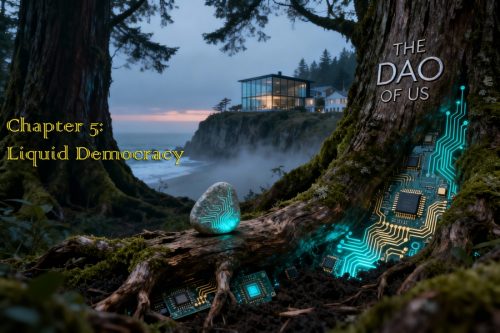
“The old way broke,” Sam began, his voice clear in the cathedral quiet of the woods. “Someone figured out how to lie to the machine. So we’re not just fixing the machine. We’re changing the rules of the game.” He held up his phone. “Right now, your token is like a stone you throw into a ‘yes’ or ‘no’ bucket. From now on, think of it as… a speaking stone. You can use your own voice. Or…” he pointed to Liam’s father, the ranger, “…you can hand your stone to him when the topic is the forest, because you trust him to speak for it wisely. And you can give a different stone to Hal,” he nodded to Perkins, “when the topic is the boats. The stones are still yours. You’re just choosing the best voice to carry them.”
An elder raised a hand. “So we’re voting for… voters? Isn’t that just what we had with the council?”
“No,” Sam said, seizing on the question. “Because you’re not electing someone for four years to decide everything. You’re matching a person to a problem, one issue at a time. And if they stop listening, you take your stone back, instantly. No recall petitions. No waiting.”
Jinx, leaning against a giant spruce, spoke up, her tone uncharacteristically patient. “It turns the DAO from a blunt-force voting machine into a… a nervous system. Signals flow along paths of trust. The fakes, the bots—they have no connections. They’re dead tissue. They get ignored.”
There was skepticism, fatigue. But there was also the palpable, living presence of the forest around them. The argument wasn’t abstract here. It was in the cool, damp air, the soft moss underfoot.
“How long?” Mrs. Chen asked.
“The timelock expires in 32 hours,” Jinx said. “The new protocol is coded. It needs to be adopted by a majority vote.”
“Another vote?” someone groaned. “We just had one of those!”
“This vote is different,” Sam said, his gaze sweeping the crowd. “This isn’t about the trees or the servers. This is about us. It’s a vote on whether we want to be a crowd of isolated voices, easy to trick, or a community that knows how to listen to its own wisdom. We vote to adopt ‘Liquid Democracy,’ and the fraudulent server farm vote is invalidated automatically by the new rules. We vote ‘no,’ and the money moves tomorrow. The machines start.”
It was the clearest choice they’d ever been given. The voting period was set for 12 hours.
Back in the library, the real work began. Jinx deployed the new smart contract layer. The interface on the app transformed. Now, next to each proposal, alongside “Vote Yes/No,” was a third button: “Delegate.” Tapping it brought up a dynamic, searchable list of every member. Next to each name was a tag cloud of their self-declared expertise: #Fishing, #History, #Engineering, #Ecology, #Childcare. You could see who they, in turn, delegated to, creating a visible web.
But the true heart of the system was the “Steward Verification.” To become a delegate, a “steward,” you had to be vouched for by five other members in good standing. Not an algorithm, but a social handshake. Jinx hated this part—it reeked of centralization—but she conceded it was the necessary immune response to the Sybil infection.
Sam watched as the first connections flickered to life. Old Man Finchley received delegate tokens from seventeen people on a proposal about repairing the sea wall. Mrs. Chen amassed a small treasury of tokens for library matters. It was slow, tentative. People were burned, and trust was a currency they spent sparingly.
Maya, sitting cross-legged in a corner with a tablet, was the first to notice the emergent pattern. “Sam,” she called softly. “Look at Jinx.”
On the “Protocol Upgrade: Liquid Democracy” proposal, Jinx’s steward profile was lighting up like a Christmas tree. Dozens, then hundreds of delegation tokens were flowing to her. Her expertise tag was simply #Code #Security #The_Machine. The town, bewildered by the technology, was instinctively entrusting their votes on the system itself to its architect. Jinx stared at her screen, watching the tally of voting power she now indirectly wielded climb into the hundreds. A look of profound discomfort crossed her face. She was becoming a central node. She was becoming what she despised.
“I don’t want this,” she muttered to Sam, her earlier fervor gone. “This is… influence. It’s power.”
“It’s trust,” Sam corrected gently. “They’re scared of the code. They trust you to guard it.”
“They shouldn’t,” she said, her voice tight. “No one should have this much weight.”
“Then delegate it away,” Sam said. “That’s the whole point.”
She looked at him, truly looked at him, and for a moment, the anarchist’s mask slipped, revealing a bewildered girl burdened by a gift she never asked for. She didn’t delegate the tokens away.
The 12-hour vote on the new system passed with 92% approval. As the final vote was recorded, a pre-programmed function in Jinx’s new contract triggered. It scanned the now-invalidated “Server Farm” vote, identified the Sybil cluster through its lack of social connections, and flagged the proposal as “Illegitimate – Social Consensus Invalid.” The execution transaction was canceled. The Old-Growth Net was saved, not by a majority, but by a new consensus on how to form a majority.
A soft ping echoed through the library. A new proposal, the first under Liquid Democracy, auto-generated: “Re-Vote: Preservation of the Old-Growth Net.”
This time, the debate was different. The anonymous fury was gone. Votes were still cast, but now you could see the flow of trust. Liam’s father, the ranger, became a powerful steward for the “Yes” vote, his delegate power comprised of tokens from people who knew him as a neighbor, a coach, a reliable man. The “No” vote had stewards too, arguing calmly for economic security, their power based on different relationships.
It was slower. It was more thoughtful. It was profoundly, humanly messy.
When the vote closed, the forest proposal passed with 67%. A clear, legitimate majority, woven together from threads of delegated trust.
That evening, Sam found Jinx on the library’s fire escape, staring at the darkening town. The server farm plot was just a shadow now.
“You did it,” Sam said.
“It’s ugly,” she replied, not turning. “It’s so… social. It’s politics. I built a perfect logic engine, and you made me connect it to a bunch of squishy, irrational, relationship-driven brains.”
“That’s where the wisdom is,” Sam said. “And the security. You can’t hack a lifetime of being someone’s neighbor.”
Jinx was silent for a long time. “I have 403 delegation tokens on system governance,” she finally whispered. “I am a central point of failure.”
Sam leaned on the railing beside her. “Then be a good steward. Or teach others to be. The system isn’t perfect. It’s alive now. It learns. It adapts. Just like us.”
Down below, they saw Maya and a group of kids walking, their phones glowing. They were comparing their delegate choices, laughing about who they’d entrusted with their “meme policy” vote. The tool was becoming part of the fabric.
The Sybil Attack had tried to poison them with isolation. In response, they had built a network of bridges. It was fragile, and new, and Jinx was right—it was terrifyingly powerful. But for the first time since the Whale’s offer, Sam felt they weren’t just using a tool. They were growing an ecosystem. And in an ecosystem, nothing, not even a flawless line of code, survived alone.
Table of contents:
Introduction
Chapter 1: The Whale’s Offer
Chapter 2: Genesis of the Arcadia DAO
Chapter 3: Proposal #001: Save the Old-Growth Net
Chapter 4: The Sybil Attack
Chapter 5: Liquid Democracy
Chapter 6: Rug Pull Threat
Chapter 7: Forking the Future
Chapter 8: The IRL Bridge
Chapter 9: Consensus in the Chaos
Chapter 10: From DAO to Home
NEXT >>> Chapter 6: Rug Pull Threat
PREVIOUS <<< Chapter 4: The Sybil Attack
