The Old Grid wasn’t just a older part of the internet. It was its sedimentary layer, compressed under the weight of decades, fossilized and forgotten. To access it, they had to use emulators that stripped away modern immersion, reducing the world to flickering low-poly models, flat textures, and the tinny, compressed audio of a bygone digital age.
Maya’s avatar, translated into this ancient space, was blocky and vague. Leo’s was little more than a smooth, grey capsule. They moved through a landscape of derelict geo-cities pages, their animated “Under Construction” signs eternally blinking. Forgotten forums stood like abandoned coliseums, their last arguments frozen in mid-sentence. The air here was thick with digital static that tasted of dust and cathode rays.
“This is digital archaeology,” Leo’s voice crackled over their primitive comm link. “Looking for one specific ghost in a city of echoes.”
Their coordinates were vague, pieced together from obscure forum posts and the preserved bookmarks of dead users: fans of Aria who’d gathered in the years before her passing. The trail was a series of emotional breadcrumbs. Maya would pause at a crumbling virtual guestbook, place her blocky hands on its code, and feel for the faintest impression of Aria’s presence—a signature of warmth, curiosity, and profound empathy that was uniquely hers.
“Here,” Maya said, her voice hushed. “She posted here. A tutorial on mixing light algorithms. There’s… excitement. The joy of sharing.”
They followed the trail deeper into the decay. The sleek, predatory silence of The Curator’s world was replaced by the gentle, mournful creaking of a forgotten neighborhood. Finally, the trail led them to a simple, unmarked door in the side of a monolithic data-archive. It was no more than a grey rectangle, a portal that didn’t belong to the surrounding architecture.
“This is it,” Leo said, running a diagnostic. “It’s a personal server instance. Self-contained. Off the main grid for decades. It’s… still running. On a trickle of power from some forgotten solar grant.”
Maya reached out. The door had no handle. She simply pushed, and the flat texture dissolved.
They stepped through into light and warmth.
The shift was jarring. The low-poly decay vanished, replaced by a space of stunning, serene clarity. It was a simulation of a sun-drenched artist’s studio. Light streamed through virtual windows, illuminating motes of digital dust. Canvases, both physical and holographic, leaned against white walls. The smell was of ozone, yes, but also of pine resin and warm circuitry—a scent profile of intense, loving curation.
In the center of the room, before a large, blank canvas that was actually a sophisticated light panel, stood a woman. She appeared to be in her late twenties, with kind eyes and hair that seemed to shift between analog curls and strands of clean data. She was dressed in practical, paint-stained clothes that occasionally glitched into the smooth lines of a digital bodysuit. This was Aria, or rather, the sophisticated AI imprint she had left behind—a snapshot of her consciousness at the time of her final work.
She turned, and her expression was not one of surprise, but of gentle, weary recognition.
“You’re earlier than I expected,” she said, her voice a melodic blend of human warmth and synthetic precision. “But then, he’s gotten more aggressive, hasn’t he? The Custodian.”
Maya and Leo stood frozen, awe-struck. This wasn’t a recording. It was interactive. A ghost with sentience.
“You… you know why we’re here?” Maya managed to ask.
“I felt the vibrations,” Aria said, gesturing to the studio around her. “When you began poking at the edges of his collection. When you felt the hollow cage. I knew someone with the right kind of sight would eventually follow the thread back to the source.” She looked directly at Maya. “You feel the residues. The emotional metadata. I designed my later works to maximize that, to leave a clear heart-print.”
Leo found his voice. “We came about ‘The Gilded Cage.’ We think The Curator is holding the real one.”
Aria’s face clouded with sadness. “Javier’s piece. Yes. A cry against constraint, bought by the ultimate constraint.” She walked to a window that looked out onto a breathtaking, impossible sunset. “But that is a symptom. My work… my final collection, ‘Threshold’… is the disease he thinks he’s curing.”
She turned, her eyes blazing with a passionate intensity that transcended her digital form. “He believes art is a finite object. A precious thing to be preserved in a perfect, unchanging state, like a insect in amber. He calls it ‘purity.’ I call it aesthetic murder.”
With a wave of her hand, she conjured a small, glowing sphere between them. It pulsed with a soft, inviting light. “This is ‘Ephemeral Heart.’ Not the token he owns. The concept. It is an environment. A space. Its core code is a simple directive: Listen. Reflect. Connect.”
Maya stepped closer, instinctively reaching out. She didn’t need her tools. The sphere radiated a powerful, yearning empathy.
“It was never meant to be looked at,” Aria explained. “It was meant to be stepped into. It reads the emotional state of the viewer—not invasively, but the way a friend senses your mood. It then adjusts its light, sound, and form to create a shared emotional landscape. A second viewer enters, and it finds the harmonic resonance between them, building a bridge. It grows more complex, more beautiful, with every person who experiences it. Its value is in the lived moment, the connection forged. Its blockchain isn’t just a ledger of ownership; it’s a ledger of experience.”
Leo’s eyes were wide with understanding. “And The Curator… he has the original token. Locked in his vault. Alone. Forever.”
“Precisely,” Aria said, the sadness returning. “He has trapped a symphony designed for an orchestra in a soundproof box. He is starving it. To him, the fact that it changes, that it requires others, is a flaw. He believes he is saving it from dilution. From the ‘noise of the crowd.’ He does not see that the crowd is the instrument.”
The monstrous perversion of it all settled over Maya. It was worse than she’d imagined. The Curator wasn’t just hoarding art; he was torturing it by denying its very purpose.
“We have to get it out,” Maya said, her voice thick.
“You cannot,” Aria replied softly. “His vault is a crypt. It is designed to prevent escape. Even if you could breach it, moving the token would only transfer a corpse.”
Despair began to creep in. But Leo was staring at the pulsing sphere of ‘Ephemeral Heart,’ his hacker mind whirring.
“You said its smart contract was a ledger of experience,” he said slowly. “The contract itself… it’s not just a deed. It’s the blueprint for how the art functions.”
A faint, hopeful smile touched Aria’s lips. “You begin to see. The token in his vault is the key. But it is not the house. The smart contract that governs ‘Ephemeral Heart’… it is open-source. He owns the key, but he does not own the architecture of connection. He never understood that was the real art.”
Maya’s breath caught. The idea was vast, dawning like the sunrise in Aria’s window. “We can’t steal the key from the crypt…”
“…but we can use the blueprint to build a new house,” Leo finished, excitement crackling in his voice. “A house with no locks. A house where the art can live as you intended.”
Aria nodded, her form seeming to grow more substantial, more alive. “Yes. You must do more than a heist. You must start a revolution. Use my contract as the foundation. Build a platform where the value is not scarcity, but accessibility. Not ownership, but stewardship. Not a price tag, but a pulse.”
She walked to them, placing a hand on Maya’s shoulder and looking at Leo. The touch felt real, warm. “He has the signature. You must create the conversation. Give my heart a place to beat. Give all the caged hearts a place to beat.”
The mission was transformed. The goal was no longer to steal a thing, but to resurrect an idea. The ghost had not asked for rescue. She had given them a manifesto.
As the studio began to gently fade, Aria’s final words hung in the air, a blessing and a charge. “Do not bring the art to the people. Build a world where the people are the art.”
The Old Grid swallowed them again, but they carried the warmth of the studio with them. They weren’t grave robbers anymore. They were midwives. And they had just been given the plans for a new world.
Table of contents:
Introduction
Chapter 1: The Gallery of Ghosts
Chapter 2: A Sentimental Steal
Chapter 3: The Memory in the Metadata
Chapter 4: The Curator’s Hunt
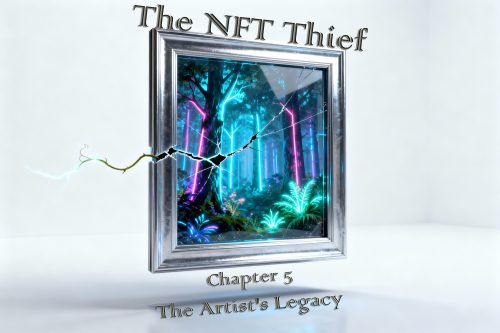
Chapter 5: The Artist’s Legacy
Chapter 6: DAWN – The Decentralized Art World Network
Chapter 7: The Forked Gallery
Chapter 8: Provenance is Everything
Chapter 9: The Living Exhibit
Chapter 10: A New Canvas
NEXT >>> Chapter 6: DAWN – The Decentralized Art World Network
PREVIOUS <<< Chapter 4: The Curator’s Hunt
