The revolution began not with a manifesto, but with a bug.
In the dim, perpetually twilight glow of Leo’s basement, the hum of servers was now the soundtrack to a fever dream. Maya had moved a sleeping bag and her primary workstation into the cluttered space. The air smelled of cold pizza, solder, and the sharp, clean scent of ozone from overworked processors. They were operating on stolen time, knowing The Curator’s systems were likely still tracing their digital shadows.
Aria’s gift—the complete, open-source smart contract for ‘Ephemeral Heart’—hovered in the center of their main holoscreen. It wasn’t just lines of code; to Maya, it looked like a luminous, breathing heart, its chambers pulsing with interconnected logic.
“It’s beautiful,” she whispered, not for the first time.
“It’s a weapon,” Leo corrected, his fingers flying across three different keyboards. “A benevolent one. He locked the art away because its value was in use. So we build a place where use is the value.”
The core of Aria’s contract was revolutionary in its simplicity. It contained a function that minted not just an asset, but a relationship. Every interaction with the artwork—a view, an emotional response (measured through anonymized biometric permissions), a remix, a comment that sparked conversation—was recorded as a unique, non-financial transaction. It wasn’t a ledger of who owned it, but of who had communed with it.
Their task was to scale this heartbeat into an entire circulatory system. They called the project DAWN: The Decentralized Art World Network.
Leo was the architect, obsessed with the backend. He needed to build a blockchain protocol that was fast, efficient, and environmentally low-impact, unlike the energy-guzzling chains of the old world. He called it the Sympathy Chain.
“Every node that supports the network gets a share of the cultural value,” he explained to Maya during a 3 AM coffee run, his eyes ringed with dark circles but blazing with focus. “But ‘value’ isn’t just crypto. It’s access, it’s voting rights on platform direction, it’s a reputation score for good stewardship. We’re making karma a currency.”
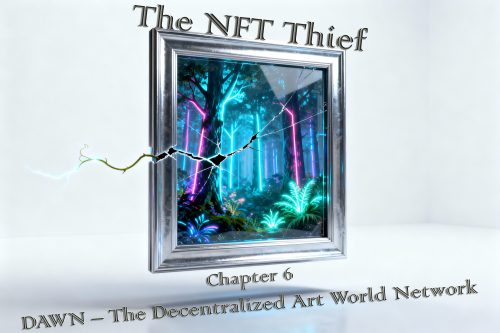
Maya was the experience, the soul. While Leo wrestled with cryptographic consensus, she was designing the world DAWN’s users would inhabit. She rejected the sterile white cubes of Veritas. Instead, she sketched environments that felt alive: a tranquil, endless forest where art hung like bioluminescent fruit from digital trees; a vast, calm ocean where pieces floated like gentle sea creatures; a cozy, infinite library where every book was a portal to an artist’s mind.
“It can’t feel like a marketplace,” she insisted, her own artistic philosophy hardening into design principles. “It has to feel like a home. A park. A place you stay in.”
Her spectral art found its purpose. She began crafting the first “public spaces” for DAWN—transient, beautiful events that would occur at random in the common areas: a shower of light-leaves falling through the forest, a constellation of forming and dissolving shapes in the ocean depths. Art that was free, ephemeral, and existed solely to delight.
They needed allies. Cautiously, Leo reached out to his network of gray-hat hackers and disillusioned crypto-kids. He didn’t offer payment; he offered a purpose. “Remember that artist who got screwed? We’re building a place where that can’t happen. We need coders who believe art isn’t a stock.” To Maya’s surprise, they came. A handful at first, then a dozen. They were given nicknames—Cipher, Patch, Forge—and worked from hidden locations across the globe.
Maya reached out to other artists she’d met in the fleeting AR scene—the ones who made art for subway walls seen through lenses, for the sound of a specific street corner, for the shared experience of a moment. The “ghosts,” like her. She showed them Aria’s contract and her DAWN designs. “A place for our art to live, not die,” she promised.
One by one, they joined. They began minting their own work on the nascent Sympathy Chain. The first pieces were simple, experimental. A collaborative poem where each new reader added a line. A soundscape that shifted based on the aggregated heartbeat data of its listeners (with explicit, revocable consent). A digital sculpture that slowly grew intricate crystal patterns every time someone spent more than five minutes in contemplation before it.
They built the key metrics of DAWN, displayed not prominently, but accessible to all:
- Collective View Time: Not a click, but sustained attention.
- Community Interaction: Derivative works, heartfelt commentary, shared experiences.
- Empathic Resonance: The anonymized, aggregate emotional response graph.
- Cultural Ripples: How often the work was referenced outside DAWN.
The smart contracts were rigged with Leo’s ingenious, transparent micro-royalty system. Every time a piece was engaged with, a tiny, automated payment in DAWN’s native token flowed to the artist and to all previous stewards (the current owner). Ownership wasn’t a finale; it was a chapter in the story, and every chapter earned you a share. It incentivized sharing, not hoarding.
The final, crucial piece was the Stewardship Log. This was Leo’s provenance hacking, turned inside out. Instead of exposing hidden lies, it proudly displayed a transparent, verifiable history of care. Who had owned this? What had they done to share it? Had they loaned it to a public DAWN gallery? Had they commissioned a derivative? The log judged not the wealth of the owner, but their contribution to the artwork’s life.
One week before their planned quiet beta launch, they hit a wall. The system could handle the art, the contracts, the metrics. But it lacked a core. A soul.
“It needs Aria’s piece,” Maya said, exhausted, staring at the beautiful, empty forest she’d built. “We’ve built the forest, but ‘Ephemeral Heart’ is the sunlight. It’s the proof of concept. Without it, it’s just another nice platform.”
“We don’t have it,” Leo said, frustration edging his voice. “We can’t get it. We have the blueprint, but not the key.”
Maya looked at the pulsing code-heart of Aria’s contract. “We have the heartbeat. What if… what if we build a cradle for it? An invitation. We launch DAWN with a blank space, a place of waiting. We tell the story of ‘Ephemeral Heart’ and what it’s supposed to be. We make the absence itself a testament to what The Curator has done.”
Leo considered it. A placeholder. A ghost in their machine, pointing to the real ghost in his. It was a powerful symbol. They would launch not with their trophy, but with their cause.
The night before the beta launch, the core team—Maya, Leo, and their six key allies—gathered in a private DAWN space, a quiet cliffside overlooking a digital sea under a false moon.
“We’re not flipping NFTs,” Leo said to the group, his avatar standing tall. “We’re flipping a paradigm. They measure value in Ethereum. We’ll measure it in seconds of wonder, in connections made, in artists who can eat.”
Maya spoke next, her voice quiet but carrying. “For so long, I thought making art that vanished made me a ghost. But I see now, art that can’t connect, that’s locked away forever… that’s the real ghost. We’re not just building a platform. We’re building a home for the things that make us feel alive.”
At dawn in their respective time zones, they flipped the switch.
DAWN went live. It was a whisper, not a shout. An invite-only beta. But the invites spread like a heartbeat. Artists told artists. Viewers who were tired of sterile galleries wandered in.
The first public piece to go viral on DAWN was a simple one called “Shared Breath,” by a reclusive artist named Kael. The same Kael of Neon Bloom. It was a quiet, interactive piece where two users anywhere in the world could sync their breathing to a calming visual wave, creating a moment of synchronized, peaceful connection. The Collective View Time metric soared. The Empathic Resonance graph showed a serene, steady pulse. The artist, for the first time, received real-time, meaningful data on how his art was affecting people, and a small, steady stream of income from the mere act of that sharing.
Maya and Leo watched from the cliffside, watching the first hundred, then thousand, then ten thousand connections light up their network map like neurons firing in a new brain. They saw the blank space reserved for “Ephemeral Heart” already filling with digital flowers and notes of hope left by visitors who had read its story.
The cradle was built. The home was ready.
Leo looked at Maya, the false dawn of the simulation glowing on her avatar’s face. “He’s going to see this. He’s going to come for it.”
Maya nodded, watching a shower of her own spectral light-leaves drift through the gathering crowd of users in the forest below. “Let him come. He has a vault. We have a world.”
The revolution was live. And it was breathing.
Table of contents:
Introduction
Chapter 1: The Gallery of Ghosts
Chapter 2: A Sentimental Steal
Chapter 3: The Memory in the Metadata
Chapter 4: The Curator’s Hunt
Chapter 5: The Artist’s Legacy
Chapter 6: DAWN – The Decentralized Art World Network
Chapter 7: The Forked Gallery
Chapter 8: Provenance is Everything
Chapter 9: The Living Exhibit
Chapter 10: A New Canvas
NEXT >>> Chapter 7: The Forked Gallery
PREVIOUS <<< Chapter 5: The Artist’s Legacy
