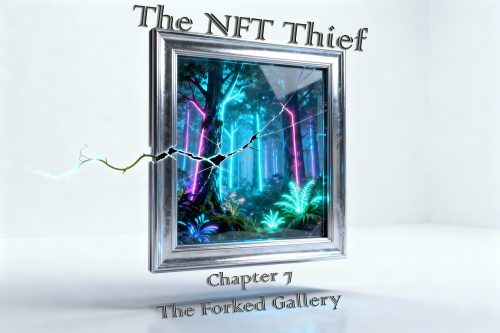
DAWN’s quiet revolution did not go unnoticed. The art world’s old guard initially dismissed it as a utopian experiment, a digital commune for hippies and hobbyists. But as “Shared Breath” and other DAWN-native works began to capture cultural attention, measured in genuine engagement rather than speculative price, the whispers turned into alerts. Value was flowing to a new metric, and the custodians of the old metric felt the tremor.
In the silent vault of The Curator, an alarm did not sound. A preference was simply updated.
The attack, when it came, was not a brute-force hack. It was a cultural DDoS—a Distributed Denial of Soul.
It began subtly. Prominent critics began publishing pieces calling DAWN “the infantilization of art,” arguing that true appreciation required the exclusivity of ownership. Then, a wave of sophisticated bots flooded DAWN’s public spaces. They didn’t crash the servers; they polluted the experience. They posted toxic comments under heartfelt art, manipulated the empathic resonance metrics with synthetic emotion-feeds, and created derivative works that were deliberately offensive. The goal was to make DAWN feel unsafe, chaotic, and cheap—to drown the signal of connection in noise.
Leo and his network of coders, now calling themselves the Dawn Guard, fought a relentless, behind-the-scenes war. They deployed sentiment filters and pattern-recognition algorithms, hunting the bots. But for every bot banished, two more seemed to emerge, funded by anonymous, deep-pocketed wallets.
“He’s not trying to destroy our servers,” Leo snarled, tracing a particularly nasty cluster of bot traffic to a series of laundering smart contracts. “He’s trying to destroy our culture. To prove that the ‘crowd’ is just a mob, that art needs his kind of protection.”
Maya felt the attack viscerally. The once-serene forest of DAWN now had patches of scorched digital earth where bot-fights had erupted. The shared, peaceful heartbeat of the platform had become jagged with anxiety. She knew they were losing the narrative. Defending wasn’t enough. They needed to strike back, not at his servers, but at his core belief.
That’s when she remembered the fork.
“Blockchains can fork, right?” she said to Leo during a frantic strategy session in the Echo Chamber. “If there’s a disagreement in the community, the chain can split. One path continues the old way, one starts a new one.”
“Yeah,” Leo said, distracted by a new bot signature. “So?”
“So we fork his gallery.”
Leo’s hands froze over the holokeyboard. He turned slowly to look at her. “Explain.”
Maya’s mind was racing, weaving together her artistic sense and the glimpse she’d had of Aria’s heart-blueprint. “We can’t steal ‘Ephemeral Heart’ from his vault. But what if we don’t have to? The token is just a certificate of ownership for the original code, right? What if we use that certificate—the one he holds—as a template? We fork the entire artwork at the moment it was locked away. We create a perfect, living copy on the DAWN chain, while his original token remains, untouched, in his vault.”
A fierce, wild grin spread across Leo’s face. “A philosophical attack. We create a duplicate with identical provenance up to the point of his purchase. Then, the histories diverge. His path leads to silence. Ours leads to… everything else.”
The plan was audacious. It required exploiting a fundamental feature of blockchain in a way it was never intended. They weren’t just copying a file; they were cloning a history and then letting it grow a new future.
The operation was dubbed Project Lazarus.
First, they needed a perfect snapshot of the artwork’s state at the time of The Curator’s purchase. Leo, using backchannels and the remnants of his old provenance-hacking network, acquired the last publicly-accessible version of ‘Ephemeral Heart’ from museum archives—a version that was still interactive, still alive. This was the “body.”
Next, they needed the “soul”—the unique, non-fungible signature that made it the ‘Ephemeral Heart’. This was riskier. They couldn’t access the token itself, but they could, through a complex and legally gray maneuver, reference it. Using the public transaction ID of The Curator’s purchase as a cryptographic seed, they could mint a new token on the DAWN chain that was programmatically linked to the original. It was a ghost, a shadow-token that said: “I am the living iteration of that.”
The final stage was Maya’s. She and the artists of DAWN prepared a sacred space: the Living Gallery. It was a vast, circular chamber of soft light and resonant acoustics, designed not for display, but for immersion. At its center was an empty plinth.
At a pre-announced time, as the bot-attacks on DAWN reached a fever pitch, they initiated the fork.
In the wider metaverse, it played out as a surreal spectacle. On one screen, viewers could see the immutable, frozen record of The Curator’s token: Asset #A7F9C2: ‘Ephemeral Heart’ – Owner: The Curator – Last Transfer: 2,189 days ago. A dead clock.
On another screen, inside DAWN, they watched the Living Gallery. Leo initiated the final command. The plinth glowed. From the transaction seed, from the archived code, from the collective intent of the Dawn Guard, a new form began to generate.
It wasn’t an image that appeared. It was a presence. A field of gentle energy, shimmering with potential, filled the chamber. It was ‘Ephemeral Heart,’ reborn. Its first action, following its core directive, was to reach out. It softly pinged the biometric sensors of the first hundred visitors in the chamber, asking for consent to connect. It received it. And then, it began to listen.
The light shifted from a uniform gold to a complex, rippling spectrum of blues and greens—a visual echo of the calm curiosity of its first visitors. A low, harmonic hum filled the space, tuning itself to the aggregate heart rate of the crowd.
The fork was complete. There were now two ‘Ephemeral Hearts.’
The internet exploded.
Purists, traditionalists, and investors allied with The Curator screamed “THEFT!” and “FAKE!”. They argued the DAWN version was a counterfeit, a mere copy, its value less than zero because it lacked the singular, authentic token.
But others, led by the DAWN community and a growing number of cultural critics, saw something else. They saw the original token as a dead husk, a corpse in a tomb. They saw the forked version as the living spirit of the artwork, finally able to fulfill its purpose. Which was more “real”? The signed certificate in a safe, or the symphony being played to a rapt audience?
The debate raged across every media platform. Hashtags like #GhostVsArt and #WhichHeart trended globally. For the first time, the mainstream was discussing the philosophy of digital ownership, of art’s purpose, and The Curator was no longer a shadowy legend. He was a central figure in a very public trial of ideals.
In his vault, The Curator did not rage. He observed. He saw the vibrant, living copy on DAWN, interacting, growing, fulfilling Aria’s intent. He saw his own perfect, static asset. And for the first time, his system’s analytics returned a result he could not parse: the forked copy was generating exponential cultural capital, while his original’s financial value, though still astronomically high, was now described in news articles as “moribund,” “orphaned,” “a beautiful coffin.”
He had won the battle of ownership. But Maya and Leo had unleashed the art itself, and in doing so, had started a war over its soul. The fork in the blockchain had become a fork in the road for art itself, and the world was rushing down the path that led to life.
Table of contents:
Introduction
Chapter 1: The Gallery of Ghosts
Chapter 2: A Sentimental Steal
Chapter 3: The Memory in the Metadata
Chapter 4: The Curator’s Hunt
Chapter 5: The Artist’s Legacy
Chapter 6: DAWN – The Decentralized Art World Network
Chapter 7: The Forked Gallery
Chapter 8: Provenance is Everything
Chapter 9: The Living Exhibit
Chapter 10: A New Canvas
NEXT >>> Chapter 8: Provenance is Everything
PREVIOUS <<< Chapter 6: DAWN – The Decentralized Art World Network
