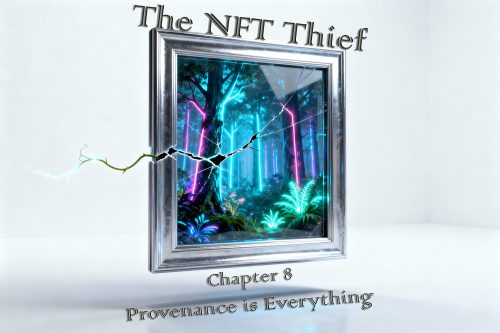
The forking of ‘Ephemeral Heart’ was the declaration of war. The public debate it sparked—#GhostVsArt, #WhichHeart—was the opening salvo. But Maya and Leo knew philosophical arguments alone wouldn’t topple a fortress built on wealth and secrecy. To win, they needed to dismantle its foundation, brick by digital brick. They needed to prove that The Curator’s entire edifice was not a museum, but a crime scene.
They launched the Transparency Audit.
It was not a hack. It was an exhumation.
Leo framed it to the growing Dawn Guard and the world as a public service initiative. “Blockchain promises transparency,” his manifesto stated. “Yet the most valuable assets are shrouded in mystery. We are a community of artists, technologists, and art lovers. We are using public tools to ask public questions about the hidden history of these so-called masterworks. Join us. Watch. Verify for yourselves.”
They started with The Curator’s known holdings, the list painstakingly compiled during their earlier hunt. Each piece was assigned a team: a coder to trace transactions, a researcher to dig into analog archives, and—where possible—an artist to provide technical and aesthetic insight. Maya was the roving consultant, the emotional radiologist.
The first major expose was “The Gilded Cage.” Leo’s earlier failed hack had laid the groundwork. Now, with the legitimacy of DAWN behind them and a global audience watching, they released the full dossier. They showed the contract where Javier Soo, dying and in debt, signed away all rights for a pittance. They displayed the clinical, algorithmic signature of the forgery currently on the public market, which Maya’s scan confirmed held no creative emotion. Then, they presented the evidence that The Curator had, through a shell company, purchased the true original from the exploitative middleman a week later. They didn’t need to breach his vault to prove he had it; the financial breadcrumbs and the sudden, total silence of the authentic piece were proof enough.
The headline wrote itself: HOARDER OF TRUTH, PROMOTER OF LIES.
The art world reeled. The value of the publicly-traded forgery cratered. More importantly, The Curator’s reputation as a discerning purist was punctured.
The audit gained momentum, becoming a cultural event. Livestreams of “Audit Hours” drew millions. Leo would walk viewers through transaction chains like a detective following a trail of blood money. Then, Maya would step in.
Their second major target was “Fragments of a Dream,” the interactive piece Elara had made that responded to collective mood. The Curator had frozen it. The DAWN team tracked down the original community that had grown around it before its imprisonment. They interviewed members who spoke, with palpable grief, of how the art had been a source of solace, a digital campfire. Maya, using a preserved fragment of the original code, demonstrated how its emotional resonance engine was meant to function—how it was designed to care. Then, she presented her scan of the frozen token.
“It feels like… a coma,” she told the global audience, her voice quiet in the stream. “The potential for connection is still there, but it’s trapped under layers of null-code. He didn’t just buy it. He induced a neurological blockade. This isn’t preservation. It’s a medically-induced coma for a social being.”
The language shifted. The Curator was no longer a “collector” or a “custodian” in the public discourse. He was a “hoarder.” A “digital taxidermist.” A “soul incarcerator.”
The audit turned to the Neo-Surrealist collection. They exposed how the clauses locking out derivative works were not part of the original artists’ contracts, but had been added by The Curator’s lawyers upon purchase—a deliberate act of cultural strangulation. They brought on the young, vibrant artists whose remix projects had been abruptly, legally suffocated. The story was no longer about static art, but about murdered potential.
Each revelation was a hammer blow to The Curator’s invisible plinth. The financial damage was immense—his collection’s market value, based on secrecy and perceived pristine provenance, was evaporating. But the true destruction was cultural. His greatest asset—his aura of impeccable, superior taste—was being publicly pickled and displayed as a specimen of grotesque ego.
Finally, they assembled the full picture of Aria’s ‘Threshold’ collection. They couldn’t scan the tokens, but they could scan everything around them. They presented Aria’s public writings, her passionate lectures on connection. They showed the vibrant, hopeful critical reception of ‘Threshold’ when it launched. Then, they showed the chilling, absolute silence that followed The Curator’s purchase. Not a single review, interview, or scholarly reference for seven years. It wasn’t just hidden; it was erased.
“This is not curation,” Maya concluded in the final audit stream, standing before a holographic wall showing the timelines of all the imprisoned works. “This is historical revisionism. He is trying to edit the past, to un-write the conversations, to un-feel the connections. He thinks provenance is a chain of ownership. He is wrong.”
Leo took over, the Sympathy Chain’s public ledger glowing behind him. “Provenance is a chain of custody. Not just of the asset, but of its meaning, its impact, its truth. Did you care for it? Did you share it? Did you contribute to its story, or did you try to end the story with yourself?” He pointed to the vibrant, complex logs on DAWN for pieces like the forked ‘Ephemeral Heart’ and ‘Shared Breath.’ “This is provenance. A living, breathing, verifiable record of an artwork’s life in the world. A record of community.”
The counter-attack from The Curator’s allies was swift and brutal—legally, financially, digitally. Cease-and-desist orders rained down. DAWN was hit with sophisticated cyber-attacks that aimed to corrupt the ledger itself. But the Transparency Audit had done its work. The public, and a critical mass of the artistic community, now saw The Curator not as a guardian, but as a villain. Donations in both crypto and volunteer hours flooded into DAWN to bolster their defenses. Lawyers from the Electronic Frontier Foundation offered pro-bono help. The attack only solidified DAWN’s position as the underdog fighting for art’s soul.
The final blow was self-inflicted. Under immense pressure, one of The Curator’s own shell-company executives, a man haunted by the audit’s revelations, turned whistleblower. He provided nothing illegal, just context—internal memos discussing “value through obscurity” and “maintaining aura via controlled scarcity.”
It was the confirmation the world needed. The Curator’s philosophy was laid bare: a cold, calculated strategy to manufacture prestige by creating artificial graves for living culture.
They never breached his vault. They never moved a single token. But by the end of the Transparency Audit, the vault no longer mattered. The art inside was culturally bankrupt. The certificates of ownership were now certificates of crime, of ethical failure. The market for “Curator-held assets” collapsed entirely, because the audit had proven that the greatest part of their value—their story—was a lie.
On the steps of the metaphorical courthouse of public opinion, Leo and Maya had won. Provenance had been redefined. It was no longer a sterile pedigree. It was the heartbeat of a work’s journey through the human heart. And by that new, vibrant, un-erasable measure, The Curator’s entire collection was not just worthless.
It was already dead.
Table of contents:
Introduction
Chapter 1: The Gallery of Ghosts
Chapter 2: A Sentimental Steal
Chapter 3: The Memory in the Metadata
Chapter 4: The Curator’s Hunt
Chapter 5: The Artist’s Legacy
Chapter 6: DAWN – The Decentralized Art World Network
Chapter 7: The Forked Gallery
Chapter 8: Provenance is Everything
Chapter 9: The Living Exhibit
Chapter 10: A New Canvas
NEXT >>> Chapter 9: The Living Exhibit
PREVIOUS <<< Chapter 7: The Forked Gallery
