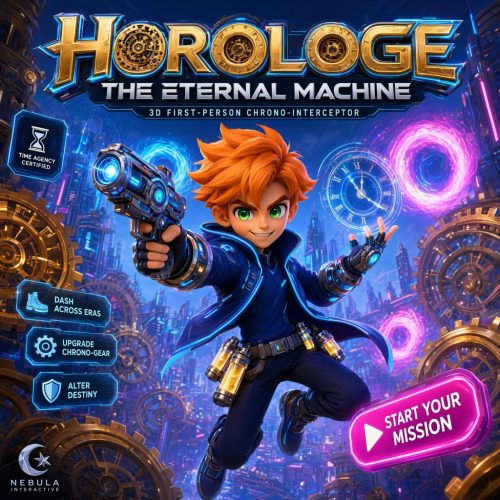
HOROLOGE
T H E E T E R N A L M A C H I N E
Somewhere outside of time, a machine the size of a planet is winding itself down — and its immune system has just noticed you. Fly a chrono-interceptor through a hundred chambers of living brass, and shoot the clock while the world stands still.
Five chassis. One machine. No way back out.
HOROLOGE: THE ETERNAL MACHINE is a first-person 3D shooter that seals you inside the cockpit of a chrono-interceptor and drops you into the works of a planet-sized clock. There is no third-person camera and no comfortable distance from the danger — only a brass heat rim around your viewport, a spinning tourbillon cage drifting in front of the glass, twin lance barrels riding the bottom of the frame, and a cathedral of interlocking gears turning in the dark on every side of you. Everything ticks. Everything gleams. Everything is hunting.
You fly the mechanism the way an arcade rail-shooter wants you to: fast, greedy and always one breath ahead of the escapement. Climb, descend and strafe through a bounded corridor of living brass while clockwork automata close in from the murk. Gunnery is entirely yours — the reticle and the shot are the same ray, so whatever sits under the crosshair is whatever you hit. It ships as a single self-contained HTML5 file: no download, no install, no plug-in. Open it and you are inside the machine in seconds, on desktop or phone.
Bank the seconds. Then spend them all at once.
Every game has a meter that punishes you. HOROLOGE gives you one that rewards you. Fighting well builds CHRONO CHARGE — precise lance hits, broken automata, harvested chroniton and threaded escapement gates all feed it. At fifty percent you can trigger a TIME FRACTURE: the entire machine drops to 36% speed for six seconds while your craft, your aim and your cannons stay at full speed, and every point you score inside the fracture is doubled.
This is real bullet-time, not a visual filter. Enemy bolts hang in the air where you can read them. Gears crawl past your canopy. The pendulums stop mid-swing. And on your HUD, the little brass clock that has been ticking faithfully all run starts running backwards — because for six seconds, it is.
Choose the face you descend behind.
Before every run you select a full-face chrono-visor — and this is not a cosmetic swap. Each of the five visors physically re-shapes the viewport frame around your screen, recolours the entire HUD, changes the reticle glow, adds its own hardware to the glass (coolant pipes, a pendulum crest, sundial spokes, a frozen-second etching, a live tourbillon cage), and carries a permanent combat perk that quietly rewrites how the run plays out.
Dense, gilded, and always one tooth from ruin.
Four classes of clockwork automaton hunt you in formation. Tick drones tumble in fast, fragile gear-swarms. Escapement turrets anchor on their pallet forks, hold distance and paint you with aimed chroniton bolts. Mainspring constructs plod forward under heavy plating and drop stasis bombs into your flight path. Paradox wraiths — six shards of impossible geometry trailing a violet aura — actually track your position and refuse to be shaken. Your chrono lance builds pressure as you fire, so trigger discipline matters; cog torpedoes lock to whatever sits nearest your reticle; and a single stasis pulse freezes every incoming bolt in the air while venting fourteen percent of your paradox. The overwind drive widens your field of view, hurls brass dust past the glass and buys you the half-second you needed to survive.
The mechanism is generous between the violence. Fly through glowing escapement gates — toothed gear rings that spin as you approach — for escalating chain bonuses, eleven percent chrono charge, an instant drive refill and a combo bump. Harvest chroniton, gear relics, phase shields, spare chassis, overwind cells, cog multipliers, torpedo pods, stasis charges, temporal tethers and the rare, glorious OVERCLOCK pickup that makes you invulnerable, doubles your damage, zeroes your paradox and dumps thirty percent straight into your charge bar. A live scanner plots every contact, every pickup, every gate and every bomb — and when your combo chain climbs past forty the whole machine drops into slow motion and your visor floods with green light.
Then, every tenth chamber, the floor starts screaming. TIMEKEEPERS announce themselves with a gong, a siren, a countdown and a colossal gilt clock face rising out of the dark — Roman numerals, a rotating gear bezel, two swinging pendulum arms and a jewel burning at the centre of the dial. They fight in three escalating phases — spread fire, then ring barrages and salvoes, then HAND SWEEPS, where the great minute and second hands spin up and fire along their own length. The central jewel takes 3.2× damage if you are precise enough to thread it. Stopping one pays 280,000 points multiplied by chamber and difficulty, and it feels like every one of those points.
Every hit you take tears the timeline.
Alongside the charge bar sits PARADOX — the cost of existing somewhere you should not. Every hull breach adds fourteen percent. Every stasis bomb that detonates beside you adds eight. It decays slowly on its own, and faster when you harvest chroniton, vent an overwind cell or fire a stasis pulse. Let it reach one hundred percent and the timeline collapses: you lose a chassis chance and the screen tears into violet scanlines before it resets.
Paradox is also a scoring strategy. Clear a chamber with the timeline stable and you are paid 360 points for every remaining percent — which turns restraint, shielding and pulse timing into real money. Greedy players fracture constantly and eat paradox; precise players bank stability bonuses and outscore them anyway.
Click here to start playing:

