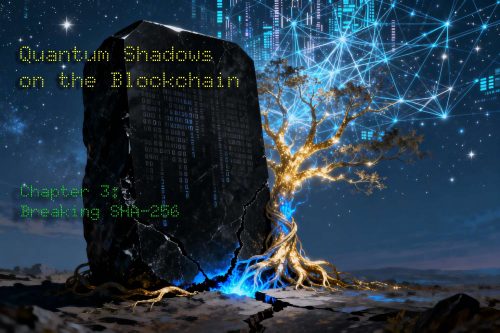
The world narrowed to the rhythmic slap of their boots on damp concrete, the gasp of their breath, and the sickly yellow glow of emergency lighting. The maintenance tunnels beneath Polytech Nexus were a forgotten circulatory system, smelling of stale water, ozone, and rust. Conduits throbbed with data and power, a constant, sub-audible hum that vibrated in Riven’s teeth.
She ran behind Kaelen, who moved with the frantic certainty of a rat that knew its warren. He’d jammed the core schematic drive into his pack, his precious quantum processor now just a burden on his back, dark and silent.
“Left here!” he hissed, skidding around a corner. “Then down the ladder at the marker!”
Riven followed, her mind a whirlwind of chaos. The serene, logical universe of the Archive—a place of hashes, verifications, and absolute certainties—was gone. In its place was this: darkness, flight, and the haunting, sorrowful voice of a digital ghost accusing history itself of a crime. Her hands trembled, not from exhaustion, but from cognitive dissonance.
They reached a small service alcove, a niche housing a buzzing transformer. Kaelen slumped against the wall, listening for pursuit. Riven stood stiffly, arms wrapped around herself.
“We need to… we need to contact the Archive Guard,” she said, her voice too loud in the confined space. “This is beyond us. This is a matter for protocol historians and cryptographic security.”
“And tell them what?” Kaelen shot back, wiping sweat from his brow. “That a ghost in my quantum computer told us the founding father of the digital age buried a secret? They’ll decommission Janus, seal the data, and Neo-Gen’s Sentinels will make sure we have ‘accidents’ before lunch. The Echo said it—the proof only exists in the quantum layer. It dies in a classical court.”
“So your solution is to become a digital grave robber?” Riven’s composure cracked, her words sharp with fear and fury. “To take a crowbar to the very first block of the most important structure humanity has ever built?”
“It’s not a crowbar, it’s a scalpel!” Kaelen pushed off the wall, his eyes blazing in the gloom. “We can fix it! We can edit the block, insert Vance’s exoneration and Thorne’s confession right into the historical record. We don’t erase the lie; we correct it. The chain would re-hash from that point forward. It would be a new truth, a better one.”
The clinical description made Riven feel physically ill. “A ‘new truth’? You’re talking about forging the foundation and hoping the whole building doesn’t notice! Every single hash that comes after Genesis is dependent on it. Change one byte, and the chain of trust becomes a chain of doubt. Every contract, every asset title, every birth record anchored to the Monolith would have its cryptographic provenance broken. It wouldn’t be an update, Kaelen. It would be a declaration that nothing—nothing—written in the past can be trusted. You’d shatter global trust to save one man’s reputation.”
“It’s not about his reputation!” Kaelen’s voice echoed down the tunnel. “It’s about his freedom. He’s a prisoner in a crystal coffin we all worship! And it’s not just him. The Echo showed us others, frozen errors. Don’t you care about truth?”
“I live for truth!” Riven shouted back. “But truth is a record, not a sentiment! It’s what happened, not what we wish had happened! The Monolith holds what was. If we start redacting it based on feeling, it becomes just another story, edited by whoever has the best key. Its power is its neutrality!”
“Its power is its tyranny!” Kaelen countered. “It’s a dictator that never dies and never learns. It froze an injustice. We have the chance to thaw it. That’s not destroying truth; that’s pursuing a higher one!”
A sharp, metallic clang echoed from a tunnel junction behind them. Distant, modulated voices. Sentinel proxies, using sonar and thermal scans.
The argument was cut off by the spike of adrenaline. “Move,” Kaelen whispered, all fury replaced by primal urgency.
They ran again, deeper into the labyrinth. After twenty minutes of silent, twisting descent, they emerged into a larger, older space—a disused server vault from the pre-Monolith era. Giant, dead racks stood like tombs. It was a good place to hide, for a moment.
Kaelen shrugged off his pack and gingerly extracted the Janus core. It was a sleek dodecahedron, now inert. “I need to see it,” he muttered, more to himself than to Riven. “I need to see the actual lock.”
“No,” Riven said, but it was a weak protest. They were past simple prohibitions.
Ignoring her, Kaelen powered up a portable interface from his pack. With careful, practiced movements, he connected leads to the core. It wasn’t a full activation, just a trickle of power to the quantum sensor array. He didn’t need to compute; he needed to listen.
The holoscreen flickered to life. He navigated past the standard layers, back to the raw, resonant data packet the Echo had left imprinted in the buffer. It was a map, a set of coordinates not in space, but in the cryptographic architecture of the Monolith. A pointer to the genesis block and the unique, quantum-signatured anomaly within it—the timelock.
With a few commands, he directed the Janus sensors to perform a non-invasive probe, a gentle tap on the vault door.
On the screen, the familiar SHA-256 hash of the genesis block appeared. Then, beneath it, Janus rendered a second, ghostly image. A shadow hash. It was almost identical, but where the official hash was a solid, unbroken string of characters, this one had a kind of shimmering porosity at its center, a nested puzzle of quantum probabilities.
“There,” Kaelen breathed, his anger forgotten, replaced by pure wonder. “See it? The timelock isn’t around the data. It’s woven into the hash itself. Thorne didn’t just encrypt a file; he made the proof of innocence a quantum-mechanical component of the block’s identity. Breaking it isn’t finding a keyhole… it’s performing surgery on a digital DNA strand.”
Riven approached, drawn despite herself. She saw the beauty of it, the monstrous, ingenious beauty. Thorne had engineered a perfect ethical paradox into mathematical reality. “It’s a door that can only be seen—let alone opened—by a technology that judges you ready by the very fact you possess it.”
Kaelen’s fingers flew. “And the surgery… it’s theoretically possible. Janus can maintain the coherence. We can map the quantum state of the lock, induce a controlled collapse to the ‘unlocked’ probability, extract the original, unaltered data packets—Thorne’s evidence, Vance’s full cognitive scan—and then…” He paused, swallowing. “…and then write a new genesis block. One that includes the correction. We fork the chain. We create a new reality where the first truth is a just one.”
He made it sound like a salvation. To Riven, it sounded like deicide. Killing the old god to install a new one.
“You’re talking about making yourself the author of history,” she said, her voice hollow. “You, a sixteen-year-old in a tunnel, get to decide what the founding truth of the world is. That’s not justice. That’s arrogance.”
“It’s using the tools I have to fix a mistake!” he insisted, turning to her. “Is your reverence for the system so complete that you’d willingly defend a lie carved into its heart?”
Before she could answer, a beam of intense white light lanced across the vault, pinning them both. From behind a server rack, three Sentinel proxies stepped into view. Their smooth helmets reflected the sickly yellow light, featureless except for the faint red glow of scanning lenses. One held a data-suppressor, its emitter dish humming. Another held a compact neural disruptor—non-lethal, but guaranteed to erase short-term memory.
“Terminate the quantum link and surrender the device,” a synthesized voice commanded, devoid of all inflection. “You are in violation of Neo-Gen Corporation security protocols.”
Kaelen instinctively clutched the Janus core to his chest. Riven stepped slightly in front of him, an absurd, protective gesture.
“You have no jurisdiction here,” Riven stated, her Archivist authority flooding back into her tone. “This is a public infrastructure zone. Your actions are unlawful.”
“Our jurisdiction is the preservation of stable records,” the lead Sentinel replied. The suppressor whined, charging. “The data anomaly you are probing is a classified historical correction. You will surrender it.”
Classified historical correction. The phrase confirmed everything. Neo-Gen didn’t just want to hide a crime; they had officially, bureaucratically, labeled the truth as an “anomaly” to be suppressed.
In that moment, Riven’s choice crystallized. She wasn’t choosing between Kaelen and the Monolith. She was choosing between a system that could send armed men to erase a truth, and the terrified, arrogant boy who wanted to fix it. The Monolith was supposed to be above this. But its perfection had been built on a foundation these men were willing to kill to keep buried.
As the Sentinel with the disruptor raised his weapon, Kaelen made his choice too. He wasn’t just protecting his invention. He was protecting the key to the vault.
With a grunt of effort, he slammed the Janus core back into his pack, yanked a small cylinder from his belt—a high-lumen emergency flare used for testing optics—and cracked it against the floor.
The vault was consumed by a blinding, magnesium-white light and a shower of sparks. The Sentinels’ sensors overloaded, their smooth helmets flashing with error signals.
“Go!” Kaelen yelled, grabbing Riven’s arm. They stumbled, half-blind, towards a rusted grating Kaelen had spotted earlier. He kicked it loose, revealing a narrower, dripping pipe. They scrambled in, just as the suppressor blast seared the air where they’d stood, fritzing the dead servers into bursts of acrid smoke.
They crawled, the flare’s dying light fading behind them, leaving them in near-total darkness. The sound of the Sentinels, calmly coordinating their pursuit, followed them.
“Sector Gamma-Seven,” Riven panted, the words a lifeline. “The old university sub-levels. That’s where he said Thorne would be.”
Kaelen, leading the way through the claustrophobic pipe, nodded. His face, glimpsed in the faint light of his palm-terminal, was set in grim determination. He had seen the lock. He knew he could break it. The violence of the Sentinels had only convinced him of the righteousness of the act.
Riven followed, her mind reeling. The unbreakable vault had been breached, not by code, but by a moral imperative that now had a face, a voice, and a corporate death squad on its trail. She ran to find the architect, not for answers, but because he was the only one who might possibly have a question big enough to contain the catastrophe that was coming. The question of what to do when you finally, after twenty years, hear the ghost in the machine begging to be set free.
Table of contents:
Introduction
Prologue: The Last Digital Monument
Chapter 1: The Unbreakable Vault
Chapter 2: The Ghost in the Quantum Machine
Chapter 3: Breaking SHA-256
Chapter 4: The Timelock Paradox <<<<<< NEXT
Chapter 5: A Fork in Time
Chapter 6: The Cost of Immutability
Chapter 7: Rewriting History, Forging a Future
Chapter 8: The New Consensus: Truth, Not Data
Epilogue: Post-Quantum Dawn
