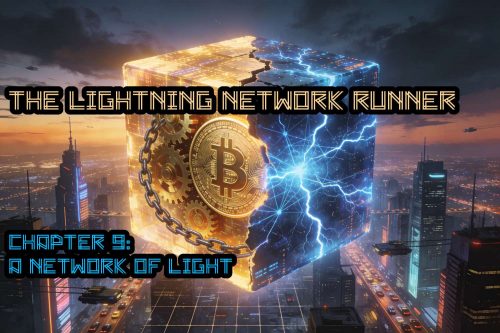
The silence after the mainnet spam attack was different. It wasn’t the tense quiet of anticipation, but the deep, steady hum of a system operating as intended. The gears of the blockchain turned, clearing legitimate transactions at a reasonable pace. The scars of the battle were there—fee levels remained higher than the old days, a permanent reminder of the city’s brush with suffocation—but the Conglomerate’ weaponized congestion had been surgically removed.
Their defeat was not announced with sirens or corporate statements. It was visible in the slow, irreversible change on the network map. The once-dominant red lattice of CSDC hubs didn’t vanish, but it faded, becoming a ghostly overlay on a new, vibrant reality. The traffic metrics told the story: their share of Lightning routing volume had plummeted to single digits. The city had voted with its satoshis, and it had chosen the mesh.
Sable, the Conglomerate envoy, stood in the same pristine control room, now lit by the cold glow of failure. The main screen displayed a financial autopsy. The cost of the spam attack had been astronomical. The loss of prestige, incalculable. The board’s directive scrolled across a secondary monitor: STRATEGIC PIVOT. FOCUS ON ENTERPRISE SETTLEMENT LAYERS. DISENGAGE FROM MICROPAYMENT INFRASTRUCTURE.
They were retreating. Not out of morality, but out of economic necessity. They could not compete with a network whose strength was derived not from capital, but from connection.
In the Aether Glades, life didn’t just return to normal; it bloomed into a new kind of normal. Ziya walked through the market, but she was no longer just a runner. She was a node, in every sense of the word. People didn’t just wave; they nodded with the shared understanding of stewards. A young tech stopped her, showing her his interface. “My channel with my aunt in the Hydroponic Spire is our family bank now,” he said, grinning. “We send money back and forth for free. It’s… it’s just ours.”
The Glades had become a living hub. Not a centralized one like the Crossing had been, but a distributed, organic one. The community council now managed a portion of the remaining war chest as a “liquidity commons,” a rotating fund to help new residents open channels or bolster existing ones for public good. Mrs. Risma, of all people, sat on the committee, her practical wisdom guiding technical decisions.
Ziya found her in her shop, which now had a small, handmade sign: Lightning Hub #001 – Channel Advice & Mycelium Art.
“Look at you,” Ziya said, a real smile easing the permanent lines of stress on her face.
“Someone has to help the newcomers navigate the streams,” Mrs. Risma said, her hands busy weaving conductive thread into a sculpture. “The spiderweb needs careful tending.”
The true epilogue of the war was written in the Crossing. Ziya and Rohan went there together, physically this time. The laundromat entrance felt like a relic from a simpler age. Inside, the great hall of servers was quieter. Many of the racks were dark, their nodes physically relocated.
The Ferryman stood at his central platform, but the towering holographic map was different. It no longer displayed the majestic, centralized golden orb of his hub. Instead, it showed the entire city as a single, luminous organism. Billions of points of light—blue, green, gold, silver—connected by countless shimmering threads. It was breathtaking in its complexity and beauty.
“You decentralized it,” Rohan said, his voice full of awe. “Completely.”
“I returned it,” the Ferryman corrected softly. “The map was always a representation of the connections between people. I had merely… collected a dense cluster of them. That density became a target. Now, the map is honest.” He gestured, and a section zoomed in—the Glades, glowing like a neural cluster, connected to a hundred other clusters. “The strength is in the truth of the connections, not in the concentration of the connector.”
He explained what he had done. His legendary routing algorithms were now open-source, available to any node. His liquidity had been fractured into thousands of tiny “anchor channels” with trusted community nodes across the city, creating a hidden scaffold of stability for the peer-to-peer mesh. He was no longer the Ferryman, the gatekeeper of the Crossing. He was the First Gardener of the network.
“What will you do now?” Ziya asked.
He looked at his map, a father looking at a child who had surpassed him. “I will watch it grow. And occasionally,” a faint smile touched his lips, “I will prune. The Conglomerate may be gone, but greed and bad code are eternal. There will be other storms. The network must learn to weather them itself.”
His gaze settled on them. “You two forced the first great storm. And you showed the network it could bend, and not break. That is a greater gift than any routing fee.”
Recognition came, but not in the ways they expected. For Rohan, it came from his father. Arjan Singh summoned him to the node chamber not for a task, but for tea—a ritual he hadn’t shared with his son since childhood. They sat on tool crates, the warm cups in their hands, the gears thudding peacefully beside them.
“The board of the Miner’s Guild has requested a meeting,” Arjan said, staring into his tea. “They wish to discuss ‘integrated layer security protocols.’ They are using phrases you coined.”
Rohan stayed silent.
“I defended the chain,” Arjan continued. “But you… you understood what the chain was for in a way I had forgotten. You saw the city it was meant to serve, not just the ledger it was meant to keep.” He took a sip. “The guild needs a liaison to the Lightning communities. Someone who speaks both languages. They asked for you.”
It was an immense offer. A bridge between the old world and the new, at an institutional level.
“Will you accept?” his father asked.
Rohan thought of the delicate, humming map in the Crossing. Of the crackle of a successful payment in a struggling shop. “Only if the role is to serve both layers,” he said. “To protect the bedrock, and to help what grows on it thrive.”
Arjan Singh nodded, a slow, deep acceptance in his eyes. “That is what it means to be a steward.”
For Ziya, recognition was a quiet tap on the shoulder in the Glades market. A woman she didn’t know, with the calloused hands of a fabricator, pressed a small, cold object into her palm. It was a token, laser-etched with a simple, elegant design: a single bolt of lightning, grounded by a single, strong block at its base.
“From the ‘New Bridges Collective’ in the Northern Spire,” the woman said. “We heard what you did. What you and the miner boy did. We’re replicating the model. We call it the ‘Glades Protocol.’”
Ziya looked at the token, emotion swelling in her throat. It wasn’t money. It wasn’t fame. It was something better: a pattern, replicating. An idea, spreading.
The city itself was the final testament. A new fluidity eased the old, congested grind. Ziya, on a final, leisurely run—not for a job, but just to feel it—saw the signs everywhere:
A street musician had a small display showing a Lightning address, filling with nano-tips from passersby every time she finished a song. Crackle. Crackle. Crackle.
A group of students pooled satoshis in a shared channel to rent a high-powered simulator for a school project, dividing the cost to the fraction of a cent.
A driverless delivery pod waited at a curb, its meter ticking down with microscopic payments for each second of loading, ensuring no one hogged the spot.
The mainnet was still there, like the deep, subterranean aquifers. It handled the large, slow, important settlements: property, major contracts, the final anchoring of vast numbers of Lightning channels. It was respected, but it was no longer the tyrannical bottleneck of daily life.
Ziya ended her run at the edge of the Glades, where Rohan was waiting. He had a portable terminal open, showing a simplified version of the living network map.
“Look,” he said, pointing. A new, thin, bright line was forming, reaching out from Neotropolis to a fledgling network identifier in a neighboring city-state. “New Athens L-Net.”
“They’re connecting to us,” Ziya breathed.
“They heard the story,” Rohan said. “The mesh is spreading.”
They stood side-by-side, watching the single line of light stabilize. It was no longer just about their city. The fight had proven a concept. Speed and security. Innovation and foundation. Trust and verification. They weren’t opposites; they were partners.
The war was over. The network was alive, resilient, and finally, truly, of the people. It was no longer a technology they used. It was a layer of their city, as essential as the streets, the power grid, the air. A network not of control, but of light—and every person held a spark.
Table of contents:
Introduction
Chapter 1: The Congested Chain
Chapter 2: The Underground Current
Chapter 3: Opening a Channel
Chapter 4: Balancing the Ledger
Chapter 5: The Hostile Takeover
Chapter 6: Force-Closing the Gates
Chapter 7: Trust in the Stream
Chapter 8: The Mainnet Sacrifice
Chapter 9: A Network of Light
Chapter 10: Instant, Final, Human <<<<<< NEXT
