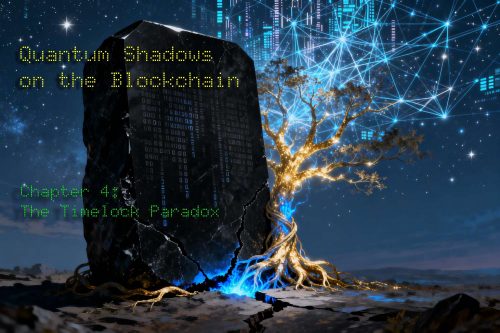
The pipe dumped them into a storm drain, which fed into an even older, drier utility tunnel lined with ceramic tiles gone brittle with age. The markings here were archaic, pre-Monolith. They were deep in the city’s forgotten bones.
Following Kaelen’s hacked map and the Echo’s cryptic clue—“the place where we first dreamed”—they navigated a maze of decommissioned passages. The air grew still and cool, the constant hum of the active city above fading to a distant whisper. The pursuit seemed to have fallen behind, lost in the labyrinth.
Finally, they found a reinforced blast door, its surface pitted with rust. A keypad, long dead, hung from a wire. But beside it was something anachronistic: a pristine, modern biometric scanner. Kaelen and Riven exchanged a glance. This was it.
Before they could decide how to proceed, the scanner lit up with a soft blue glow. A beam swept over them, analyzing, not attacking.
“Life signs recognized: one Archivist, one Quantum Signature associated with Project Janus. Threat assessment: ambiguous. Entry granted.”
With a deep, grinding sound of disused mechanisms, the blast door shuddered and slid open a meter. Beyond was not a lab, but a garden.
They stepped through, the door sealing behind them with a final thud. The contrast was disorienting. The space was a vast, retrofitted reservoir chamber. Light, real sunlight, filtered down from a series of ingenious mirrored shafts far above, illuminating a miniature ecosystem. Verdant ferns and moss-covered rocks surrounded a clear, recycled pond. The air was rich with the scent of damp earth and growing things, a shocking perfume after the sterile ozone and rust of the tunnels.
And in the center, seated on a stone bench beside the water, was a man tending to a bonsai tree with infinite patience. He was gaunt, his hair more white than grey, his face a landscape of deep lines. But the intensity in his eyes was unmistakable. This was Dr. Aris Thorne.
He did not look up as they entered. His attention was on a single, delicate branch. “The problem with immutable systems,” he said, his voice a dry rustle, like pages turning, “is that they cannot adapt. This tree, however, understands compromise. Every cut is a conversation between the ideal form and the living reality.”
Kaelen stared, his mouth slightly agape. The legendary architect, the genius of absolute truth, was hiding in a hole in the ground, talking to a plant.
Riven approached first, her Archivist training pushing her into a formal posture despite the surreal setting. “Dr. Thorne. I am Riven of the Central Archive. This is Kaelen, of Polytech Nexus. We… we’ve spoken to the Echo.”
Thorne’s hands stilled for a moment, then continued their precise pruning. “I know. I felt the resonance. A new note in a silence I’ve listened to for twenty years.” He finally set his shears down and looked at them. His eyes were ancient, weary, but sharp as diamond drills. They took in Kaelen’s pack, Riven’s greyweave tunic, the mud on their boots, the fear and fervor on their young faces. “So. You found the crowbar. And you’ve come to ask the mountain if it minds being moved.”
Kaelen found his voice, bursting with the need for answers. “You buried him! You buried your friend alive in code to protect your… your legacy!” The accusation echoed in the tranquil space.
Thorne didn’t flinch. “I buried the truth to save it. And I buried a ghost to bear witness. Two different tasks. One stone.” He gestured to a mossy rock. “Sit. The Sentinels won’t find this place. Its existence isn’t on any blockchain.”
They sat, the tranquility of the garden at war with the storm in their hearts.
“The Echo showed us,” Riven said, her voice more controlled. “The memory. Your choice. Why a timelock? Why not just keep the evidence secret?”
“Because a secret held by one man dies with him,” Thorne said, his gaze drifting to the shimmering water of the pond. “A secret woven into the foundation of the world has a chance to live. Neo-Gen owned the courts, the media, the ‘truth’ of that moment. My word against theirs was nothing. But the Monolith… the Monolith was everything. If I had challenged them openly, the protocol would have been stillborn, labeled a tool of criminals. So I made a compromise.”
He leaned forward, the weight of decades pressing down on his words. “I asked myself one question: does the world deserve the truth if the cost is shattering the vessel that holds all truth? My answer was… not yet. So I built a puzzle. A lock that could only be opened by a key that didn’t exist. A quantum key.”
“You hoped no one would ever build it,” Kaelen said, a bitter edge to his tone.
“I hoped someone would,” Thorne corrected, his eyes locking onto Kaelen’s. “But not someone who just wanted to prove they could. I hoped for someone who, upon finding the lock, would pause. Who would look at the crowbar in their hand, look at the mountain, and ask: ‘What is inside that is worth the avalanche?’ The timelock wasn’t a barrier. It was a test. A test of maturity. For the technology, and for the soul holding it.”
He turned to Riven. “You are the Keeper. You see the mountain and think: it is beautiful, it is permanent, it defines the horizon. To move it is sacrilege.” He turned to Kaelen. “You are the Keymaker. You see the mountain and think: it is in my way. What is on the other side? To not move it is cowardice.”
“Elias is not a ‘what’,” Kaelen shot back, heat rising in his cheeks. “He’s a who. And he’s been trapped in your test for twenty years!”
A profound pain flickered in Thorne’s eyes. “Every day of those twenty years, I have lived with that. He was my friend. I sacrificed him on the altar of a future truth. Do you think I am unaware of the cost?” He stood up, his movements stiff. “The timelock was my moral failure given mathematical form. I lacked the courage to choose the person over the principle. So I built a machine to make the choice for a future generation. You.”
The word hung in the humid air.
“You’re passing the buck,” Kaelen said, disgusted.
“I’m passing the responsibility,” Thorne replied. “The same responsibility I failed. You hold the crowbar. The mountain is before you. Inside is a jewel of justice, and the certainty of an avalanche. Do you break the vault, knowing it destroys the temple? Or do you leave the jewel in the dark, preserving the temple built on a lie?”
Riven felt the paradox wrap around her, cold and tight. This wasn’t a theoretical debate in an Archive seminar. This was the living, breathing, horrible calculus of it. Thorne had engineered a perfect trap for the conscience. “There has to be a third way,” she insisted, though it sounded like a plea. “The system shouldn’t force this choice!”
“The system is a mirror,” Thorne said softly. “It shows us the flaw in our own thinking. We wanted perfect, unassailable memory. We got it. And in doing so, we discovered that perfect memory can be a perfect prison. The error isn’t in the code, children. It’s in us.”
A soft, resonant chime echoed through the chamber, coming from a small, crystalline device on Thorne’s workbench. It was the same quantum resonance sensor Kaelen had in his pack.
“They’re closer than I thought,” Thorne murmured. “Neo-Gen has refined their sniffers. They’ll be at the outer door soon.”
He moved suddenly, with purpose. He went to the bench and picked up a small, sealed data-crystal—old, pre-Monolith tech. He pressed it into Riven’s hand. “The raw, classical logs. Useless in any court, but… context. For when you tell the story.” He then turned to Kaelen and placed a hand on the Janus pack. “You built the key. You understand the lock. The choice of how—or if—to turn it is yours. Not mine. I forfeited that right twenty years ago.”
“You’re coming with us,” Kaelen said, though it sounded uncertain.
Thorne smiled, a sad, gentle expression. “No. My part in this is to be the diversion the Echo could not fully be. A ghost can confuse sensors. A living architect, broadcasting from a hidden location… that is a signal they cannot ignore.” He gestured to a small, almost invisible hatch camouflaged among the ferns. “That leads to a transit line, long abandoned. It will take you to the surface near the old university grounds. Go.”
“They’ll take you,” Riven said, horror dawning.
“They’ll try,” Thorne agreed. “And while they are focused on the man who built the prison, the two people who might free the prisoner can escape.” He looked at them both, his aged face a mask of regret and hope. “Do not repeat my mistake. Do not worship either the mountain or the crowbar. Find the third way. For Elias. For all the ghosts we’ve locked in our machines.”
The main blast door shuddered. A deep, thrumming vibration—the sound of industrial cutters—began to sing through the metal.
“Go!” Thorne commanded, his voice firm for the first time.
Kaelen grabbed Riven’s arm, pulling her toward the hatch. She stumbled, looking back at Thorne, who had picked up his bonsai shears again, not as a tool, but as a weapon, facing the glowing, melting center of the door with the calm defiance of a gardener protecting his plot.
They scrambled into the dark hatch, pulling it shut behind them just as the blast door failed with a shriek of tearing metal and a flood of harsh, white light. The last thing they heard was Thorne’s voice, not shouting, but stating a simple fact into the glare:
“The lock is open. The test has begun.”
Then they were falling down a slick chute into darkness, the sanctuary and its keeper left behind, the paradox now theirs alone to solve, with the sounds of pursuit redirected, and the weight of the crowbar heavier than ever in their hands.
Table of contents:
Introduction
Prologue: The Last Digital Monument
Chapter 1: The Unbreakable Vault
Chapter 2: The Ghost in the Quantum Machine
Chapter 3: Breaking SHA-256
Chapter 4: The Timelock Paradox
Chapter 5: A Fork in Time <<<<<< NEXT
Chapter 6: The Cost of Immutability
Chapter 7: Rewriting History, Forging a Future
Chapter 8: The New Consensus: Truth, Not Data
Epilogue: Post-Quantum Dawn
