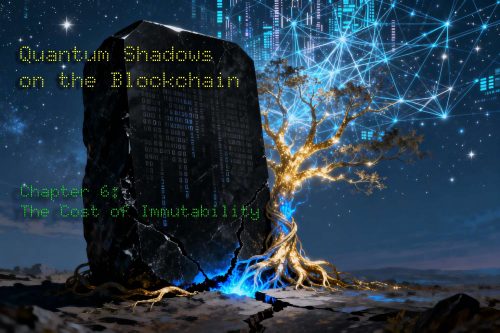
The ghost of the Echo’s final vision—the chain embraced by light, not broken by a fork—hung in the air of the dead server room, a fragile promise. But before they could build a valley, they had to fully comprehend the desolation of the landscape. They had to walk through the prison they had revered.
“Show me,” Riven said, her voice stripped of its Archivist’s certainty, leaving only raw need. “Not the metadata. The… the human context. Show me what the immutability cost.”
Kaelen, his earlier zeal tempered by the Echo’s fading plea, nodded silently. This was no longer about proving a point. It was an autopsy. He reconfigured the Janus link. Instead of broad resonance pulses, he began crafting precise quantum queries. He would use the machine not as a crowbar, but as a key to a spectral archive—one that could unlock the emotional and contextual data trapped in the quantum shadow of the immutable records.
The holoscreen resolved into a new interface. On the left, the official, immutable record of a block—clean, factual, absolute. On the right, a shimmering, quantum-accessible space, waiting to be filled with the story around the fact.
“Start with Block 482,” Riven whispered. “The forged land deed.”
Kaelen initiated the query. The left side displayed the deed: legal identifiers, coordinates, the unforgeable (yet forged) signature hash, the transfer timestamp. It was sterile. Inarguable.
On the right, the quantum space stirred. Janus reached through time, not to alter the data, but to retrieve what was entangled with it: the cognitive and emotional residuals from the verification moment, the subsequent appeals, the human wreckage. It was like listening to the echo of a scream in a stone.
They didn’t just read a court appeal. They felt it. A sensory impression bloomed in the space—the smell of loam and mint from the land in question, the tactile memory of soil under fingernails, the gut-churning panic of a family patriarch seeing the irrevocable transfer notice. They heard the choked, desperate testimony of a daughter before a magistrate: “The signature is a fake! The data-heist logs from the lender’s server prove it!” They felt the magistrate’s cold, sympathetic regret as a palpable force: “The evidence you cite is not on the Monolith. It is contested. The deed, however, is immutable. The law is clear. The land is theirs.”
The impression faded, leaving behind the cold, immutable fact of the deed. A family’s heritage, stolen and then sanctified by the very system meant to protect property. The cost: not just land, but trust, legacy, a future.
Riven wrapped her arms around herself. “It’s not data,” she said, her voice thick. “It’s a tomb.”
“Next,” Kaelen said, his own throat tight. “Block 1,104. The lab director.”
The left side showed the verdict: GUILTY. Negligent Bio-Release. Sentence: Perpetual Digital Confinement.
The right side dissolved into the claustrophobic, sanitized horror of a sealed lab. They felt the director’s shock at the accusation, her frantic, technical certainty of her protocols. Then, Janus resonated with a buried, encrypted data-packet—the suppressed environmental logs. They didn’t just see the data; they experienced the director’s moment of discovery: the spike of vindication and terror as she found proof of a rival’s sabotage, followed by the crushing realization that the packet was sealed under a corporate subsidiary’s proprietary chain. She could see her innocence, but she could not prove it on the immutable public record. The verdict was a fact. Her innocence was a ghost. The cost: a life, caged not by steel, but by a legal precedent that valued chain integrity over exculpatory truth.
On and on they went, diving into the quantum shadows.
They witnessed the delta collective’s elders singing the “Sunsong,” the patterns of light on water weaving into the melody, an oral history encoded in sound and feeling. Then they felt that cultural memory slam against the cold, anonymous tag of “public domain.” The collective’s legal petitions were not just text; they were waves of profound cultural grief, the disintegration of identity, all met with the implacable reply: “Original creator cannot be verified per Monolith timestamp authority. Artifact is now heritage of all.” The cost: a living song turned into a sterile resource.
They saw a young artist’s first, brilliant digital sculpture, uploaded with a flawed copyright tag—a simple typo. A corp scooped it up, claimed the “abandoned” asset. The artist’s corrections were rejected. The ‘flaw’ was immutable. The sculpture became the centerpiece of a global ad campaign. The artist’s despair was a taste of ashes.
Each block was a world. Each immutable fact was a star around which orbits of human pain, error, and injustice were forever locked, unable to break free.
Riven was shaking, tears cutting clean tracks through the dust on her cheeks. She had spent her life authenticating these blocks, ensuring their purity. She had never considered that purity could be a kind of poison. “We built a system to prevent lies,” she choked out. “And instead, we gave lies the permanence of stone. We didn’t stop wrongdoing; we just… gave it a permanent copyright.”
Kaelen sat slumped before the console, the fire to break the chain utterly gone. He saw now that his fork was a form of violence, too. “Editing them… even to heal… it’s just another kind of erasure. It says the pain never mattered. That it was just a… a bug to be patched.” He looked at his hands, the hands that built the key. “Thorne’s paradox wasn’t a puzzle. It was a reflection. Break the chain for justice, and you destroy the concept of historical truth. Preserve the chain for truth, and you become a custodian of endless, frozen wrongs. There’s no winning.”
The grand, philosophical ideals had crumbled, replaced by the intimate, suffocating weight of specific, human suffering. The Monolith wasn’t just Thorne’s failed compromise; it was a colossal, amplifying chamber for every human failure, every act of malice, every tragic mistake, echoing forever.
In the heavy silence, the faint, residual quantum signature of the Echo seemed to stir, not as a form, but as a whispered concept in the machine. The final image it had projected—the chain embraced by light—reappeared in their minds’ eyes.
Riven wiped her face, a new, grim clarity hardening within her. “A fork destroys. Preservation sanctifies the crime.” She looked at the haunting image on the screen, at the original, guilty block. “But what if the truth isn’t in the fact, but in the journey? What if the immutable record is just… Chapter One?”
Kaelen followed her gaze. “The overlay,” he murmured. “The valley. Not changing the block. But… building on it.” He sat up straighter, a programmer’s mind engaging with the tragedy. “Janus can create quantum-entangled annotations. Data that is fundamentally linked to the original block, but exists as a separate layer. The block stays. The hash never changes. But…”
“But anyone with the right key—a quantum key, a key of understanding—can see the full story,” Riven finished, her Archaeologist’s mind leaping to the implications. “The deed remains. But tethered to it is the family’s testimony, the smell of their mint, the magistrate’s regret. The verdict stands. But linked to it is the director’s proof, her despair, the corporate seal that locked it away. The song is public domain. But wrapped around it is the collective’s memory, their grief, their voice.”
“It doesn’t change history,” Kaelen said, wonder dawning. “It adds… context. It adds compassion. It adds the truth that the data alone killed.”
“It turns a monument into a… a learning site,” Riven said. “The original block is the artifact. The overlay is the museum placard, the guided tour, the apology carved beside the original stone.”
They looked at each other, not as adversaries, but as co-authors of a desperate, new grammar. The cost of immutability was absolute. It was the freezing of time. But the cost of correction didn’t have to be the shattering of history. It could be its elaboration.
The path was no longer a fork in the road. It was the road itself, widening to include the scars on the landscape, building shoulders and signposts that acknowledged every crash, every wrong turn, without denying the road had been traveled.
In the gloom of Server Room Gamma-7, surrounded by the silent witnesses of dead servers and the luminous ghosts of frozen pain, the Keeper and the Keymaker began to draft the blueprint for a valley. They would call it the Truth Layer. And its first entry would be the heaviest: a quantum-linked annotation of sorrow, explanation, and exoneration, tethered to the very first block of the world.
They had seen the cost. Now, they would begin the audit.
Table of contents:
Introduction
Prologue: The Last Digital Monument
Chapter 1: The Unbreakable Vault
Chapter 2: The Ghost in the Quantum Machine
Chapter 3: Breaking SHA-256
Chapter 4: The Timelock Paradox
Chapter 5: A Fork in Time
Chapter 6: The Cost of Immutability
Chapter 7: Rewriting History, Forging a Future <<<<<< NEXT
Chapter 8: The New Consensus: Truth, Not Data
Epilogue: Post-Quantum Dawn
