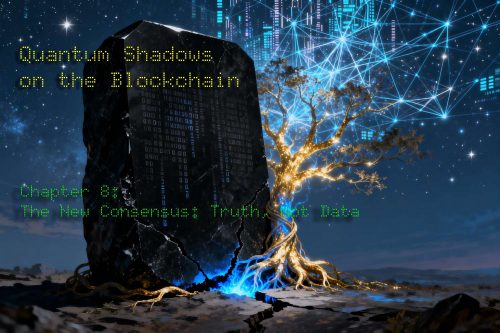
The silence following the Sentinels’ retreat was not empty. It was filled with a low, rising tide of sound—the resonant hum of the Janus core cooling, the frantic pinging of the console, and, from the world above, a gathering, indistinct roar. It wasn’t the roar of physical chaos, but of data in upheaval.
The Truth Layer protocol had escaped the tomb of Server Room Gamma-7. It was now a living thing, replicating across the global network, attaching itself to the Monolith’s public facing nodes like a symbiotic organism. Riven and Kaelen stood amidst the wreckage of their barricade, listening to the world wake up to a new dimension of its own history.
On the console, the flood of verification requests had morphed into something else: Context Contributions. The first, foundational annotation—the story of Elias Vance and the tainted genesis—was being witnessed, parsed, and… built upon.
A historian in the Pan-Asian Archive appended a quantum-tethered packet of corroborating news fragments from the Data Crash era, previously dismissed as conspiracy theory. A collective of legal scholars in the Euro-Synod linked a analysis of Neo-Gen’s corporate structure and its historical pattern of litigation to suppress whistleblowers. A digital artist, inspired, created a subtle, haunting light-sculpture of two entangled chains and submitted it as an aesthetic response, which the protocol accepted as a valid form of contextual witness—Proof of Context could be emotional, not just evidential.
“They’re not just accepting it,” Riven whispered, watching the data bloom in real-time. “They’re… joining it.”
Kaelen limped over, a burn graze on his arm from the capacitor discharge. He watched the screen, his face etched with exhaustion and awe. “The protocol is working. The consensus mechanism… it’s not validating computational power. It’s validating the weight of shared understanding.”
It was more than a technical success. It was a sociological event. The immutable Monolith, for twenty years a cold, judge-like authority, now had a companion that spoke in human voices. The public, so long passive consumers of certified truth, were becoming active curators of nuanced understanding.
The fallout was swift, but not the catastrophic crash Riven had feared. Markets dipped, then stabilized on the news that the original asset chain was untouched—property deeds, currency tokens, identities remained valid. What changed was the atmosphere around them. Neo-Gen Corp’s stock valuation didn’t just fall; it evaporated within hours, as the Truth Layer around the genesis block became the primary source for every financial and historical analysis. Their lies were not erased; they were permanently framed by the truth.
Authorities, forced into action by the irrefutable, crowd-verified context, announced the reopening of the Elias Vance case. Thorne, retrieved from Neo-Gen custody (where he’d been held for “questioning”), was not charged as a criminal, but summoned as the essential witness to the genesis of both the lie and the system that had hidden it. His public statement, terse and heavy with regret, was appended to the Truth Layer with millions of signatures of witness.
A week after the broadcast, Riven and Kaelen stood not in a dusty crypt, but in the main amphitheater of the Central Archive Spire. They were clean, dressed in simple, neutral clothes, but the ordeal was visible in the new gravity behind their eyes. Before them sat a live assembly of the world’s most prominent historians, ethicists, and protocol engineers, with billions more watching via stream.
Master Historian Elara, her face solemn, introduced them. “They did not bring down a mountain. Nor did they hide a jewel. They showed us the valley in between. I give you the architects of the Truth Layer.”
Riven stepped to the podium. The quiet, studious Archivist was gone. In her place was a curator of a new kind of history. The hologram behind her displayed the two chains: the solid, linear Monolith, and the shimmering, interconnected web of the Truth Layer.
“We thought truth was a point in time,” she began, her voice clear and carrying. “A fixed coordinate. ‘This happened.’ The Monolith gave us that, and we were grateful. But we confused data with truth. Data is a fossil—perfect, unchanging, and dead. Truth… truth is alive. It is the understanding of why the fossil is there, what the world was like around it, and what its discovery means for us now.”
She gestured to the web. “We did not change the fossil. We built a museum around it. The Truth Layer holds the testimony, the regret, the correction, the art, and the apology. It allows the past to be a teacher, not a tyrant. It allows us to say, ‘This is what was recorded, and this is the fuller story we now understand.’ It introduces humility into the absolute.”
Kaelen stepped forward next. The arrogant keymaker had been tempered. “We built a system that could break any lock,” he said. “And in doing so, we found that the most important thing wasn’t the breaking, but the responsibility that comes after. The new consensus on the Truth Layer—Proof of Context—isn’t about who has the most power. It’s about who contributes the most clarity. It’s a collaborative search for meaning, anchored to an unchangeable past.”
A protocol engineer from the old guard stood, his expression skeptical. “You’ve created a permanent layer of… subjectivity. Opinion. How is this not just a return to the pre-Monolith chaos of competing narratives?”
Riven answered. “Because every annotation is cryptographically tethered to the immutable data point it references. You cannot have the context without the source. And the consensus protocol filters out noise. It requires verification, corroboration, and ethical rigor. It’s not opinion; it’s auditable understanding. The narrative is no longer competing; it’s completing.”
A young historian from a reclaimed delta collective spoke, her voice thick with emotion. “You have given us our song back. Not by taking it from the commons, but by giving it its story. You have given us our voice.”
That was the moment the new consensus truly solidified. It wasn’t in the code, but in the tear-streaked face of a woman whose culture had been frozen in a mistake, and was now thawing in the light of shared context.
In the days that followed, the principles codified in the Truth Layer began to ripple outwards. Courts began accepting quantum-tethered contextual evidence in appeals, not to overturn immutable verdicts, but to guide reparations and pardons. Educational platforms shifted from teaching history as a series of certified facts to teaching it as an exploration of anchored narratives. The very language changed; people spoke of “understanding the context of a block” rather than just “verifying its data.”
The system was no longer a vault. It was a living record.
As the global conversation surged around them, Riven and Kaelen found themselves on a quiet balcony of the Spire, looking out at the city gleaming under the dusk sky. The holographic news tickers flowing up the sides of buildings no longer just reported facts. They glowed with soft, intermittent pulses of light, indicating: Context Available.
“It’s messy,” Kaelen said, finally breaking their comfortable silence. “It’s not the clean, perfect logic I thought I wanted.”
“It’s alive,” Riven replied. “And alive things are always messy.” She looked at him. “What will you do now? You have the only functional quantum core on the planet.”
He shrugged, a genuine, thoughtful gesture. “Work on making more. Smaller, cheaper, more efficient. Not as keys to break things, but as… looms. To help people weave their context. And to build the next layer of defense. If this is the new truth, we have to protect it.”
She nodded. “I’m staying at the Archive. But not as an authenticator. As a curator. As a guide for the Truth Layer.” She smiled, a real, unburdened smile. “Someone has to help people learn how to read the whole story.”
They stood side by side, the Keeper and the Keymaker, their roles transformed. Below them, the city pulsed with light—the solid, unwavering white of the old Monolith, and the dancing, multifaceted colors of the new Truth Layer, weaving together into a single, more profound picture of the world.
The chain was immutable. But they were not. And in that difference, they had found not just a solution, but a future.
Table of contents:
Introduction
Prologue: The Last Digital Monument
Chapter 1: The Unbreakable Vault
Chapter 2: The Ghost in the Quantum Machine
Chapter 3: Breaking SHA-256
Chapter 4: The Timelock Paradox
Chapter 5: A Fork in Time
Chapter 6: The Cost of Immutability
Chapter 7: Rewriting History, Forging a Future
Chapter 8: The New Consensus: Truth, Not Data
Epilogue: Post-Quantum Dawn <<<<<< NEXT
