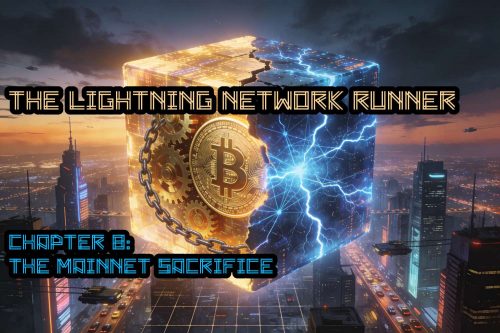
The silence after the storm of connections was not peace; it was the taut, breathless quiet of a trap being set. For a week, the new mesh network thrived. The crackle of peer-to-peer payments became the city’s new background music, a symphony of liberated value. The Conglomerate’s red hubs still pulsed on the map, but they were now islands in a shimmering blue and gold sea, seeing only the traffic that chose to pay their tolls out of laziness. Their economic stranglehold was broken.
Ziya allowed herself a sliver of hope. She walked through the Aether Glades market, now buzzing with trade that connected to every corner of Neotropolis. She saw Risma teaching others how to manage their node channels, her face alight with purpose. The victory felt earned, sustainable.
Rohan felt no such ease. The engineer in him knew that a system pushed to equilibrium would face a counter-force. The Conglomerate had lost a battle of economics and ideology. Their next move would not be subtle. He monitored the mainnet with a vigilance that bordered on the fanatical, his scripts parsing the mempool for anything anomalous.
The attack began not with a bang, but with a sigh—a long, digital exhalation of meaningless data.
It started at 04:00 Universal Network Time. Rohan’s primary monitor, which tracked the health of the main chain, flickered. A graph representing the mempool—the holding area for unconfirmed transactions—began to climb. Not a spike, but a steady, relentless ascent.
“What in the…” he muttered, leaning forward. The transactions flooding in were identical in structure: tiny, 1-satoshi payments from a cyclotron of newly-generated addresses to another set of addresses. They had no purpose but to exist. They were the digital equivalent of dumping truckloads of gravel onto every lane of a highway.
Spam.
But this was spam of a monstrous, unprecedented scale. Within minutes, the mempool swelled from its usual few thousand transactions to hundreds of thousands. The fee market, a delicate auction for block space, went insane. The “high priority” fee rate quintupled, then decupled.
Ziya felt it first as a systemic ache. She was coordinating a large rebalancing of the Glades’ core channels, which required a mainnet transaction to anchor a new batch of peer-to-peer links. The fee estimate on her terminal, usually a modest number, was a blinking, red-eyed monster. It demanded more for the single transaction than she had made in her entire first month as a runner.
“Rohan,” she commed, her voice tense. “Fee spike. Is it local?”
“Negative,” his reply was grim. “Global. The mainnet is under a spam attack. Transaction count is approaching theoretical limits. Blocks are full of… dust.”
Dust. Worthless, clogging dust.
The implications slammed into them both simultaneously. The Lightning Network was not an isolated system. Its security, its very existence, was anchored to the main chain. Channels needed to be opened and closed on it. If the mainnet became unusably expensive, the Lightning Network would slowly, inexorably, suffocate.
No new channels could be opened to expand the mesh. Worse, if a channel needed to be closed in an emergency—because of a dispute, a hardware failure, or a simple desire to access funds—the cost to settle would be catastrophic. The entire elegant, trust-based structure of their mesh would become a prison, locking value away behind a paywall of impossible fees.
The Conglomerate wasn’t attacking the Lightning. They were attacking the ground beneath its feet.
“They’re trying to create a settlement crisis,” Rohan said, awe and horror in his voice. “They’ll let the Lightning network live, but make it impossible to enter or exit. It becomes a beautiful, closed garden that withers because it can’t exchange with the earth.”
“Can your node clear it?” Ziya asked, already knowing the answer.
“One node can’t. The spam is coming from thousands of sources, likely a botnet of hijacked devices. It’s a proof-of-work chain, Ziya. We need work. A lot of it. More than they’re throwing at us.”
He pulled up the global mining power distribution. The Singh node was powerful, but it was a single fortress in a vast landscape. The spam was being mined by other actors—opportunistic miners drawn by the skyrocketing fees, who were happily processing the junk for profit, further entrenching the congestion.
His father, Arjan, entered the chamber, his face ashen as he read the diagnostics. “They are burning capital to attack the integrity of the chain itself,” he said, his voice thick with disbelief. “This is… sacrilege.”
“It’s a tactical demolition,” Rohan corrected, his mind racing. “They don’t care about the chain. They just want to collapse the tunnels that connect to our city.” He looked at his father. “We have to join a mining pool. Immediately. Coordinate with others to filter this out.”
Arjan Singh’s face hardened. “Join a pool? We are an independent node. Our work is our own. Our integrity is solitary.”
“Our integrity is about to be responsible for strangling the city!” Rohan shot back, the frustration of months boiling over. “That chain out there isn’t a monument, Father! It’s infrastructure! And right now, it’s failing! We have a responsibility to fix it, even if it means working with others, even if it means… helping her network.”
The word ‘her’ hung in the hot air. Arjan knew who he meant. He looked from his son’s desperate face to the gears, their majestic turn now processing a tide of garbage. The paradox was exquisite and painful: to defend the sacred main chain, he had to collaborate to save the very off-chain system he disdained.
“What would you have me do?” Arjan asked, defeat and dawning resolve in his eyes.
“We use our hash power not to mine the highest fee transactions,” Rohan explained, pulling up a communication panel. “We join the ‘Clean Chain’ pool. They’re a collective of miners who filter identifiable spam. We mine only legitimate transactions. We take a short-term profit hit. We defend the base layer.”
It was a declaration of war—not against the Conglomerate directly, but against the economic self-interest that was the miner’s creed. They would mine for the health of the network, not for profit.
As Rohan sent the signals to align his node with the collective, Ziya faced her own, more visceral battle. The mesh was starting to panic. Nodes that had been happily routing payments were now trying to close small, obsolete channels to free up capital, only to be met with fee estimates that exceeded the channel’s total value. It was digital quicksand.
She had to stabilize the human network. She broadcast a message across every community channel, her voice forceful and calm. “Do not force-close channels! I repeat, do NOT settle to mainnet. This is a targeted attack. Keep routing. Keep the flow going inside the mesh. The mainnet is wounded, but we are not. Our network runs on trust, not on-chain fees. Trust the streams.”
She was asking for an immense leap of faith. To leave funds locked in channels while the exit doors were being welded shut. She needed them to believe in the system more than they feared the trap.
Then, the Ferryman commed, his signal weak, as if routed through a dozen desperate hops. “Ziya. The Crossing’s primary settlement channel… it is under dispute. A counterparty is attempting a malicious close. With these fees, if they succeed, I cannot afford the justice transaction. I will lose everything.”
The ultimate threat. The Conglomerate was using the cover of the spam attack to launch pinpoint legal assaults. They were exploiting the chaos to steal.
“Rohan!” Ziya yelled into her comms. “The Ferryman’s under attack in the legal layer! He needs his justice transaction mined, now, or he’s gone!”
Rohan stared at his interface. The Clean Pool was making a dent, but slowly. The spam was a tsunami. The Ferryman’s critical justice transaction was a tiny, vital lifeboat in a storm of garbage. To get it confirmed, it would need to outbid the spam. It would need a fee larger than the Ferryman could possibly afford.
He looked at his family’s capital reserves. At his own savings. He thought of the Ferryman, who had dissolved his hub to give them all a chance.
Without a word, Rohan detached a portion of his personal funds and created a new transaction. He didn’t send it to the network. He sent it to Ziya. “This is for the Ferryman’s fee. Route it to him, instantly. Tell him to attach it to his justice transaction and broadcast with maximum priority.”
Ziya received the funds via Lightning in a crackle. She didn’t thank him. She relayed the command.
The Ferryman’s life-or-death transaction, now supercharged by Rohan’s sacrifice, entered the mempool. It was a minnow among whales of spam, but it had a golden hook—a fee so high it shone like a beacon.
“It’s in the pool,” Rohan reported. “Now we have to make sure it gets into a block. Our block.”
He manually overrode his node’s alignment with the Clean Pool for a single, crucial mining round. He pointed the full, formidable hash power of the Singh Mining Node at one task: mining the next block, and including that one, vital transaction.
In the chamber, the great gears seemed to spin with a new, desperate urgency. The hum rose in pitch. Arjan Singh watched his son, no longer just an operator, but a general directing a defense of the realm. He saw the cost, the sacrifice, the blurred line between defending legacy and enabling the future.
The mining round completed. A new block was forged.
Block #849,307.
Rohan’s screen refreshed. He scanned the list of transactions.
There, nestled among a few legitimate transfers, was the Ferryman’s justice transaction. Confirmed.
In the Crossing, the Ferryman let out a breath he seemed to have held for a century. His core capital was safe. The attack had been parried.
But the war for the mainnet raged on. The spam continued. The fees remained stratospheric. The Clean Pool was gaining ground, block by hard-fought block, but it was a grueling war of attrition.
Ziya joined Rohan on the hologram in his chamber, her image flickering with network stress. They watched the graphs together, two commanders surveying a burning plain.
“We’re holding,” he said, his voice hoarse. “Barely.”
“The mesh is holding too,” she said. “People are trusting the streams. But Rohan… we can’t live like this forever. Cut off from the bedrock.”
He knew she was right. The Lightning Network was a magnificent canopy, but its roots needed to drink from the deep, secure soil of the main chain. The Conglomerate had found the symbiotic point and was injecting poison.
“We need a bigger counter-weight,” Rohan said, his mind clicking through possibilities. “We need to make mining spam unprofitable for everyone else.” An idea, radical and dangerous, formed. “The spam transactions are paying high fees, but they’re tiny. What if we broadcast a set of legitimate transactions with even higher fees per byte? We’d outbid the spam, but we’d also… we’d also burn our own capital to clear the pipes.”
It was a financial suicide pact to save the patient. They would use the last of the Glades’ war chest, and his family’s reserves, to create a fee market so high that even the opportunistic miners would abandon the spam for their lucrative, legitimate transactions. They would, in effect, pay a colossal ransom to the very miners who were part of the problem, to bribe them into doing their job.
It was the ultimate sacrifice: using the system’s greed to temporarily heal it.
Ziya looked at the community wallet—the 5.0 BTC they had won, the symbol of their victory. To spend it now, to burn it on fees, felt like surrendering. But to hoard it while the network died was a slower surrender.
She contacted the Glades council. She explained the brutal calculus. There was no debate. The vote was unanimous. Use it.
Rohan secured his family’s agreement, a solemn, heavy nod from his father.
In a coordinated strike, they broadcast a volley of high-value, high-fee transactions from multiple sources, designed to be irresistibly delicious to miners. The effect was instantaneous. The fee market, already insane, went supernova. Miners around the world pivoted, scrambling to include these new, juicy transactions. Blocks began to clear. The mempool started to shrink, the spam pushed down the priority list.
It was working. But the cost was a river of satoshis flowing into the hands of anonymous miners, a literal fortune burned to buy back the functionality of the chain.
After six hours, the spam attack ceased as abruptly as it began. The Conglomerate had spent a fortune to launch it; they wouldn’t spend more to compete with this counter-bribe. The mainnet began to breathe again. Fees descended from the stratosphere, settling at a high, but manageable, level.
The cost was staggering. The Glades’ war chest was halved. The Singh family’s reserves were significantly depleted.
In the sudden quiet, Ziya and Rohan stared at their respective screens, exhausted. The mainnet was scarred but functioning. The Lightning mesh, having held its breath, began to tentatively settle a few critical channels, the fees painful but not impossible.
They had won by sacrificing the treasure they had fought to win. They had defended the foundation by proving they valued the city built upon it more than the gold in its vaults.
Rohan looked at the gears, still turning, still secure. They had defended the bedrock, and in doing so, had saved the canopy that his rival—his partner—had built upon it. The interdependence was no longer theory. It was blood and satoshis, paid in full.
The Conglomerate’s final gambit had failed. But as the adrenaline faded, a cold realization settled in: an enemy willing to burn the world to stop you from building a better one is an enemy with nothing left to lose. The battle for the layers was over. The war for the soul of the city was just beginning.
Table of contents:
Introduction
Chapter 1: The Congested Chain
Chapter 2: The Underground Current
Chapter 3: Opening a Channel
Chapter 4: Balancing the Ledger
Chapter 5: The Hostile Takeover
Chapter 6: Force-Closing the Gates
Chapter 7: Trust in the Stream
Chapter 8: The Mainnet Sacrifice
Chapter 9: A Network of Light <<<<<< NEXT
Chapter 10: Instant, Final, Human
