The rhythm was established, a steady pulse beneath the skin of the city. The daily sync between Ziya and Rohan was no longer a war council or a tense negotiation. It had become a ritual, as natural as breathing.
They met in a new space—a small, sun-drenched atrium garden atop one of the lower arcologies in the Glades, a neutral ground they’d claimed as their own. Mrs. Risma had placed a small, mycelium-grown table and two chairs there. It was their unofficial embassy.
Ziya arrived, a sheen of sweat on her forehead from a morning sprint. Rohan was already there, a holographic display hovering above the table, showing the serene, steady status of their shared channel. It was the original one, the 1.0 BTC conduit that had saved the Glades and survived a war. Its balance shifted daily, but it remained open, a permanent bridge.
“Morning,” Ziya said, dropping into a chair and taking a long drink from her water canister. “Liquidity flow is optimal. The new community grid is selling surplus solar to three other sectors via the mesh. The path hops through twelve nodes, but the fee is practically zero.”
Rohan nodded, zooming in on a subsection of the network map. “I see it. The route passes through a new node in the Hydroponic Spires that has… questionable security practices. Their channel reserve is set too low. It’s a tiny risk, but a risk.”
A month ago, Ziya would have dismissed it as irrelevant noise. Now, she leaned in. “Show me.”
He did. He explained the technicality—how an improperly configured “reserve” could, under extremely specific conditions, allow a node to theoretically cheat, though it would be instantly detectable. It was a hypothetical within a hypothetical, the kind of edge-case that had once been his sole obsession.
“Who runs that node?” Ziya asked.
“An agricultural collective. Probably just using default settings.”
“I’ll be near there this afternoon. I’ll drop in, show them how to adjust it. Frame it as a ‘network health tip.’”
A small, genuine smile touched Rohan’s lips. She was thinking about security. Not as a wall, but as a shared immune system for the network.
This was their new dance. She taught him fluidity; he taught her structure.
Later that day, Ziya took Rohan on a “runner’s tour.” Not through back alleys, but through the living economy. They stood in a bustling micro-market where vendors displayed prices in satoshis per gram, per piece, per minute. A customer bought a single synth-berry. Crackle. Another paid for five minutes of high-bandwidth Holo-net access. Crackle.
“See that?” Ziya whispered, pointing to an old woman selling knitted data-cable socks. “Each pair has a tiny NFC tag with a Lightning invoice. She doesn’t even need a terminal. The buyer taps with their phone. The payment hops from the buyer, through three other shoppers’ channels acting as unwitting routers, to her. It’s… it’s just how things work now. Invisible.”
Rohan watched, not as an analyst, but as an observer. He saw the lack of friction, the absence of the anxious waiting that had once defined transactions. The speed was not just convenient; it was humane. He’d defended the finality of the mainnet, but he was witnessing the profound value of the instant.
In return, he invited her deep into the sanctum of the Singh Mining Node. Not to the control room, but to the very heart of it. He showed her the great, physical gears, each one representing a hash of a block from years past.
“This one,” he said, placing a hand on a cool, transparent alloy gear etched with ancient numbers, “is block #210,000. The first one my grandfather mined. It’s where our family’s stewardship began.”
Ziya didn’t see a monument to slowness. She saw a legacy of commitment. She understood, viscerally, the weight he felt. The cost of the electricity, the maintenance, the sheer persistence required to keep this truth-machine running. It wasn’t opposed to her world of light-speed; it was the anchor that made it possible to be so daring.
“You protect the history,” she said, understanding dawning.
“And you enable the present,” he finished. They stood in the hum of history, and for the first time, the two ideas didn’t clash. They complemented.
Their final, formal collaboration was a proposal for the Miner’s Guild and the newly formed Mesh Council. They presented it together in a Guild hall, a place of wood and stone that had never seen someone like Ziya address it.
Rohan spoke first, laying out the technical framework. “The base layer must remain secure, immutable, and robust. We propose a ‘Settlement Assurance Protocol’—a commitment from major mining pools to prioritize Lightning channel open/close transactions during periods of high congestion, treating them as critical infrastructure.”
Then Ziya stepped forward. She showed holos of the Glades, of the micro-markets, of the flowing data. “His protocol protects the roots. But this,” she gestured to the vibrant images, “is the fruit. The roots exist for the tree to bear fruit. The fruit, in turn, nourishes the ground. The fees from millions of Lightning transactions now feed the miners’ security budget. We are symbiotic. The protocol isn’t a concession. It’s an acknowledgment of a shared circulatory system.”
The old miners listened, some skeptical, some intrigued. But they couldn’t argue with the numbers Rohan presented or the palpable truth in Ziya’s images. The proposal passed. It was a small treaty, a line of code in a vast system, but it symbolized everything: the new and the old, formally agreeing to protect each other.
Afterward, they returned to their atrium garden. The sun was setting, painting the haze between the towers in shades of orange and purple. The city’s lights began to twinkle on, but among them now were millions of unseen, instantaneous sparks, a second, faster layer of illumination.
“It’s working,” Ziya said, not needing to specify what ‘it’ was.
“It is,” Rohan agreed. He pulled up their channel status one more time on his wrist-terminal. Channel #847592-ZR: OPEN. Balance Stable. Health: Optimal. “We never closed it.”
“Why would we?” Ziya replied, a playful challenge in her eyes. “It’s useful.”
A comfortable silence fell between them, the kind that only exists between people who have fought side-by-side and built something together.
“You know,” Rohan said, gazing at the cityscape, “I used to think of final settlement as the only thing that mattered. The immutable truth on the chain. ‘Instant’ seemed… reckless.”
“And I thought ‘final’ was just another word for ‘slow’ and ‘expensive’,” Ziya said, leaning back in her chair. “A gatekeeper.”
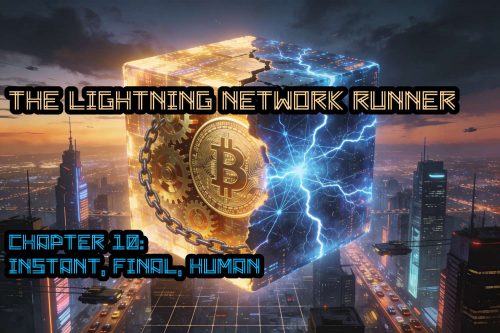
“But they’re not opposites,” Rohan concluded, the synthesis of their year-long conflict finally articulating itself perfectly. “They’re the two ends of the same transaction. Lightning is instant. The mainnet is final. And the reason we built both…” He looked at her, then at the glowing windows where people lived, worked, and traded.
Ziya finished the thought, her voice soft but firm. “…is human.”
Instant. Final. Human.
It was their manifesto. A three-word summary of the new world they’d midwifed into being.
As the last light faded, a shared, priority alert pinged on both their terminals. Not a city alert. A network-wide beacon, forwarded through a hundred peer nodes.
It was a distress signal. A call for help. The sender tag was unfamiliar, from a city three hundred kilometers down the coast. The message was brief, frantic, and all too familiar:
“Mainnet congested by corporate entity ‘Harbor Trust.’ Lightning channels being bought, not built. Need understanding of Glades Protocol. Need guidance. Can you assist?”
Ziya and Rohan looked up from their wrists, their eyes meeting across the table. A year ago, such a message would have been for one of them alone, and would have been met with a competitive, ideological response. Now, they saw the same thing: a network in pain, a pattern repeating. A call for the exact blend of knowledge they now held, together.
Without a word, they both began to gather their things. Ziya saved her local state backups. Rohan encrypted a bundle of his security schematics and best practices.
“The train to the coast leaves in forty minutes,” Rohan said, already calculating the logistics.
“I know a runner there,” Ziya added, her mind mapping the new city’s likely layout. “We can route a direct channel to them to start sharing data before we even arrive.”
There was no discussion of if. Only how. The rivalry was a fossil, preserved in the amber of their first angry meeting in that alley. What remained was partnership. A channel, always open.
They walked out of the garden together, heading for the inter-city transit hub. Ziya moved with her usual ready-for-anything grace. Rohan walked with his steady, purposeful stride. They didn’t walk as one entity; they walked as two synchronized parts of a resilient system.
Below them, Neotropolis thrummed. The great gears of the mainnet turned in their deep bunkers, recording the slow, weighty truths of deeds and ownership. And through the air, between a million devices, leapt countless instantaneous bolts of value, trust, and human connection—a network of light, built on a foundation of stone, finally fulfilling its purpose.
The city didn’t just function. It thrived. And its two once-opposed architects walked into its glowing heart, ready to carry the light to the next city, and the next.
Table of contents:
Introduction
Chapter 1: The Congested Chain
Chapter 2: The Underground Current
Chapter 3: Opening a Channel
Chapter 4: Balancing the Ledger
Chapter 5: The Hostile Takeover
Chapter 6: Force-Closing the Gates
Chapter 7: Trust in the Stream
Chapter 8: The Mainnet Sacrifice
Chapter 9: A Network of Light
Chapter 10: Instant, Final, Human
