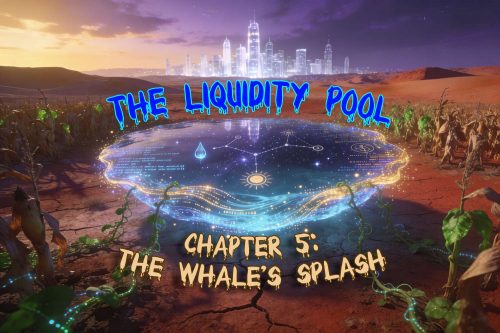
When the Speculator arrived, he didn’t break the Oasis. He filled it. Then he owned it.
The Glass City financial district was a canyon of gleaming white towers, each one vying to scrape the sky. Holographic advertisements flickered across their facades—solar token prices, water futures, real estate listings that cost more than a Drylands farmer would earn in a lifetime. The streets were clean, almost sterile, scrubbed by automated sweepers that hummed through the night.
In a penthouse office on the forty-seventh floor of the Meridian Tower, a man in his early thirties sat alone, watching markets move.
He had no name that appeared in public records—at least, none that anyone could trace to his trading activities. He was known simply as the Speculator, or sometimes the Whale, though he found both terms reductive. He wasn’t a speculator in the sense of gambling; he was an arbitrageur, a liquidity strategist, a market efficiency specialist. He found places where prices were wrong and made them right. That he profited from the process was incidental. Or so he told himself.
His real name, if anyone cared to dig, was Dorian Voss. But no one cared to dig. They only cared about his trades.
Today, his attention was fixed on a small, unremarkable smart contract on a secondary blockchain. The Oasis Pool. He had discovered it three days ago, buried in a forum thread about decentralized finance for agricultural communities. At first, he had dismissed it—just another idealistic project bound to fail. But the numbers intrigued him.
Low liquidity. Growing volume. Inefficient pricing.
Inefficiency was opportunity.
He pulled up the pool’s dashboard on his primary screen. Total liquidity: just over 6,000 credits. Daily volume: about 800 credits. Fees: modest. But the spread between the pool’s internal price and the external market price was significant—sometimes as high as 2-3%. In a well-capitalized market, arbitrage would close that gap instantly. Here, it persisted for hours.
“Fascinating,” he murmured to the empty room.
He began to calculate. With a sufficiently large deposit, he could capture most of that spread. He could also—if he chose—manipulate the pool’s pricing to extract even more value. Not maliciously, exactly. Just… efficiently.
His fingers hovered over the keyboard.
Then he began to type.
Scene 5.1: The Stranger in Glass City
The Speculator didn’t visit the Drylands. He had no reason to. His world was screens and numbers, not dust and desperation. But he understood the Drylands better than most of its inhabitants did. He understood that scarcity created value. That desperation created opportunity. That the Guild had grown fat and lazy on a monopoly it no longer deserved.
And he understood that the Oasis Pool, for all its noble intentions, was a machine waiting to be exploited.
He spent the morning researching. The pool’s creator: Zara Chen, seventeen, a DeFi prodigy from Glass City’s technical academy. The community organizer: Ravi, sixteen, a farmer’s son with no formal training but plenty of grit. The pool’s governance: minimal. Its security: adequate but not exceptional. Its liquidity providers: mostly small farmers who didn’t understand impermanent loss.
“Children,” he said, almost affectionately. “Playing with fire.”
He transferred 100,000 credits from one of his dormant wallets into a fresh address—one not linked to his known trading history. Then he split the funds: 50,000 water credits, and solar tokens worth 50,000 credits.
He was about to execute the deposit when his private communicator chimed.
Unknown sender: The Guild would like to discuss a partnership. We share a common interest in the Oasis Pool. Reply for details.
The Speculator raised an eyebrow. The Guild had noticed him. That was interesting—and potentially useful. But partnerships were messy. Partnerships required trust, and trust was inefficient.
He deleted the message without responding.
Then he executed the deposit.
Scene 5.2: The Splash
Ravi was in the tomato field when the pool dashboard exploded.
He had been checking the pool regularly—every few hours, not every few minutes, as his obsession had cooled into routine. The solar token surge had stabilized; impermanent loss had eased; the community had stopped panicking. Life had returned to something like normal.
Then he refreshed the dashboard and froze.
Total Liquidity: 118,000 credits.
He blinked. Refreshed again. The number didn’t change.
Yesterday, the pool had 6,000 credits. Today, it had 118,000. A single address—a wallet he didn’t recognize—had deposited 50,000 water credits and solar tokens worth 50,000 credits. In one transaction.
Ravi’s hands shook as he pulled up Zara’s contact.
“Did you see it?” he asked when she answered.
“I saw it.” Her voice was tight. “We have a whale.”
“A whale?”
“Someone with massive capital. They just multiplied the pool’s liquidity by nearly twenty times.”
Ravi tried to process this. More liquidity was good, right? It meant deeper pools, lower slippage, more fee earnings. But the way Zara said “whale” made it sound like a threat.
“What does this mean for us?” he asked.
“It means the pool is more stable. Large trades won’t move prices as much. That’s the good news.”
“What’s the bad news?”
Zara paused. “The whale now controls about forty-five percent of the pool’s liquidity. That means they have outsized influence. If they withdraw, the pool collapses. If they start making large trades, they can move prices however they want.”
“Can they steal our money?”
“No. The smart contract prevents that. But they can manipulate the market in ways that hurt small LPs. Impermanent loss, price manipulation, fee extraction. Nothing illegal. Nothing the code prevents. Just… predatory.”
Ravi sat down in the dirt, his back against a tomato stake. “Who is this person?”
“I don’t know. The wallet address is new. No transaction history before today. They’re hiding their identity.”
“Can we find out?”
“Maybe. But even if we do, what then? We can’t stop them from participating. The pool is open to everyone. That’s the point.”
Ravi looked out at his fields. The tomatoes were almost ready for harvest—red and ripe and beautiful. For a moment, he had allowed himself to believe that the worst was behind them. That the pool would grow slowly, steadily, powered by the community that had built it.
Now a stranger had arrived with more money than Ravi’s entire village had seen in a lifetime.
“This changes everything,” he said.
“Yes,” Zara agreed. “It changes everything.”
Scene 5.3: The New Reality
The first week after the whale’s arrival was disorienting.
The good: Trading volume exploded. The pool’s deep liquidity attracted merchants, cooperatives, even a few small Guild traders looking for better rates. Daily volume jumped from 800 credits to 12,000. Fees poured in. Ravi’s community earned more in seven days than they had in the previous month.
The troubling: The whale traded constantly. Large buys, large sells, always timed to capture tiny price differences. The whale wasn’t using the pool to buy water or sell solar—they were using it to arbitrage, extracting value from every inefficiency.
Ravi watched the whale’s trading pattern on his spreadsheet. Each day, the whale would:
- Buy a large amount of solar tokens, driving up the price.
- Wait for small LPs to rebalance their positions.
- Sell the solar tokens back at a slightly higher price.
- Repeat with water credits.
The profits were small per trade—fractions of a percent—but multiplied by hundreds of trades, they added up. The whale was extracting thousands of credits from the pool every week.
And the fees? The whale earned those too. As a liquidity provider, they got a share of every trade’s fee—including the fees generated by their own trades.
“It’s a feedback loop,” Zara explained during a late-night call. “They provide liquidity, which earns them fees. Then they trade, which generates more fees. Then they earn a share of those fees. The more they trade, the more they earn. And the more they earn, the more they can trade.”
“It’s like they’re farming the pool,” Ravi said.
“Exactly. Yield farming. It’s a legitimate strategy in DeFi. But it’s usually done by people who believe in the project, not by predators looking to extract value.”
“Do you think they’re a predator?”
Zara hesitated. “I don’t know. They haven’t done anything malicious. They’re just… playing. But their play is creating volatility. And volatility hurts small LPs who don’t understand impermanent loss.”
Ravi pulled up the community’s earnings. They were still positive—the fees had more than offset the impermanent loss from the whale’s trading. But the volatility was wearing on people. Mrs. Kim had called him twice that week, worried about the wild swings in her pool share.
“The Guild is using this,” Ravi said. “I’ve heard whispers. They’re telling people the pool is unstable. That the whale is going to crash it.”
“The Guild wants us to fail. That’s not new.”
“But now they have evidence. The pool is unstable. Not because the code is broken, but because one person has too much power.”
Zara was quiet for a long moment. Then she said, “We need to change the rules. Time locks. Trade limits. Governance that rewards long-term commitment over large capital.”
“Can we do that?”
“The code can be upgraded. But upgrades require community votes. And the whale controls forty-five percent of the voting power.”
Ravi closed his eyes. “So we’re trapped.”
“For now. But not forever. We’ll figure something out.”
Scene 5.4: The Speculator’s Pattern
By the second week, Ravi had become an expert on the whale’s behavior.
He stayed up late every night, analyzing the transaction history, building models, looking for patterns. The whale was methodical—almost mechanical. Trades executed at the same times each day, in the same sizes, following the same sequences.
It wasn’t random. It was an algorithm.
“The whale is using a bot,” Ravi told Zara. “Automated trading. The same strategy, over and over.”
“Can you reverse-engineer it?”
“I think so. They’re exploiting a specific inefficiency in the pool’s pricing. When the pool’s price diverges from the external market by more than 0.5%, the bot executes a series of trades to capture the difference. It’s arbitrage, pure and simple.”
“Arbitrage is supposed to make markets more efficient,” Zara said. “It closes price gaps. That’s a good thing.”
“Not when the arbitrageur controls half the liquidity. They’re not closing gaps—they’re creating them. Their own trades cause the price to move, then they profit from the movement they created.”
Zara frowned. “That’s not arbitrage. That’s manipulation.”
“Can we prove it?”
“Maybe. But proving it doesn’t matter. The code allows it. The question is whether we can change the code to prevent it.”
Ravi stared at his spreadsheet. The whale’s profits were now visible as a separate line item—tens of thousands of credits, extracted from the pool in just two weeks. The community’s earnings had grown too, but not as fast. The whale was taking more than they were giving.
“We need to talk to them,” Ravi said. “The whale. Whoever they are. We need to ask them to stop.”
Zara looked skeptical. “You think they’ll listen?”
“I think they’re a person. And people can be reasoned with. Maybe.”
“Or maybe they’re a corporation. Or a trading bot with no human behind it. Or someone who doesn’t care about farmers or communities or fairness.”
“Then we’ll find out. But we have to try.”
Scene 5.5: The Guild Alliance
The Speculator’s private communicator chimed again.
Unknown sender: You’ve made quite a splash. The Guild is impressed. We have information that could help you. In return, we ask only for a small consideration.
This time, the Speculator didn’t delete the message immediately. He had been watching the Guild’s activity—their clumsy attempts to discredit the pool, their predatory buyouts of panicked LPs. They were amateurs, but they had something he didn’t: local knowledge. They knew the farmers, the politics, the weak points in the Drylands’ infrastructure.
He replied: What kind of information?
The response came within seconds: The pool’s governance structure. Its vulnerabilities. The identities of its key players. And a proposal for how we might work together to… accelerate certain outcomes.
The Speculator leaned back in his chair. He didn’t need the Guild. He had capital, technology, and patience. But allies could be useful—as long as they didn’t become liabilities.
I’ll consider it, he wrote. But I don’t do partnerships. I do transactions. If you have something I want, name your price. No ongoing commitments.
The Guild’s response was almost fawning: Of course. Whatever you prefer. We will prepare a proposal.
The Speculator closed the communicator. He had no intention of letting the Guild dictate terms. But he would listen. Information was valuable, even from amateurs.
And if the Guild wanted to help him drain the Oasis, who was he to refuse?
Scene 5.6: Ravi Confronts the Whale (Attempted)
Ravi sent the message on a Thursday evening, after three days of drafting and re-drafting.
To: [Whale Wallet Address]
Subject: A request from a farmer
Hello.
I don’t know who you are, but I know you’ve been trading in the Oasis Pool. You have every right to be there. The pool is open to everyone. That’s the point.
But I want you to know who else is in the pool. Farmers. Families. People who put their life savings into this because they believed in something fairer than the Guild. Your trades are making them scared. Your profits are coming from their uncertainty.
I’m not asking you to leave. I’m asking you to think about what you’re doing. These aren just numbers on a screen. They’re people. Real people.
Please stop.
—Ravi
He stared at the message for a long time. Then he sent it.
The reply came three hours later.
From: [Whale Wallet Address]
Subject: Re: A request from a farmer
Ravi—
I read your message. I understand your concern. But you need to understand something: I am not your enemy. I am providing liquidity. I am paying fees. I am following the rules you wrote.
If the rules hurt people, change the rules.
I will continue to trade as long as it is profitable. That is not cruelty. That is markets.
—The Speculator
Ravi read the reply three times. The Speculator wasn’t wrong. He wasn’t breaking any rules. He wasn’t even being cruel, exactly. He was just… playing a different game.
Ravi typed back: How do I change the rules?
The reply: That’s your problem. Not mine.
The conversation ended.
Ravi sat on his rooftop, the tablet glowing in his hands. The stars were out, cold and distant. Somewhere in Glass City, a man was extracting wealth from his community, and there was nothing illegal about it.
“Change the rules,” Ravi murmured. “How?”
He thought about Zara’s talk of governance upgrades. Time locks. Trade limits. Voting power based on time in the pool, not just capital. The tools existed. But using them required a vote. And the Speculator controlled forty-five percent of the votes.
They were trapped. Unless—
Unless they could convince the other LPs to act together. To coordinate. To use their collective power to counter the whale’s influence.
It was a long shot. But it was the only shot they had.
Ravi opened a new message, this time to Zara.
To: CodeZara
The Speculator isn’t going to stop. So we need to make him irrelevant.
How do we build a pool that no single whale can control?
Her reply came instantly: I’ve been thinking about that. Meet me at the border tomorrow. I have an idea.
Ravi smiled. It wasn’t hope, exactly. It was something harder, sharper. Determination.
The whale had splashed into their pool. Now it was time to build a bigger ocean.
Table of contents:
Introduction
Chapter 1: The Desert of Scarcity
Chapter 2: The Automated Market Maker
Chapter 3: Providing the Pool
Chapter 4: Impermanent Loss
Chapter 5: The Whale’s Splash
Chapter 6: Draining the Oasis <<<<<< NEXT
Chapter 7: The Flash Loan Attack
Chapter 8: Rebalancing the Ecosystem
Chapter 9: Deep Liquidity
Chapter 10: A More Fertile Ground
