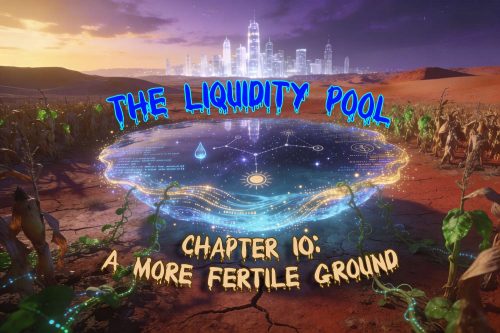
The Oasis didn’t end scarcity. It didn’t end greed. But it turned a desert of exploitation into something new—a garden where fairness could, slowly, take root.
Scene 10.1: The Harvest Festival
The rain came on the morning of the festival.
Not a storm—nothing so dramatic. Just a steady, gentle shower that soaked the red soil and turned the air sweet and clean. Children ran outside with their mouths open, catching drops on their tongues. Their parents laughed and didn’t tell them to come inside.
Ravi stood at the edge of the village meeting hall, which had been transformed for the celebration. Lanterns hung from every beam. Tables groaned under the weight of flatbreads, roasted vegetables, spiced rice, and sweets that had been saved for months. The music was loud and joyful, a mix of traditional Drylands drumming and Glass City synth beats.
The harvest had been good. Not the best in living memory—the drought had seen to that—but good. The Oasis had kept water flowing at fair prices. The Guild’s infrastructure partnership had helped distribute crops to new markets. And the community’s fee earnings had funded irrigation repairs, seed banks, and a small emergency fund for the next dry spell.
“This is what we were fighting for,” Mira said, appearing at Ravi’s side. She had a cup of something that smelled like spiced cider and a smile that reached her eyes.
“This is what we were surviving for,” Ravi corrected. “Fighting is different.”
“Same thing, in the Drylands.”
He couldn’t argue with that.
The festival continued into the afternoon. Ravi’s father, Malik, danced with his mother, Leena, for the first time in years. Priya organized a clapping game for the younger kids and won a pie-eating contest she hadn’t officially entered. Old Man Hernan sat in a corner, nodding along to the music, his gnarled fingers tapping the table.
Zara had taken the bus from Glass City. She stood near the food tables, awkwardly holding a plate of food she hadn’t touched, watching the celebration with something like wonder.
“You look like you’ve never seen people be happy before,” Ravi said, walking over.
“I haven’t. Not like this. In Glass City, happiness is… expensive. New clothes, fancy restaurants, rooftop parties. Here, it’s just… people.”
“People are enough. They always were.”
Zara set down her plate. “I used to think code was enough. The right formulas, the right smart contracts, the right incentives. But code doesn’t dance. Code doesn’t laugh. Code doesn’t forgive.”
“Code doesn’t have to. That’s what people are for.”
They stood together, watching the celebration. The rain had stopped, leaving puddles that reflected the late afternoon sun.
Ravi raised his cup. “To the Oasis.”
Zara raised hers. “To the people who made it real.”
Scene 10.2: Zara’s Return
After the festival, Ravi and Zara walked through the fields.
The tomatoes were finished for the season, but the okra was still green, and the new drip irrigation system hummed quietly in the background. The air smelled of wet earth and growing things.
“I’ve been thinking about what comes next,” Zara said. “The Oasis is stable. Governance is working. But there are other Drylands—other communities like yours, still trapped by their own Guilds, their own droughts, their own desperation.”
“You want to build more pools.”
“I want to open-source everything. The code, the governance templates, the educational materials. Let anyone build their own Oasis. Let a thousand pools bloom.”
Ravi smiled. “That’s very poetic for a programmer.”
“I have hidden depths.”
They walked in silence for a moment. Then Zara stopped.
“I couldn’t have done this without you,” she said. “The code was the easy part. The hard part was the people. Getting them to trust. Getting them to coordinate. Getting them to believe that something new was possible. You did that. Not me.”
“I just talked to my neighbors.”
“You just changed the world.” She hugged him—quick, fierce, the same way she had at the border months ago. “Thank you.”
“Thank me by coming to the next harvest festival. And the one after that.”
“Deal.”
She walked back toward the village, her silhouette small against the setting sun. Ravi watched her go, then turned back to his fields.
The work was never done. But for now, it was enough.
Scene 10.3: The Speculator’s Last Appearance
Ravi’s tablet buzzed late that night.
He was sitting on the rooftop, watching the stars emerge through the clearing clouds. The festival had wound down; the village was quiet. His family was asleep.
The message was from a wallet address he recognized.
From: The Speculator
You won this round. But markets don’t have endings. They have cycles. I’ll see you in the next one.
Ravi read the message twice. His heart didn’t race the way it would have months ago. He wasn’t afraid. He was just… tired. Tired of predators who thought the world was a game, tired of people who saw communities as extractable resources.
He typed back:
To: The Speculator
Maybe. But next time, we’ll be ready. And there will be more of us.
He waited for a reply. None came.
The Speculator had moved on to other prey. That was what predators did. They didn’t learn. They didn’t repent. They just followed the profit.
But the Oasis was still here. The farmers were still here. And they had learned something the Speculator would never understand: that a thousand small roots hold better than one big rock.
Ravi put away his tablet and watched the stars.
Somewhere in Glass City, a man in a penthouse was planning his next move. Somewhere else, the Guild was adapting, surviving, finding new ways to be useful. The world hadn’t changed overnight. It had just shifted, slightly, in a direction that felt like hope.
That was enough for tonight.
Scene 10.4: The Guild’s Trial
The six-month trial of the Guild’s infrastructure partnership was up for review.
The meeting hall was full—not with fear this time, but with the quiet intensity of people who had learned to govern themselves. Torvin sat in the back, alone. He had not spoken during the debate. He had simply watched.
Mira presented the data.
“The Guild has met all performance metrics. Delivery times: 98% on schedule. Storage fees: 12% below market average. Dispute resolution: zero complaints filed with the Oasis governance committee.”
The room murmured. Some of the farmers still remembered the Guild’s abuses. Others were willing to judge based on results.
“However,” Mira continued, “there have been two incidents where Guild agents attempted to bypass the smart contract and negotiate directly with farmers. Both incidents were reported, investigated, and resolved. The Guild paid a penalty in both cases.”
Torvin shifted in his seat. He had fired those agents, but the damage was done.
“The question before us,” Mira said, “is whether to extend the partnership for another year, modify its terms, or terminate it entirely.”
The debate lasted two hours.
Mrs. Patel spoke about forgiveness—not of the Guild, but of the need to move forward. Mr. Nguyen spoke about the importance of keeping the Guild on a short leash. Old Man Hernan, surprisingly, spoke in favor of extension.
“They’re useful,” he said. “That doesn’t mean I trust them. But usefulness is enough, as long as the code enforces the rules.”
The vote was called.
For extension with stronger penalties: 72%
For termination: 18%
For extension without changes: 10%
The partnership would continue, but with higher penalties for any future violations. The Guild would be watched, monitored, constrained.
Torvin stood up. He didn’t applaud. He didn’t frown. He simply nodded and walked out.
Ravi watched him go. The Guild Master wasn’t a friend. He wasn’t an enemy anymore. He was just part of the system—a small part, with clear rules and transparent consequences.
That was the Oasis’s real victory. Not the destruction of the Guild, but the taming of it.
Scene 10.5: The New Generation
Ravi found Priya on the rooftop, staring at her tablet.
“What are you looking at?” he asked.
“A proposal for a new pool. In the Eastern Drylands. They heard about the Oasis and want to build their own.”
“Are you going to help them?”
Priya looked up. “I’m twelve. What can I do?”
“Talk to them. Explain impermanent loss in plain language. Show them how governance works. Teach them what we learned—the hard way.”
Priya was quiet for a moment. Then she smiled. “I can do that.”
Mira climbed up the ladder, joining them. She had a tablet of her own.
“The Eastern Drylands proposal is interesting,” Mira said. “But I’ve been thinking about something bigger. What if we created a network of pools? Connected liquidity, shared governance, cross-pool arbitrage? Like a federation of Oases.”
“That sounds complicated,” Ravi said.
“Good complicated. The kind of complicated that makes the system stronger.”
They talked late into the night—not about the past, but about the future. New crops they wanted to try. A proposal to add energy storage tokens to the pool. A plan to help the Eastern Drylands build their own Oasis.
Priya asked, “Do you think we’ll ever be done? Like, finished? No more problems?”
Ravi thought about it. “No. There’s always another problem. But that’s not bad. It means there’s always another chance to build something better.”
Mira nodded. “My grandmother used to say: ‘The best time to plant a tree was twenty years ago. The second best time is now.’ We’re planting trees. Lots of them.”
The stars were bright overhead. The rain had washed the air clean. Somewhere in the distance, a night bird called.
Ravi looked at his sister, at his friend, at the tablet screens glowing in the darkness. They were young. They had made mistakes. They would make more.
But they had also built something that worked. Something that lasted. Something that belonged to them.
That was enough.
Scene 10.6: The Final Reflection
Ravi sat alone on the rooftop after Priya and Mira had gone to bed.
The Oasis dashboard was open on his tablet. The numbers glowed softly in the darkness:
Total Liquidity: 1,240,000 credits
LP Addresses: 1,847
Total Trades: 94,231
Fees Earned (All Time): 187,000 credits
The numbers weren’t just numbers. Behind each one was a story. The Patel family’s well, finally repaired. The Nguyens’ new pump, humming quietly through the night. The Kims’ daughter, attending school in Glass City on a scholarship funded by pool fees.
The Guild hadn’t disappeared. It had adapted—because even predators adapt when the environment changes.
The Speculator hadn’t repented. He had moved on—because predators follow profit, not grudges.
But something real had happened. A community had learned that it could build its own tools. That code could serve people, not just capital. That a desert could become a garden—if enough people were willing to plant, and water, and wait.
Ravi looked out over the Drylands. The rain had stopped, but the ground was wet. In the morning, he knew, there would be new green shoots. Not a miracle. Just the result of patient work.
He thought about the first message he had sent to Zara, almost a year ago: Can this work for real people? Not just code?
Her answer: That’s the only reason I built it.
And she had meant it. And it had worked. Not perfectly—nothing was perfect. But well enough. Fairly enough. Together.
Ravi closed his tablet and looked up at the stars.
The Oasis wasn’t a place. It was a promise—kept, day by day, by people who refused to believe that scarcity was the end of the story.
The rain would come again. The droughts would return. The predators would circle. But the Oasis would remain—not because it was invincible, but because it was rooted in something stronger than code.
It was rooted in them.
Ravi climbed down from the rooftop and went inside. His family was asleep, their breathing soft and steady. He lay down on his bed and closed his eyes.
For the first time in a year, he didn’t dream of water.
He dreamed of fields.
Table of contents:
Introduction
Chapter 1: The Desert of Scarcity
Chapter 2: The Automated Market Maker
Chapter 3: Providing the Pool
Chapter 4: Impermanent Loss
Chapter 5: The Whale’s Splash
Chapter 6: Draining the Oasis
Chapter 7: The Flash Loan Attack
Chapter 8: Rebalancing the Ecosystem
Chapter 9: Deep Liquidity
Chapter 10: A More Fertile Ground
