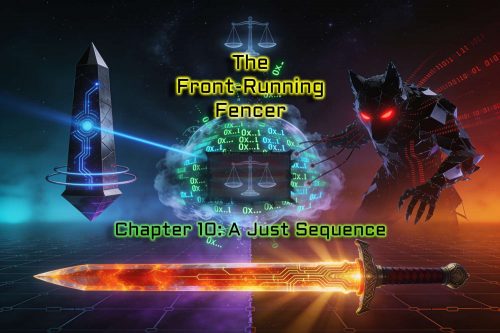
The diner was called “The 24-Hour Stop,” and it looked exactly like every other 24-hour diner Jesse had ever seen—cracked vinyl booths, a counter with swivel stools, a jukebox that hadn’t worked since before he was born, and the smell of coffee that had been brewing since the Clinton administration.
Jesse sat in a booth by the window, his phone propped against a ketchup bottle, staring at Emberheart on the screen. The sword glowed in the dim light of the diner, orange and red pulsing softly like a heartbeat. He couldn’t stop looking at it.
Across from him, Nia was on her third cup of coffee. Marcus had insisted on driving them both to the diner after the sale—“You don’t win a war and then sit in an apartment eating cold pizza” —and now he was at the counter, ordering a slice of pie he didn’t want and a milkshake he definitely did.
“You’ve been staring at that screen for twenty minutes,” Nia said.
“It’s been twenty minutes?”
“Twenty-three, actually.”
Jesse finally set the phone down. “I keep expecting it to disappear. Like I’ll refresh my inventory and it’ll be gone. Sold to someone else. Taken by a bot.”
“That’s the trauma,” Nia said, not unkindly. “You’ve been front-run so many times that success feels wrong.”
“Is that a technical term?”
“It’s a therapy term. You should probably see someone.”
Marcus slid into the booth across from Jesse, a plate of apple pie and three milkshakes balanced precariously in his hands. “One for each of us,” he announced, distributing the glasses. “We’re celebrating.”
“It’s ten o’clock at night,” Nia said.
“Milkshakes don’t have a curfew.”
Jesse took a sip. Vanilla. Cold and sweet and exactly what he didn’t know he needed.
“So,” Marcus said, pointing a spoon at Jesse. “One sword. That’s all you wanted. And instead, you helped redesign the entire network’s transaction ordering.”
“I didn’t redesign it. I just asked questions.”
“You asked the right questions,” Nia said. “That’s harder than writing the code.”
Marcus nodded. “My sister doesn’t give compliments. If she says you did something hard, you did something hard.”
Jesse felt his face warm. He looked down at the milkshake, then back at his phone. Emberheart still glowed. Still his.
Scene 1: The Final Sale
The memory of the sale was already blurring at the edges, the way intense moments do—sharp in some places, soft in others.
Jesse remembered the countdown. The click. The encryption process, which had felt like forever. The wait, shorter than he’d expected but longer than he’d hoped. And then the moment when the dashboard updated and the sword appeared in his inventory.
He hadn’t screamed. He hadn’t cried. He’d just sat there, staring, until Nia had put a hand on his shoulder and said, “You did it.”
And he’d replied, “We did it.”
Because that was the truth. The sword was in his wallet, but it didn’t belong to him alone. It belonged to everyone who had stayed in the DAO when leaving would have been easier. To Cipher, who had worked through countless nights without ever revealing their face. To the users who had posted their stories, who had kept believing that fairness was possible. To Nia, who had opened her apartment and her code and her guilt to a stranger who didn’t know the difference between a hash and a promise.
“I’m proud of you,” Marcus said, pulling Jesse back to the present. “Both of you. When I left for school, I thought the validator pool was going to die. Nia was running it alone, barely breaking even, and I was too far away to help. Now we’re on FairChain, we’re processing more transactions than ever, and we’re actually winning.”
“We’re not winning yet,” Nia said. “QuickPath is still operating. The Seeker is still active on QuickChain. We’ve created a fair zone, but the war isn’t over.”
“The war never ends,” Jesse said. “That’s what I’ve learned. There’s always a new exploit, a new bot, a new way to game the system. Fairness isn’t a destination. It’s a process.”
Marcus raised his milkshake. “To the process, then.”
“To the process,” Nia echoed.
Jesse raised his glass. “To a just sequence.”
They clinked glasses, and for a moment, the diner felt like a cathedral.
Scene 2: The Diner Conversation
The pie disappeared. The milkshakes melted. The jukebox remained stubbornly silent.
Jesse found himself telling the whole story—not just the technical parts, but the emotional ones. The night he’d thrown his phone across the room. The sick feeling in his stomach when he saw The Seeker’s address. The moment in the library when Nia had first explained the mempool and he’d realized the system wasn’t broken—it was designed.
“I thought the system was broken,” he said. “But it wasn’t. It was just designed for someone else’s benefit.”
“That’s the thing about systems,” Marcus said. “They’re never neutral. Every rule, every protocol, every default setting—it all benefits someone. The question is who.”
Nia nodded. “The old network benefited validators who could extract MEV. It benefited bots like The Seeker. It benefited people with fast connections and deep pockets. Everyone else was just… feedstock.”
“And now?” Jesse asked.
“Now the network benefits users who want fair access. It’s not perfect—nothing is—but it’s better. The encrypted mempool means bots can’t see what you’re doing. The VRF ordering means they can’t predict the sequence. Time-lock encryption means they can’t front-run even if they try.” Nia paused. “The Seeker isn’t gone. It’s just not profitable to front-run anymore.”
“It’ll find other exploits,” Jesse said.
“It will. And we’ll find other fixes. That’s how this works. Attack and defend. Exploit and patch. The network evolves.”
Marcus set down his spoon. “You sound like Cipher.”
Nia smiled—a rare, unguarded smile. “Maybe I’ve been spending too much time in virtual meetings.”
Jesse laughed. “Or maybe you’ve become the person who was supposed to be in those meetings all along.”
Scene 3: The Realization
The diner had emptied out. A single waitress wiped down the counter. The neon sign outside flickered—OPEN 24 HOURS —though Jesse suspected “open” was doing some heavy lifting.
“Can I ask you something?” Nia said.
“Anything.”
“When you first came to my apartment, after the Emberheart sale, what did you think of me?”
Jesse considered the question. “I thought you were guilty.”
Nia didn’t flinch. “I was.”
“I thought you knew the system was unfair and you were profiting from it anyway. And I thought you hated yourself for it.”
“I did.”
“But I also thought you were the only person who could help me. Because you understood how it worked. And because you wanted to change it.” Jesse leaned back in the booth. “You weren’t the villain. You were someone trapped in a villain’s system, trying to find a way out.”
Nia was quiet for a long moment. Then she said, “What about now? What do you think of me now?”
Jesse didn’t hesitate. “I think you’re a hero. Not the kind in stories—the kind who shows up every day and does the hard, boring, frustrating work of building something better. The kind who doesn’t give up even when giving up would be easier.”
Marcus made a fake coughing sound. “Cough my sister cough the hero cough.”
“Shut up,” Nia said, but she was smiling.
Scene 4: Epilogue — Three Months Later
The Fair Sequencing DAO had grown to over two hundred validators.
Jesse watched the numbers climb on his dashboard—not from Nia’s apartment anymore, but from his own bedroom. He’d set up a small monitor on his desk, next to the display frame that now held Emberheart. The frame glowed, the sword’s molten light casting orange reflections on the wall.
The past three months had been a blur of meetings, documentation, and user outreach. Jesse had written over forty guides, posts, and manifestos explaining why FairChain mattered. He’d started a user advocacy group called the Fair Buys Coalition, which now had over three thousand members. He’d even been interviewed for a podcast—Collector’s Corner —where he’d told the story of the Emberheart sale to an audience of thousands.
Nia had become a respected voice in validator governance. She’d written a code of conduct for fair validators—a document that had been adopted by over a hundred pools. She’d spoken at three conferences (virtually, because she refused to travel), and she’d been featured in a major industry publication under the headline: “The Teenager Who Fixed Front-Running.”
(The headline made her furious. “I didn’t fix it alone,” she’d texted Jesse. “You were there. Cipher was there. The DAO was there.” Jesse had replied: “The headline should have been ‘The Teenagers Who Fixed Front-Running.’ Plural.” Nia had sent back a single word: “Fine.”)
Cipher had remained anonymous, as always. But they’d released a series of technical papers documenting the Fair Sequencing Protocol—papers that had been cited by researchers at three different universities. A startup had even reached out, offering to fund further development. Cipher had declined, but referred them to the DAO.
And The Seeker?
The Seeker was still active on QuickChain, but QuickChain was a ghost town. Transaction volume had dropped by ninety percent. Most validators had either switched to FairChain or shut down entirely. QuickPath had rebranded twice, trying to escape its reputation, but the community remembered.
The last time Jesse had checked the old mempool viewer, he’d seen The Seeker’s address still scanning, still submitting transactions, still trying to front-run. But there was almost nothing left to front-run. The users had left. The value had left. The Seeker was a predator in an empty forest, circling trees that no longer held prey.
Jesse felt something like pity. Not for The Seeker—it was just code, after all—but for the people who had built it. They had optimized for extraction instead of creation. They had chosen profit over people. And in the end, they had lost everything because there was nothing left to extract.
Scene 5: The Last Purchase
The sale was for a shield—not legendary, not rare, but beautiful. A round shield with a phoenix emblem, the feathers picked out in gold and crimson. The creator had listed fifty copies at fifteen credits each. No auction. No bidding. Just first-come, first-served, on FairChain.
Jesse didn’t need the shield. His collection was already complete with Emberheart. But he wanted it. And more importantly, he wanted to prove—to himself, to the network, to anyone still watching—that the system worked.
He opened his wallet app. Fifteen credits ready. The creator’s address saved.
He encrypted the transaction. Submitted the hash. Waited.
The block finalized in 3.8 seconds.
The shield appeared in his inventory.
No front-running. No sandwich. No bot. Just a clean, fair, honest purchase.
Jesse stared at the screen for a moment. Then he smiled.
He walked to his wall—the display frames, each one holding a piece of his collection. The dragon-scale cloak. The compass that pointed to hidden treasure. The quiver of endless arrows. And in the center, the biggest frame of all, Emberheart—the sword that had started everything.
He placed the phoenix shield next to the compass. It fit perfectly.
His phone buzzed. A message from Nia:
“Saw the shield purchase. You’re becoming a whale.”
Jesse typed back: “Just a collector with a working network.”
“The network works because people use it. Thank you for being one of them.”
“Thank you for building it.”
He set down the phone and looked at his collection one more time. The frames glowed in the dim light of his bedroom—proof that he had been there, that he had won, that the system could be fair.
Outside, the city hummed with its own rhythms. Somewhere out there, The Seeker was still scanning, still trying. Somewhere, a new exploit was being discovered, a new bot was being deployed, a new battle was beginning.
But tonight, none of that mattered.
Tonight, Jesse had his sword. And his shield. And a network that finally, finally worked for everyone.
He stood in front of the display frames, the fencer’s pin still pinned to his jacket—the one he’d worn to Collector Con, the one that had started this whole journey. He touched it gently.
“A just sequence,” he said to the empty room. “That’s all anyone ever wanted.”
And for the first time in months, he turned off his phone, climbed into bed, and slept without dreaming of bots.
EXTENDED EPILOGUE: THE FAIR BUYS COALITION
Six months after the fork, the Fair Buys Coalition held its first in-person meetup.
It was at a community center downtown—a small room with folding chairs, a projector, and a table of snacks that someone had brought from a grocery store. About forty people showed up. Collectors, mostly. A few validators. One journalist who smelled like cigarettes and hope.
Jesse stood at the front of the room, wearing his fencer’s pin and a hoodie that said FAIR BUYS on the front. Nia sat in the front row, arms crossed, pretending not to be nervous.
“I’m not a coder,” Jesse began. “I’m not a validator. I’m not a cryptographer. I’m just someone who wanted to buy a sword and got robbed by a bot.”
The room laughed.
“That sword—Emberheart—is on my wall now. I got it on FairChain, using the Fair Sequencing Protocol. And I’m here tonight because I want everyone in this room to be able to say the same thing about the artifacts they love.”
He paused, looking at the faces in the crowd. Some were young, like him. Some were older—collectors who had been in the game for years, who had lost thousands of credits to front-running. Some were just curious, trying to understand what all the fuss was about.
“The Seeker isn’t dead,” Jesse said. “It’s still out there, still scanning, still trying to find an angle. QuickPath rebranded again—they’re calling themselves ‘Express Chain’ now, which is cute—but they’re still running the same extractive protocol. They haven’t changed. They’ve just put on a new mask.”
He clicked a slide. The screen showed a graph—FairChain vs. QuickChain transaction volume over the past six months.
“FairChain is now processing eighty percent of the network’s transactions,” Jesse said. “Eighty percent. That’s not because we have better marketing. It’s because we have better math. We have an encrypted mempool, VRF ordering, and time-lock privacy. We have a system that makes front-running impossible, not just unprofitable.”
The room applauded.
“But we can’t stop,” Jesse continued. “The Seeker will adapt. New exploits will be discovered. New bots will be deployed. The work of fairness is never done. That’s why the Fair Buys Coalition exists—to advocate for users, to audit new protocols, to hold validators accountable.”
He looked at Nia. She nodded.
“And that’s why the Fair Sequencing DAO exists—to build the next generation of fair protocols. VRF was just the beginning. There’s already research on zero-knowledge mempools, on fair ordering for cross-chain transactions, on ways to make front-running not just impossible but inconceivable.”
Jesse stepped away from the podium. “I’m not going to lie to you. This is hard work. It’s boring, technical, sometimes frustrating. There are days when I want to throw my laptop out the window and just play video games.”
More laughter.
“But then I remember the feeling of watching a transaction fail. Of knowing I was first, but finishing last. Of realizing that the system I trusted had been designed to exploit me.”
His voice softened. “No one should feel that way. Not about a game. Not about a collection. Not about anything. And if we have the power to build something better, then we have the responsibility to do it.”
The room was silent.
Then someone in the back—a young woman with purple hair and a backpack covered in patches—started clapping. The applause spread, rippling through the folding chairs, growing louder and louder.
Jesse felt his face get hot. He looked at Nia, who was clapping too, a smile on her face that he’d never seen before—proud, relieved, maybe even a little amazed.
He raised his hand. The applause died down.
“Thank you,” he said. “Now let’s get to work.”
That night, after the meetup ended and the folding chairs were stacked and the leftover snacks were divided among whoever wanted them, Jesse and Nia walked to the diner—the same 24-hour diner, the same cracked vinyl booths, the same jukebox that still didn’t work.
Marcus was already there, holding down a booth in the corner. He’d driven down from college for the meetup, claiming he wanted to “see what all the fuss was about,” but Jesse suspected he just missed his sister.
“How’d it go?” Marcus asked as they slid into the booth.
“Good,” Nia said. “Really good.”
“Jesse gave a speech.”
“I gave a speech.”
Marcus raised an eyebrow. “The kid who didn’t know what a mempool was six months ago gave a speech about fair ordering protocols?”
“The kid who got front-run gave a speech about why front-running needs to die,” Jesse corrected. “There’s a difference.”
The waitress came by. They ordered milkshakes—vanilla for Jesse, chocolate for Nia, strawberry for Marcus—and sat in comfortable silence until the drinks arrived.
“So what’s next?” Marcus asked.
Nia answered first. “Cipher has a new proposal. Zero-knowledge mempools. Even stronger privacy than time-lock encryption. It’s theoretical now, but the math is promising.”
“And you?” Marcus looked at Jesse.
“The Fair Buys Coalition is growing. We’re going to start auditing artifact sales—making sure creators aren’t accidentally building front-running vulnerabilities into their contracts. Education, basically. Teaching people how to protect themselves.”
“That’s not as glamorous as building new cryptography.”
“It’s more important.” Jesse took a sip of his milkshake. “You can build the most perfect protocol in the world, but if people don’t know how to use it, it’s useless. The Seeker didn’t just exploit code. It exploited ignorance. The more people understand how the system works, the harder it is to cheat them.”
Marcus nodded slowly. “You’ve changed, you know. Both of you.”
“Is that bad?” Nia asked.
“It’s not bad. It’s just… different. You used to be so angry, Nia. At the system, at yourself, at everyone who was profiting while you struggled. Now you’re… calmer.”
“I’m not calmer. I’m just channeling the anger into something useful.”
“And Jesse.” Marcus turned to him. “You used to be just a collector. Now you’re an organizer. A leader.”
Jesse shook his head. “I’m just a guy who wanted a sword.”
“That’s how it starts.” Marcus raised his milkshake. “With one person who wants one thing and refuses to accept that the system is broken. That’s how every revolution begins.”
They clinked glasses. The milkshakes were cold. The diner was warm. And outside, the city hummed with the quiet chaos of people living their lives, unaware that two teenagers and a mysterious ally had changed the rules of the game.
Jesse got home around midnight. His bedroom was dark except for the glow of the display frames—the dragon-scale cloak, the compass, the quiver of arrows, the phoenix shield, and at the center, Emberheart.
He stood in front of the frames for a long time, just looking.
His phone buzzed. A message from Nia: “Get home okay?”
He typed back: “Yeah. Just looking at the collection.”
“Happy?”
“Yeah. Tired. But happy.”
“Good. Get some sleep. Tomorrow we have to figure out zero-knowledge mempools.”
Jesse laughed. “Can’t it wait?”
“The Seeker never sleeps. Neither can we.”
He set down the phone and looked at Emberheart one last time. The blade glowed orange and red, pulsing softly, like a heartbeat.
A just sequence, he thought. That’s all anyone ever wanted.
He climbed into bed, pulled the covers up to his chin, and closed his eyes.
For the first time in a long time, he didn’t dream about bots.
He dreamed about swords.
Table of contents:
Introduction
Chapter 1: The Mempool
Chapter 2: A Transaction in the Dark
Chapter 3: The Gas Auction
Chapter 4: The Sandwich Attack
Chapter 5: The Priority Fee War
Chapter 6: A Fair Ordering Protocol
Chapter 7: The Commit-Reveal Scheme
Chapter 8: The Encrypted Mempool
Chapter 9: The Time-Weighted Consensus
Chapter 10: A Just Sequence
