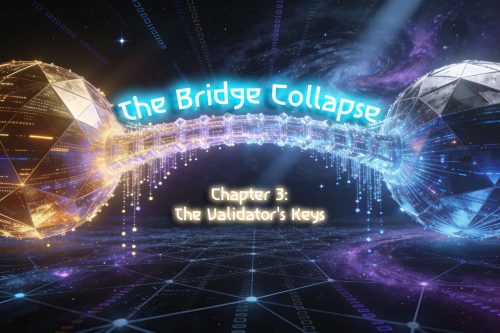
The Command Hub had never felt so cold.
Tess sat motionless in her chair, staring at the main display with unseeing eyes. The visualization that had once shown the beautiful golden sphere of Chain A’s pooled assets now showed nothing—a hollow, empty void where millions of tokens had been just minutes ago. The silver orb of Chain B still glowed, but it was a mockery now, a reminder of what had been lost.
1,847,320 tokens. Gone.
The community chat continued to scroll in a frenzy of panic and rage, but Tess had stopped reading it. She couldn’t bear to see the accusations, the blame, the hatred directed at her. She had built the bridge. She had trusted the validators. She had failed everyone.
Remy stood beside her, his face pale but his jaw set with grim determination. He had been monitoring the network since the attack, trying to trace the stolen funds, but so far, he had found nothing. The attackers had covered their tracks with professional precision.
“We need to move,” Remy said, his voice cutting through the fog of Tess’s despair. “The attackers are still out there. They might strike again.”
Tess laughed bitterly, a hollow, humorless sound. “Strike again? There’s nothing left to strike. The bridge is empty.”
“The bridge on Chain A is empty,” Remy corrected. “But Chain B still has assets. And there are other bridges, other pools. The attackers might try to expand their attack.”
Tess shook her head slowly. “I don’t care. It’s over. Everything I built is gone.”
Remy grabbed her shoulders, forcing her to look at him. “Tess, listen to me. I know you’re devastated. I know you feel like you failed. But we don’t have time for this. The attackers are still out there, and we’re the only ones who know how they did it. If we don’t act, they’ll keep stealing, keep destroying, keep hurting people.”
Tess stared at him, her eyes red-rimmed and unfocused. For a moment, she didn’t seem to understand what he was saying. Then, slowly, something flickered in her gaze—a spark of anger, of resolve, of the fierce determination that had built the Sylva Bridge in the first place.
“You’re right,” she said, her voice hoarse but steady. “You’re right. We have to stop them.”
Remy released her shoulders, relief washing over his features. “Good. Now, we need to conduct a forensic audit. We need to trace the attackers’ footsteps, find out exactly how they got Validator #3’s keys, and identify any other vulnerabilities they might have exploited.”
Tess nodded, her mind already shifting into investigator mode. She pulled up her interface, her fingers flying across the holographic keyboard.
“Start with the phishing attack,” she said. “We know the operator clicked a suspicious link three weeks ago. We need to trace that link, find out who sent it, and see if the attackers used it to access anything else.”
Remy nodded, pulling up his own data streams. “I’ll focus on the network side. I’ll trace the connections, the authentication logs, anything that might show how the attackers moved from the phishing email to the private keys.”
They worked in silence for the next hour, the only sounds the soft hum of the cooling fans and the occasional chime of incoming data. The community chat continued to scroll in the background, but neither of them paid it any attention. They had a job to do.
The first breakthrough came from Remy.
“I found something,” he said, his voice sharp with excitement. “The phishing link—it’s gone now. The attackers took it down after they got what they wanted. But I found a cached version in the network logs.”
Tess leaned over, studying the data on his display. “Can you trace the source?”
“Already did,” Remy said, pointing to a string of code. “It came from a server in a different sector—one that’s known for hosting malicious content. The attackers used a relay network to mask their location, but I managed to trace it back to a specific IP address.”
Tess’s eyes widened. “That’s incredible. Can you link it to anyone specific?”
“Not yet,” Remy admitted. “The IP address is registered to a shell company—one of those fake corporations that exist only on paper. But I’m running a deeper trace. I might be able to find the real owner.”
Tess nodded, turning back to her own data. “Good. Keep working on that. I’m focusing on the validator’s operator—Victor Vance. I want to know everything about him.”
Victor Vance was Validator #3’s operator, a middle-aged man with a reputation for reliability and professionalism. He had been part of the Validator Council for three years, and his record was spotless—until now.
Tess pulled up his personal file, scanning through the details. Victor was married, had two children, and lived in a comfortable apartment in the city’s residential sector. He had no criminal record, no history of financial trouble, and no obvious motives for betraying the council.
But Tess wasn’t looking for motives. She was looking for vulnerabilities.
She started with Victor’s daily routine, tracing his digital footprint over the past month. He logged in to the validator dashboard at the same time every day, checked his email in the morning, and rarely deviated from his schedule.
Until three weeks ago.
On that day, Victor’s routine changed. He logged in to the validator dashboard late, at an unusual hour. He accessed a link that didn’t match his normal browsing patterns. And then, for a brief moment, his authentication logs showed a second login—someone else accessing his account from a different location.
That was the moment of compromise.
Tess dug deeper, tracing the sequence of events. The phishing email had arrived at 8:47 AM, disguised as a mandatory firmware update from the validator hardware manufacturer. It looked legitimate—the logo was correct, the language was professional, and the link pointed to a domain that closely resembled the manufacturer’s official website.
Victor had clicked the link at 8:52 AM. He had entered his credentials on the fake login page, including his two-factor authentication code. And then, seconds later, the attackers had used that information to access his account, copy his private keys, and establish a shadow presence on the validator dashboard.
The entire process had taken less than two minutes.
Tess felt a surge of anger—not at Victor, but at the attackers. They had preyed on his trust, his professionalism, his willingness to follow instructions. They had manipulated him into betraying everything he had worked to protect.
But anger wouldn’t help. She needed to understand the full scope of the compromise.
She pulled up Victor’s activity logs for the weeks following the phishing attack. The attackers had been careful, using the shadow key only during maintenance windows when Victor’s node was offline. They had limited their activity, testing the waters before making their move.
And then, today, they had struck.
Tess found the moment of the attack. At 2:47 PM, the attackers had used Validator #3’s key to approve the fraudulent transfer. They had executed it flawlessly, routing the stolen funds through a series of mixing protocols that made them nearly impossible to trace.
By the time Tess had noticed the anomaly, the transfer was already complete.
She leaned back in her chair, her mind reeling. The attackers were professionals. They had planned this meticulously, waited for the perfect moment, and executed their plan with surgical precision.
And they were still out there, with a stolen key and a fortune in stolen assets.
“We have to find them,” Tess said, her voice fierce. “We have to stop them before they do this again.”
Remy looked up from his data stream, his expression grim. “I’ve been thinking about that. The attackers had access to Validator #3’s keys for three weeks. That’s a long time to plan. They might have compromised more than just one validator.”
Tess’s blood ran cold. “You think there are more compromised keys?”
“I don’t know,” Remy admitted. “But we can’t assume this is isolated. We need to audit every validator’s activity logs, not just Validator #3’s.”
Tess nodded, her heart pounding. The task was daunting—nine validators, months of logs, countless signatures to verify. But it was the only way to be sure.
“Let’s start with the remaining eight,” she said. “We’ll compare their activity against the same windows that Validator #3 was compromised. If there are any anomalies, we’ll find them.”
The next several hours were a blur of data analysis. Tess and Remy worked side by side, their interfaces glowing in the dim light of the Command Hub. They cross-referenced signatures, timestamps, and network logs, looking for any sign of compromise.
By midnight, they had their answer.
The other eight validators were clean. Their signatures were consistent, their activity logs unblemished. The attackers had focused exclusively on Validator #3.
“One compromised validator,” Tess said, her voice heavy. “That’s all it took to drain the entire bridge.”
Remy nodded grimly. “It’s a single point of failure. The bridge required seven of nine signatures for approval. The attackers only needed one compromised key to reach that threshold. If they had tried to force a transfer with just the compromised key, the system would have rejected it. But with the other six validators unknowingly approving the transaction, it went through.”
Tess felt a sickening realization wash over her. “The other validators—they didn’t know. They were just doing their jobs, approving a transfer that looked legitimate. They had no idea they were helping the attackers.”
“Exactly,” Remy said. “The attackers exploited the system’s trust. They knew that if they could get just one compromised key, they could piggyback on the other validators’ signatures to reach the approval threshold.”
Tess stared at her data, her mind racing. The bridge’s multi-sig requirement was supposed to be its greatest strength—a guarantee that no single validator could act alone. But in practice, it had become a vulnerability. The attackers had turned the system’s trust against itself.
“We need to change that,” Tess said, her voice firm. “We need to strengthen the multi-sig requirements. Make it harder for a single compromised key to cause this kind of damage.”
“How?” Remy asked.
Tess thought for a moment. “We could increase the threshold. Require more than seven signatures for large transfers. Or we could add a time delay—allow users to review and cancel suspicious transactions before they’re finalized.”
Remy nodded slowly. “That could work. But it won’t help us now. We need to focus on the present—recovering the stolen funds and identifying the attackers.”
“You’re right,” Tess said. “Let’s keep tracing the phishing attack. There has to be a connection to the attackers’ real identities.”
The next breakthrough came from an unexpected source: Victor Vance himself.
Tess had reached out to him hours ago, informing him of the compromise and requesting his cooperation in the investigation. Victor had been shocked, horrified, and deeply apologetic. He had promised to provide any information he could.
Now, a message from Victor appeared on Tess’s interface.
“Tess—I found something. On the day of the phishing attack, I received a second email, a few hours later. It looked like a follow-up from the manufacturer, confirming that the firmware update had been successfully installed. I didn’t think anything of it at the time, but looking back, I realize it was suspicious. The language was slightly off, and the domain was different from the first email.”
Tess’s heart raced. “Remy, look at this. Victor got a follow-up email. It might be another clue.”
Remy pulled up the email headers, analyzing the metadata. “The domain is registered to the same shell company as the phishing link. The attackers sent a follow-up to make Victor think the update was legitimate. They were covering their tracks.”
“But why go to all that trouble?” Tess asked. “They already had his credentials. Why bother with a follow-up email?”
Remy thought for a moment. “To buy time. They wanted Victor to feel confident that everything was normal. If he had grown suspicious, he might have changed his credentials or reported the incident. The follow-up email made him feel secure.”
Tess shook her head in disbelief. “They thought of everything. This wasn’t just an attack—it was a full-scale operation.”
Remy nodded grimly. “They’re professionals. And they’re still out there.”
Tess spent the next hour combing through Victor’s email history, looking for any other suspicious messages. She found three more—all from the same shell company domain, all designed to maintain Victor’s trust in the fake firmware update.
The attackers had been patient, methodical, and thorough. They had invested weeks in building their cover, ensuring that Victor would remain oblivious to the compromise.
And it had worked. Perfectly.
Tess felt a grudging respect for the attackers’ skill, even as her anger burned hotter than ever. They were brilliant, ruthless, and utterly without conscience.
But they had made one mistake.
“Remy,” Tess said, her voice sharp with excitement. “Look at this. The follow-up emails—they all came from the same server. And that server has a unique signature—a specific set of network protocols that it uses to route its traffic.”
Remy leaned over, studying the data. “You’re right. This server is using a custom routing protocol. It’s rare—only a few hundred servers in the sector use it. We can narrow down the list of suspects.”
Tess felt a surge of hope. “Then let’s do it. Let’s find out who these attackers really are.”
The next few hours were a race against time. Tess and Remy worked together, cross-referencing the server’s routing protocols with known networks, narrowing down the list of suspects with each passing minute.
By dawn, they had a name.
“VexCorp,” Remy said, his voice flat. “They’re a security consulting firm that specializes in penetration testing and vulnerability assessments. But they also have a dark side—they’ve been linked to several high-profile cyberattacks in the past.”
Tess stared at the name, her mind reeling. “VexCorp? I’ve heard of them. They’re supposed to be legitimate.”
“On the surface,” Remy agreed. “But there have been rumors for years that they operate a shadow division—a group that carries out attacks for clients who want to stay anonymous. The phishing campaign against Victor Vance has all the hallmarks of their work.”
Tess felt a cold fury building in her chest. “They stole millions from innocent users. They destroyed everything I built. And they did it for profit.”
Remy nodded grimly. “We have the evidence. We have the connection to VexCorp. Now we need to bring them to justice.”
But even as he spoke, Tess knew it wouldn’t be easy. VexCorp was powerful, well-connected, and skilled at covering its tracks. Bringing them down would require more than just evidence—it would require a coordinated effort from the entire community.
“We need to present this to the Validator Council,” Tess said. “We need their help to take down VexCorp and recover the stolen funds.”
Remy hesitated. “Are you sure? The council failed us. They let this happen.”
“They made a mistake,” Tess said firmly. “But they’re not the enemy. The enemy is VexCorp. And if we want to stop them, we need to work together.”
Remy was silent for a long moment. Then, slowly, he nodded.
“Okay,” he said. “Let’s do it.”
The meeting with the Validator Council was tense, emotional, and ultimately productive.
Tess presented her findings—the phishing attack, the shadow key, the connection to VexCorp. The council members listened in stunned silence, their faces pale with shock and shame.
“We failed,” one of them admitted. “We trusted the system, trusted each other, and we let this happen. We owe you an apology, Tess. And we owe the users a solution.”
Tess nodded, accepting the apology but not dwelling on it. “We need to act quickly. VexCorp still has the stolen funds, and they might be planning another attack. We need to freeze their assets, alert the other bridges, and work together to bring them down.”
The council agreed. They authorized Tess to lead the investigation, provided her with additional resources, and pledged their full cooperation.
It was a small victory, but it was a start.
Later that night, Tess and Remy sat together in the Command Hub, exhausted but determined.
“We did it,” Tess said, her voice weary. “We found the attackers. We’ve got the council’s support. We’re finally making progress.”
Remy nodded, but his expression was troubled. “We found the attackers, but we still haven’t recovered the stolen funds. VexCorp is still out there, and they’re still dangerous.”
“I know,” Tess said. “But we’ll get them. We’ll find a way.”
Remy was silent for a moment, staring at the data streams on his display. Then he spoke, his voice thoughtful.
“Tess, this attack happened because the bridge had a single point of failure. One compromised validator was all it took to drain the entire system. If we’re going to rebuild, we need to do it differently. We need to build a system that’s resilient, not just efficient.”
Tess nodded slowly. “I know. And I’ve been thinking about that. What if we built a network of bridges—not just one, but many? Each one with its own validators, its own security protocols. If one bridge is compromised, the others can route around it.”
Remy’s eyes widened. “That’s… that’s actually brilliant. A decentralized bridge network. Interconnected, but not interdependent.”
Tess smiled, the first genuine smile she had managed in days. “I’m calling it the Decentralized Bridge Network. And I’m going to build it. With your help.”
Remy grinned back at her. “You know what, Tess? I think I’d like that.”
They sat together in the dim light of the Command Hub, the weight of the past few days slowly lifting from their shoulders. There was still work to be done—so much work—but for the first time since the attack, Tess felt hope.
The Sylva Bridge was gone. But something new was rising in its place.
Table of contents:
Introduction
Chapter 1: The Connecting Chain
Chapter 2: A Trustless Bridge
Chapter 3: The Validator’s Keys
Chapter 4: The Relayed Message <<<<<< NEXT
Chapter 5: The Hacked Oracle
Chapter 6: The Bridge Drain
Chapter 7: The Forensic Audit
Chapter 8: The Rotating Validator Set
Chapter 9: The Decentralized Bridge Network
Chapter 10: Interconnected, Not Interdependent
