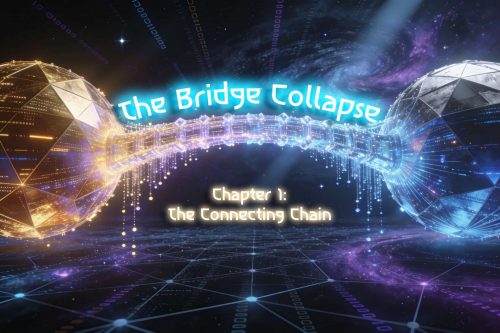
The Sylva Bridge Command Hub hummed with the soft, persistent whir of cooling fans and the occasional chime of incoming data packets. Tess sat in her ergonomic chair, her fingers dancing across a holographic interface that projected shimmering blue and green data streams into the air before her. The room was circular, with walls lined with screens displaying real-time metrics—transaction volumes, validator statuses, pool balances, and network latency graphs.
But Tess barely needed to look at the screens anymore. She could feel the bridge’s pulse in her bones.
The Sylva Bridge was her masterpiece. A technological marvel that connected two entirely separate blockchain networks—Chain A and Chain B—allowing users to move digital assets between them as easily as transferring money between bank accounts. It was elegant, efficient, and, most importantly, trusted. Tess had spent two years perfecting its architecture, and now, at seventeen, she was the youngest Bridge Operator in the sector.
She glanced at the main display, which showed a stylized visualization of the bridge’s operations. On the left, a glowing golden sphere represented Chain A’s asset pool—millions of tokens locked in smart contracts, waiting to be unlocked. On the right, a shimmering silver orb represented Chain B, where equivalent assets were minted and circulated. Between them, a pulsing blue line represented the bridge itself, the “connecting chain” that made interoperability possible.
A soft chime announced an incoming transfer request. Tess straightened in her chair, her eyes scanning the details.
Transfer ID: #84721-B
User: Sparrow_Alpha
Source: Chain A (Pool: 1,847,320 tokens)
Destination: Chain B
Amount: 2,500 tokens
“Another one,” Tess murmured, a small smile crossing her lips. She loved watching the process unfold—the elegant ballet of code and cryptography that made cross-chain transfers possible.
She initiated the sequence, her fingers moving with practiced precision across the interface. The system responded immediately, executing the pre-programmed steps that Tess had designed months ago.
The first step was the Lock.
On her left screen, Tess watched the Chain A smart contract spring to life. The contract was a digital vault—secure, immutable, and governed by the strictest cryptographic rules. When the transfer request was approved, the contract automatically locked the specified amount of assets, moving them from the user’s wallet into the bridge’s custody.
A visualization appeared: 2,500 tiny golden sparks detached from the larger golden sphere and drifted into a separate “lock box,” marked with the Transfer ID. The user’s wallet on Chain A showed the tokens leaving. The bridge’s pool showed them arriving.
“Lock confirmed,” a synthesized voice announced. “Chain A custody transferred.”
Tess nodded, her eyes moving to the right screen. The second step was the Mint.
On Chain B, an equivalent smart contract received the lock confirmation. But this contract didn’t lock assets—it created new ones. In the world of blockchain, this was called “minting”—generating new tokens out of thin air, backed entirely by the locked assets on Chain A.
The visualization showed 2,500 silver sparks materializing on Chain B’s side, shimmering into existence within the bridge’s secondary pool. The user’s wallet address on Chain B was already prepared to receive them.
“Mint confirmed,” the voice announced. “Equivalent assets created on Chain B.”
Tess leaned back, watching the final step: the Transfer. The newly minted tokens flowed from the bridge’s pool into Sparrow_Alpha’s wallet on Chain B. The total time: just under four seconds.
Transfer #84721-B was complete.
Tess allowed herself a moment of satisfaction. The Sylva Bridge had just processed its 84,721st successful transfer without a single failure. Every token was accounted for. Every transaction was mathematically verifiable. The system was perfect.
She was so focused on her work that she almost didn’t notice the figure slouching in the doorway.
“You know,” a voice drawled, “watching you work is like watching a very orderly, very predictable machine. It’s almost hypnotic.”
Tess spun around, her hand instinctively reaching for a panic button before she recognized the speaker. “Remy! You scared me.”
Remy grinned, pushing off the doorframe and ambling into the Command Hub. He was sixteen, a year younger than Tess, with perpetually messy hair and eyes that seemed to notice everything and trust nothing. He wore a faded hoodie with a stylized “R” logo—his own personal brand, because of course he had one.
“Sorry, sorry,” he said, not sounding sorry at all. “I just came to check on the relay logs. Some of my data feeds were acting weird this morning. Thought I’d see if your side was having issues.”
Tess raised an eyebrow. “Nothing on my side. The bridge is running flawlessly, as usual.”
“Flawlessly,” Remy repeated, the word dripping with skepticism. He pulled up a small holographic display from his wrist device, scrolling through lines of data with practiced ease. “Always a dangerous word, Tess. Nothing is ever truly flawless.”
“Careful,” Tess said, a playful edge in her voice. “If you keep being that cynical, you’ll develop wrinkles before you’re eighteen.”
Remy snorted. “I prefer to call it ‘healthy skepticism.’ It’s kept me alive in this industry.” He paused, squinting at one of the data streams on Tess’s main display. “Speaking of which, what’s that?”
He pointed to a thin blue line on the visualization—a “relayed message” stream that carried transaction proofs between chains. Tess followed his gaze.
“That’s just the standard relayer traffic,” she explained. “It’s how the chains communicate with each other. You know that—you’re the one who submits half of these proofs.”
“I know what a relayer does,” Remy said, tapping his display. “But look at this entry. The validator signature on this proof has a timestamp that’s… off.”
Tess frowned, pulling up the specific data entry on her own screen. It was a validator signature from one of the nine entities that governed the bridge—the Validator Council. Each transfer had to be approved by at least seven of the nine validators, and their digital signatures were the bridge’s ultimate security layer.
But Remy was right. The timestamp on this particular signature was strange. It had been recorded during a scheduled maintenance window for that validator—a time when they should have been completely offline.
Tess shook her head. “That’s probably just a synchronization glitch. The validator’s node might have been slightly delayed in reporting its timestamp. It happens sometimes.”
“Does it?” Remy asked, his tone neutral but his eyes sharp. “I’ve been doing this for a while, Tess. I’ve never seen a validator sign something while their node was down for maintenance. That’s not a glitch. That’s an impossibility.”
Tess felt a flicker of irritation. Remy was always finding problems that didn’t exist. He was a brilliant relayer—one of the best in the business—but his relentless pessimism could be exhausting.
“It’s fine,” she said, closing the data window. “The signature is valid. The cryptography checks out. Whatever minor timestamp discrepancy you’re seeing is just noise.”
Remy held her gaze for a moment, his expression unreadable. Then he shrugged, his face relaxing into his usual sardonic smile.
“Okay, okay. I’ll take your word for it. You’re the expert.” He stretched, his joints cracking audibly. “Anyway, I should get back to my own feeds. Some of us have to work for a living.”
“You’re paid in tiny transaction fees,” Tess pointed out.
“Tiny transaction fees that add up,” Remy shot back, already heading for the door. “Don’t forget, Tess—if a system is too perfect, it’s usually hiding a flaw.”
He was gone before she could respond, his footsteps echoing down the hallway.
Tess turned back to her screens, shaking her head. Remy’s comment lingered in her mind, unwelcome and persistent. She dismissed it with a mental shrug. He was wrong. The Sylva Bridge was a masterpiece. She had designed it with multiple layers of security, redundancy, and cryptographic verification. There was no way a single compromised signature could slip through.
But even as she thought it, a small voice in the back of her mind whispered: What if he’s right?
The rest of Tess’s shift was uneventful. She processed another fifteen transfers, all of which went through without a hitch. She responded to a few user inquiries in the community chat, explaining the bridge’s mechanics to a newcomer who was nervous about “locking” their assets.
“Think of it like a safety deposit box,” she typed, her fingers flying across the interface. “When you move tokens from Chain A to Chain B, we lock your original assets in a secure vault. Then we create equivalent assets on Chain B. When you want to move back, we burn the Chain B assets and unlock the originals. It’s always one-to-one. You never lose value.”
The user, who went by the handle “CryptoNewbie42,” seemed satisfied with the explanation. Tess smiled. This was the part of the job she loved—helping people understand the technology and trust it enough to use it.
By the time her shift ended, the sun had long since set outside the Hub’s tinted windows. Tess saved her work, checked the bridge’s health metrics one last time, and logged off.
The Command Hub fell silent, the displays dimming to their standby state. Tess looked at the main visualization one more time—the golden and silver spheres, the pulsing blue line, the nine validator slots glowing green.
It was beautiful. It was perfect.
She turned and walked out, the door sliding shut behind her with a soft hiss.
Tess’s apartment was small but functional, cluttered with data pads, technical manuals, and the occasional energy bar wrapper. She lived alone—had been living alone since her parents relocated to a different sector for work. The independence suited her. It gave her time to focus on what mattered: the bridge.
She collapsed onto her sofa, her mind still buzzing with the day’s events. Remy’s words echoed in her head: “If a system is too perfect, it’s usually hiding a flaw.”
Tess pulled up the bridge’s validator logs on her personal device, scrolling through them idly. She didn’t know why she was checking—Remy was just being paranoid, as usual. But something about that timestamp bugged her.
She found the entry he had pointed out: Validator #3, signature timestamped during maintenance. The cryptographic proof was flawless. The mathematics didn’t lie.
But the timestamp didn’t add up.
Tess frowned, her fingers hovering over the device. She could dig deeper. She could trace the signature’s origin, verify the validator’s activity logs, and definitively prove that Remy was wrong.
She almost did it. Almost.
Then she shook her head, closed the app, and tossed the device onto the coffee table. It was late. She was tired. And Remy was probably just being dramatic.
Tomorrow, she would run a full diagnostic on the validator logs, just for peace of mind. But tonight, she needed sleep.
She lay back on the sofa, staring at the ceiling. The apartment was silent except for the faint hum of the city outside—a constant, low-frequency drone of data centers and transit systems and the digital heartbeat of a connected world.
Tess closed her eyes, and for a few moments, she felt at peace.
But as she drifted toward sleep, one last thought surfaced, unbidden and unsettling:
What if the flaw wasn’t in the bridge? What if it was in the validators?
The thought was so alarming that it jolted her awake. She sat up, heart racing, and reached for her device again.
Then she stopped herself. She was being ridiculous. The Validator Council was composed of nine of the most trusted entities in the sector. They had reputations to protect, security protocols that rivaled military-grade systems, and everything to lose if they were compromised.
The thought faded, and Tess lay back down, convincing herself she was just overtired.
She fell asleep a few minutes later, the device forgotten on the coffee table, the validator logs unexamined.
Across the city, in a cluttered apartment filled with cooling fans and data arrays, Remy was still awake.
He was running his own diagnostic, pulling the same logs Tess had dismissed, analyzing the same timestamp anomaly. His eyes were bloodshot, his face illuminated by the harsh blue glow of multiple holographic displays.
The signature from Validator #3 was valid. The cryptography was flawless. But the timestamp was impossible.
Remy had been a relayer for three years. He had seen network glitches, synchronization errors, and latency spikes. He knew the difference between an honest bug and something suspicious.
This was suspicious.
He pulled up a second set of logs—Validator #3’s activity history for the past six months. He ran a pattern analysis, looking for any other anomalies.
His heart rate quickened as the results came in.
There were more.
Three other signatures with impossible timestamps. All from Validator #3. All during maintenance windows. And all in the past two weeks.
Remy leaned back, his mind racing. Someone was using Validator #3’s private keys. Someone who wasn’t the validator themselves.
He pulled up his secure messaging app and started typing a message to Tess.
“Tess. I know you think I’m paranoid, but I found more anomalies. We need to talk. ASAP.”
He hesitated, his finger hovering over the “send” button. Tess would probably dismiss it again. She was so confident in her creation, so proud of what she had built, that she couldn’t see the cracks forming.
But Remy had seen enough cracked systems to know that denial was the first step toward disaster.
He sent the message, watched it move from “sending” to “sent,” and then stared at the data on his screen.
The bridge was beautiful, elegant, and powerful. But it was built on trust—trust in nine entities, trust in their keys, trust in their security.
And Remy had just found proof that one of those entities was no longer trustworthy.
He didn’t sleep that night. He couldn’t. He just stared at the data, waiting for the inevitable moment when the attackers would strike.
The next morning, Tess woke to a buzzing notification on her device. It was Remy’s message.
She read it, sighed, and typed a quick reply: “I’ll check the logs again later. But I’m sure it’s nothing. Get some sleep, Remy. You look like you need it.”
She didn’t check the logs. She didn’t even think about the timestamp anomaly.
She had a busy day ahead of her—a meeting with the Validator Council, a new batch of user transfers, and a system upgrade scheduled for the afternoon.
The Sylva Bridge was her masterpiece, her legacy, her life’s work. It was perfect.
She just didn’t know yet how soon that perfection would shatter.
Table of contents:
Introduction
Chapter 1: The Connecting Chain
Chapter 2: A Trustless Bridge <<<<<< NEXT
Chapter 3: The Validator’s Keys
Chapter 4: The Relayed Message
Chapter 5: The Hacked Oracle
Chapter 6: The Bridge Drain
Chapter 7: The Forensic Audit
Chapter 8: The Rotating Validator Set
Chapter 9: The Decentralized Bridge Network
Chapter 10: Interconnected, Not Interdependent
