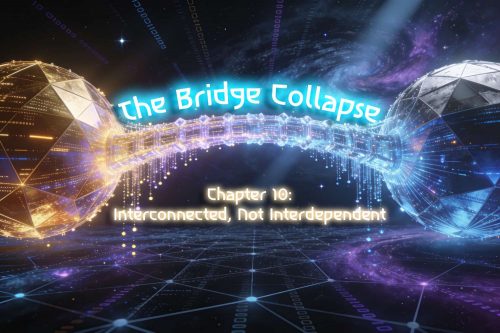
Six months had passed since the launch of the Decentralized Bridge Network. Six months of growth, refinement, and constant vigilance. The network had expanded to include fifteen bridges connecting eight different chains, with more in development. The community had embraced the system with enthusiasm, using it to move assets across the ecosystem with unprecedented ease and security.
But Tess knew that the work was never finished.
She stood in the Command Hub, her eyes fixed on the network visualization that dominated the room. The display showed a complex web of glowing connections—bridges, chains, validators, and data streams all intertwined in a beautiful, chaotic dance. It was a testament to everything she and Remy had built together.
“You’re staring at it again,” Remy said, his voice tinged with amusement. He walked up beside her, a steaming cup of something in his hand. “I swear, you spend more time looking at that display than you do sleeping.”
Tess smiled, not taking her eyes off the visualization. “I can’t help it. Every time I look at it, I see something new. A connection I hadn’t noticed. A pattern I hadn’t seen. It’s like the network is alive.”
Remy snorted, taking a sip of his drink. “It’s not alive, Tess. It’s just code. Beautiful, elegant, incredibly complex code. But still just code.”
Tess finally turned to him, her eyes sparkling with amusement. “You’re such a cynic, Remy. Can’t you just appreciate the beauty of what we’ve built?”
Remy grinned, his usual sardonic humor on full display. “I appreciate it every day. But I also appreciate that the network is only as strong as its weakest link. And that’s why we can’t afford to get complacent.”
Tess nodded, her expression turning serious. “You’re right. And that’s exactly why I’ve been staring at the display. We have a new challenge on the horizon.”
Remy raised an eyebrow. “What kind of challenge?”
Tess gestured to the display, zooming in on a specific section of the network. “See this? It’s a new chain that wants to join the network. But it has a completely different architecture than anything we’ve connected before. It uses a different consensus mechanism, different smart contract language, different everything.”
Remy studied the data, his brow furrowing. “That’s going to be complicated. We’ll need to build a completely new type of bridge to connect to it.”
“Exactly,” Tess said. “And that means new vulnerabilities, new attack vectors, new unknowns. We’re venturing into uncharted territory.”
Remy was silent for a moment, his mind processing the challenge. Then he spoke, his voice thoughtful.
“Do you remember what you said to me, back when we were first building the network? You said the goal wasn’t to build a perfect system. It was to build a system that could adapt and evolve.”
Tess nodded slowly. “I remember. And I still believe that. But adapting and evolving means taking risks. And taking risks means we might fail again.”
Remy placed a hand on her shoulder, his grip firm and reassuring. “We’ve failed before, Tess. And we survived. We learned. We grew. That’s what makes this network so strong—not just the technology, but the people behind it.”
Tess smiled, a genuine smile that reached her eyes. “You’re right. We’ve been through the worst, and we came out stronger. We can handle whatever comes next.”
She turned back to the display, her eyes fixed on the new chain. “So let’s build that bridge. Let’s connect that chain. And let’s prove that this network can do anything.”
The new bridge project took weeks of intense work.
Tess and Remy assembled a team of developers, security experts, and community volunteers to tackle the challenge. They spent countless hours analyzing the new chain’s architecture, designing the bridge’s protocols, and testing the system’s security.
“This is unlike anything we’ve done before,” Tess admitted during one of their late-night planning sessions. “The chain’s consensus mechanism is completely different. We can’t just copy the existing bridge designs—we have to start from scratch.”
Remy nodded, his eyes fixed on the code he was writing. “I’ve been working on a new type of relay protocol. It’s designed to handle the chain’s unique transaction structure. If it works, the bridge will be able to process transfers as efficiently as the others.”
Tess leaned over, studying his code. “It’s elegant, Remy. Really elegant. But we need to be careful. A new protocol means new vulnerabilities. We need to test it thoroughly before we deploy it.”
Remy grinned, a hint of his old recklessness surfacing. “Where’s the fun in that?”
Tess laughed, the sound bright and genuine. “The fun is in building something that doesn’t break. Remember what happened the last time we deployed something without testing it properly?”
Remy’s grin faded, replaced by a more serious expression. “I remember. And you’re right. We’ll test it. Thoroughly.”
The testing phase lasted two weeks.
Tess and Remy ran the new bridge through every possible scenario—successful transfers, failed transfers, edge cases, and worst-case scenarios. They simulated attacks, injected errors, and pushed the system to its limits.
And finally, they were ready.
“The bridge is stable,” Tess announced to the team. “We’ve tested it thoroughly, and we’re confident it’s secure. We’re ready to connect to the new chain.”
The team erupted in cheers. Tess smiled, her heart swelling with pride. This was what she had always dreamed of—a network that could grow, adapt, and evolve to meet the needs of the community.
The connection to the new chain was a success.
Tess watched on the main display as the network visualization updated, adding a new glowing node to the web of connections. The new bridge was online, processing transfers, connecting the chain to the rest of the ecosystem.
“It’s beautiful,” Tess whispered, her voice filled with awe.
Remy stood beside her, his own eyes fixed on the display. “It is. And it’s only the beginning. There are dozens more chains out there, each one with its own unique architecture. We can connect them all.”
Tess nodded, a spark of excitement in her eyes. “That’s the vision. A truly interconnected ecosystem, where anyone can move assets between any chains, securely and efficiently.”
She turned to him, her expression thoughtful. “But we can’t do it alone. We need the community’s help. We need developers, security experts, validators—all working together to build the network.”
Remy smiled, a genuine smile that reached his eyes. “That’s the beauty of this network, Tess. It’s not just ours. It belongs to everyone. And everyone has a stake in making it work.”
The Bridge Monitoring Service was Tess’s next priority.
She had been working on it for months, refining its AI algorithms, expanding its capabilities, and integrating it with the network’s infrastructure. The service was already operational, but Tess wanted to make it even better.
“We need real-time anomaly detection,” she told Remy during one of their planning sessions. “Not just for individual bridges, but for the entire network. If an attack is happening anywhere, we need to know about it immediately.”
Remy nodded, his fingers flying across his interface. “I’ve been working on a new algorithm that can detect patterns across multiple bridges simultaneously. It’s designed to identify coordinated attacks—the kind that might target several bridges at once.”
Tess studied his work, her eyes widening with excitement. “This is incredible, Remy. With this algorithm, we could detect an attack before it even happens.”
Remy grinned, a hint of pride in his voice. “That’s the goal. We’ve already prevented several attacks with the current system. This new algorithm will make us even faster.”
Tess smiled, her heart swelling with gratitude. “Thank you, Remy. For everything. I couldn’t have done this without you.”
Remy shrugged, his grin turning sheepish. “That’s what partners are for, right?”
The first real test of the new algorithm came two weeks later.
Tess was in the Command Hub, reviewing the network’s daily report, when the monitoring service issued a warning.
“Anomaly detected,” the system announced, its voice calm and steady. “Multiple bridges showing suspicious activity. Pattern indicates a coordinated attack.”
Tess’s heart raced. She pulled up the details, her eyes scanning the data with frantic urgency.
“What is it?” Remy asked, rushing to her side.
Tess pointed to the display. “It’s a coordinated attack—targeting three different bridges simultaneously. The attackers are using the same techniques as before—compromised keys, time-delay attacks, relayed message backdoors.”
Remy’s face went pale. “Can we stop them?”
Tess was already executing the response protocols. “I’m isolating the affected bridges. Rerouting all traffic to the remaining bridges. The monitoring service is tracking the attackers’ movements in real-time.”
The network visualization showed the three bridges dimming, their connections severed from the rest of the network. The traffic was rerouted instantly, flowing through the unaffected bridges.
“Bridges isolated,” Tess announced, her voice steady. “Traffic rerouted. No assets have been lost.”
Remy let out a long breath, the tension slowly leaving his shoulders. “That was close. If the monitoring service hadn’t caught it…”
“I know,” Tess said, her voice heavy. “But it did catch it. And the system worked perfectly. The network is still operational, and the attackers have been neutralized.”
She pulled up the forensic data, analyzing the attackers’ activity. “They’re using the same techniques as before—phishing attacks, shadow keys, time-delay attacks. But the network’s distributed architecture prevented them from doing any damage.”
Remy nodded, a grim satisfaction in his eyes. “They thought they could break the system. But they didn’t count on the network’s resilience.”
Tess smiled, a genuine smile of pride and relief. “That’s the power of the Decentralized Bridge Network. Interconnected, but not interdependent. No single point of failure.”
She turned to the display, her gaze sweeping across the network. The bridges were glowing, their connections pulsing with activity. The system was alive, vibrant, and resilient.
“We’ve proven that it works,” Tess said, her voice filled with conviction. “The network is strong. It can survive anything.”
Later that evening, Tess sat alone in the Command Hub, her interface glowing with the network’s data streams. The system was quiet, the bridges humming with activity in the background.
She thought about everything that had happened—the attack, the despair, the forensic audit, the validator rotation, the network launch. It had been the most difficult period of her life, but it had also been the most transformative.
She had learned so much. She had learned that trust was a vulnerability, that systems needed to be resilient by design, that the community was the most powerful force for change. And she had learned that she was stronger than she ever thought possible.
Her communicator chimed with a message from a young user she had been mentoring—a newcomer to the ecosystem who had been asking questions about the network.
“Tess, I’ve been reading about the Sylva Bridge attack. It’s terrifying. How can we ever be truly safe? How can we trust that the network won’t be broken again?”
Tess read the message, her heart aching with empathy. She remembered feeling the same way—the fear, the doubt, the overwhelming sense of vulnerability.
She typed a thoughtful reply.
“That’s a great question. And the honest answer is: we can never be truly safe. There will always be attackers, always be vulnerabilities, always be risks. But that doesn’t mean we should give up. It means we should build systems that are resilient by design—systems that can survive attacks, adapt to new threats, and evolve over time.
“The old Sylva Bridge was built on trust—trust in the validators, trust in the cryptography, trust in the system. But trust is a vulnerability. The new network doesn’t rely on trust. It relies on redundancy, diversity, and constant vigilance. We accept that attacks will happen. And we build systems that can survive them.
“That’s the lesson I’ve learned through all of this. Security is a journey, not a destination. It’s not about building a perfect system. It’s about building a system that can learn, adapt, and grow stronger over time. And that’s exactly what we’re doing with the Decentralized Bridge Network.
“So don’t be afraid. Be vigilant. Be engaged. Be part of the community. Because the network is only as strong as the people who use it and protect it. And together, we can build something that truly lasts.”
She sent the message, her heart swelling with hope. The young user’s question had reminded her of something important—something she had almost forgotten in the chaos of the past months.
The network wasn’t just about technology. It was about people. It was about community. It was about building something together that was stronger than any single individual could create alone.
Remy found her still sitting in the Command Hub, staring at the network visualization.
“Hey,” he said, his voice soft. “Everything okay?”
Tess turned to him, a small smile on her face. “Everything’s perfect. I was just thinking about how far we’ve come.”
Remy walked over, standing beside her. “It’s been quite a journey, hasn’t it? From the Sylva Bridge to this.” He gestured to the network visualization, the glowing web of connections that stretched across the display.
Tess nodded, her eyes fixed on the display. “I still remember the day you showed me that timestamp anomaly. I thought you were crazy.”
Remy laughed. “I thought you were stubborn. Which, to be fair, you were.”
Tess laughed too, the sound bright and genuine. “I was. And I’m sorry for that. If I had listened to you sooner…”
Remy shook his head. “Don’t do that, Tess. Don’t blame yourself. The attack wasn’t your fault. It was the attackers’ fault. And we stopped them. We built something better. That’s what matters.”
Tess was silent for a moment, his words sinking in. Then she spoke, her voice thoughtful.
“Do you ever wonder what the future holds? For the network, I mean.”
Remy considered the question, his eyes fixed on the display. “I think it’s going to keep growing. More bridges, more chains, more users. I think the network is going to become the backbone of the entire ecosystem.”
Tess nodded slowly. “I think so too. And I think that’s going to bring new challenges. New vulnerabilities. New attacks.”
Remy grinned, a hint of his old adventurous spirit shining through. “Good. Because I was starting to get bored.”
Tess laughed, the sound echoing through the empty Command Hub. “You’re impossible, you know that?”
Remy shrugged, his grin widening. “That’s what partners are for, right?”
Tess smiled, her heart swelling with gratitude. “Yeah. That’s what partners are for.”
The next morning, Tess arrived at the Command Hub to find a message waiting for her from the Validator Council.
“Tess, we’ve been monitoring the network’s performance. We’re impressed with the results. The Decentralized Bridge Network is everything we hoped it would be—resilient, secure, and adaptable. We’re proud of what you’ve accomplished.”
Tess read the message, a smile spreading across her face. It was a small acknowledgment, but it meant the world to her.
She typed a quick reply.
“Thank you. But I couldn’t have done it without the community’s support. The network belongs to everyone—the validators, the relayers, the users. We built it together, and we’ll protect it together.”
She sent the message and leaned back in her chair, her eyes fixed on the network visualization. The bridges were glowing, their connections pulsing with activity. The system was alive.
And Tess was ready for whatever came next.
Table of contents:
Introduction
Chapter 1: The Connecting Chain
Chapter 2: A Trustless Bridge
Chapter 3: The Validator’s Keys
Chapter 4: The Relayed Message
Chapter 5: The Hacked Oracle
Chapter 6: The Bridge Drain
Chapter 7: The Forensic Audit
Chapter 8: The Rotating Validator Set
Chapter 9: The Decentralized Bridge Network
Chapter 10: Interconnected, Not Interdependent
