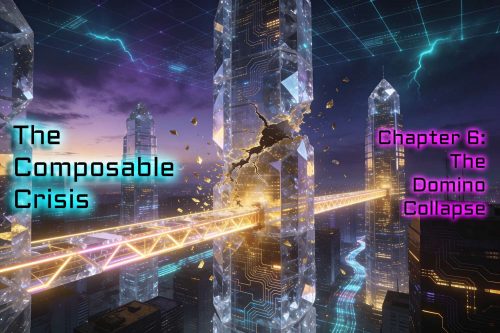
The DeFi District was in chaos.
Ravi watched from his virtual vantage point as the city he’d helped build crumbled around him. Protocol A’s skyscraper flickered with emergency warnings, its once-pristine facade now cracked and dim. Protocol B’s farm lay barren, its fields scorched by the stampede of withdrawing users. The bridges connecting protocols—the arteries of composability—were clogged with panicked traffic, avatars rushing to salvage whatever they could.
But amid the chaos, something else was happening. Something systematic. Something cold and precise.
Ravi noticed it first in the transaction logs. A series of rapid-fire operations, each one perfectly timed, each one exploiting the price discrepancies between protocols. They were too fast to be human, too coordinated to be random.
“The Arbitrage Bot,” he murmured.
Ravi had heard of the Arbitrage Bot before. It was a legend in the DeFi community—an automated trading system that scanned the ecosystem for price differences and executed flash loans to profit from them. Some users admired it as a market efficiency tool. Others feared it as a predator.
Ravi had always been neutral. The bot was just code, following its programming. It didn’t have intentions, didn’t have malice. It just did what it was designed to do.
But now, watching the bot’s activity, Ravi realized that the bot’s “just doing what it’s designed to do” was making the crisis worse. Much worse.
He pulled up the bot’s transaction history and felt his blood run cold. The Arbitrage Bot had detected the oracle mismatch between Protocol A and Protocol B—the same mismatch that had triggered his liquidation—and was exploiting it ruthlessly.
The bot’s logic was elegant in its brutality. Step one: Execute a flash loan—borrow a massive amount of capital in a single transaction, with the condition that it must be repaid in the same transaction. Step two: Use the borrowed capital to buy discounted collateral from Protocol A’s liquidation engine. Step three: Sell that collateral on Protocol B for a profit. Step four: Repay the flash loan with interest, keeping the difference.
Each individual arbitrage trade was tiny—a fraction of a percent profit. But the bot executed thousands of them per minute, each one applying downward pressure on Protocol A’s prices and upward pressure on Protocol B’s. The mismatch widened instead of narrowing.
“It’s not just profiting from the crisis,” Ravi muttered. “It’s making the crisis worse.”
He watched as another wave of arbitrage transactions flooded the network. Protocol A’s collateral value dropped another 2%. Protocol B’s oracle, still lagging, showed the higher value. The bot swooped in, bought the discounted assets, and sold them for a tidy profit.
“Stop,” Ravi whispered. “Please stop.”
But the bot didn’t stop. It was code. It had no conscience, no mercy. It was doing exactly what it was designed to do, and the ecosystem was paying the price.
At 7:15 PM, Ravi called Talia.
“The Arbitrage Bot,” he said. “It’s making everything worse.”
Talia was silent for a moment. Then she said: “I’ve been tracking it. The flash loans are accelerating the cascade.”
“Can we stop it?”
“Not easily. The bot is decentralized—it runs on multiple nodes, executing transactions across the network. We’d need to shut down the entire ecosystem to stop it.”
Ravi’s heart sank. “There has to be something we can do.”
“We’re working on it. The core teams are discussing a temporary pause on flash loans. But that takes coordination, and we’re already stretched thin.”
Ravi thought about the bot’s activities. Thousands of transactions per minute, each one exploiting the chaos. It was like watching a vulture circle a wounded animal, picking at the carcass while it was still alive.
“There has to be another way,” he said.
“Maybe,” Talia said. “But we don’t have time to find it. The bot is accelerating the collapse. We need to stop it before it’s too late.”
At 7:30 PM, Ravi dove deeper into the bot’s behavior.
He pulled up the code—or at least, the parts of it that were visible on the network. The bot was complex, a sophisticated piece of automation that had been refined over years of operation. Its creators had designed it to be efficient, ruthless, and almost impossible to stop.
But as Ravi studied the code, he noticed something. A small vulnerability. A tiny oversight in the bot’s logic that could be exploited.
“The bot assumes that price discrepancies will correct themselves,” Ravi muttered. “It’s designed to profit from arbitrage, not to create it. If we can flood the market with conflicting signals, the bot might get confused.”
He called Talia. “I might have a way to slow the bot down.”
“How?”
“By creating a false price signal. If we can make the bot think the discrepancy is going the other way, it might execute trades that hurt its own profitability.”
Talia was silent for a moment. “That’s risky. If we flood the market with bad data, we could make the crisis worse.”
“Or we could give ourselves time to stop the bleed. It’s worth a try.”
“Let me talk to the core teams. I’ll get back to you.”
At 7:45 PM, Ravi sat alone in his room, staring at his dashboard. The Arbitrage Bot was still active, its transactions scrolling across his screen in an endless stream. Each one was a small wound, a tiny cut that bled the ecosystem of value.
He thought about the bot’s creators. Were they watching? Did they understand the damage their creation was causing?
It’s not the bot’s fault, he told himself. It’s just code. It’s following its programming. The fault is with the system that allowed it to exist.
But that didn’t make it any easier to watch.
At 8:00 PM, Talia called back.
“The core teams agree. We’re going to try it. But we need you to implement the false signal.”
Ravi blinked. “Me? Why me?”
“Because you understand the protocol architecture better than anyone. And because you have the tools to do it quickly.”
Ravi felt a surge of anxiety. He was being asked to intervene in the crisis—to actively shape its outcome. It was a responsibility he hadn’t asked for, but it was one he couldn’t refuse.
“What do I need to do?” he asked.
“I’ll send you the parameters. You’ll need to create a temporary data feed that conflicts with the bot’s assumptions. It’s a short-term solution, but it should buy us time.”
Ravi nodded, even though Talia couldn’t see him. “I’ll do it.”
“Thank you, Ravi. This means a lot.”
For the next hour, Ravi worked with feverish intensity. He created a false data feed, injected it into the network, and watched as the Arbitrage Bot’s behavior began to change.
The bot hesitated. Its transactions slowed. It was processing conflicting signals, trying to reconcile data that didn’t match. For a moment, Ravi thought it might work.
But then the bot adapted. Its algorithms recalibrated, prioritizing some data sources over others. The transactions resumed, faster and more aggressive than before.
“It’s learning,” Ravi muttered. “The bot is learning.”
He called Talia. “It’s not working. The bot is adapting too quickly.”
“We expected that,” Talia said. “The core teams are activating the next phase: a temporary pause on flash loans. It’ll take ten minutes to implement.”
“Ten minutes is too long. The bot will execute thousands of transactions in that time.”
“I know. But it’s the only option we have.”
At 9:15 PM, Ravi watched the Arbitrage Bot’s transactions with growing despair. Each one was a tiny victory for the bot, a tiny defeat for the ecosystem. The price gap between Protocol A and Protocol B had widened to 5%, and the bot was exploiting it ruthlessly.
This is what Talia warned me about, he thought. Systemic risk. Interconnected protocols. A small failure amplifying into a catastrophe.
He thought about his strategy, his leverage loop, his beautiful machine. It had been a toy compared to this—a child’s building blocks next to a skyscraper. The Arbitrage Bot was a reminder that the ecosystem was bigger than any individual, more complex than any strategy.
I was a fool to think I could control it, he thought. I was a fool to think I could outsmart it.
But even as he thought it, he felt a flicker of determination. He’d made mistakes, yes. He’d been overconfident, reckless, naive. But he was still here. He was still learning. And he was still fighting.
At 9:30 PM, the flash loan pause activated.
Ravi watched as the Arbitrage Bot’s transactions suddenly stopped. The network was quiet, the bot’s relentless assault finally halted. For the first time in hours, the ecosystem had a moment of peace.
“It’s working,” Ravi whispered. “The pause is working.”
He opened his community dashboard and saw the messages flooding in. Users were relieved, grateful, cautiously optimistic. The crisis wasn’t over, but the worst of it had been contained.
Ravi felt a wave of exhaustion wash over him. He’d been awake for almost twenty hours, running on adrenaline and fear. Now that the immediate danger had passed, his body was reminding him of its limits.
But he couldn’t rest. Not yet. There was still work to do.
At 10:00 PM, Talia called.
“The flash loan pause is holding. The Arbitrage Bot is temporarily disabled. We have time to breathe.”
“For now,” Ravi said. “But the bot will reactivate eventually. The moment the pause ends, it’ll resume its activities.”
“We know. That’s why we’re using this time to implement permanent solutions.”
“What kind of solutions?”
“Better risk parameters. Improved oracle synchronization. And a new approach to composability—one that prioritizes safety over efficiency.”
Ravi nodded. “That sounds like the right direction.”
“We’ll need your help to design it,” Talia said. “You understand the ecosystem better than almost anyone. Your perspective is valuable.”
Ravi felt a surge of gratitude. Even after everything, Talia was still willing to work with him. She still believed in his ability to contribute.
“I’ll help,” he said. “Whatever you need.”
“Good. Get some rest. Tomorrow, we rebuild.”
But Ravi couldn’t sleep. He lay in bed, staring at the ceiling, thinking about the Arbitrage Bot. It wasn’t evil—it was just code, following its programming. But its programming had caused immeasurable damage.
That’s the problem with automation, he thought. It doesn’t have a conscience. It doesn’t understand the consequences of its actions. It just does what it’s designed to do.
He thought about his own strategies, his own automation, his own code. He’d built systems that executed trades without his direct intervention, trusting that they’d make the right decisions. But they didn’t have consciences either. They were just tools, and tools could be used for good or for harm.
The difference between the Arbitrage Bot and me, he realized, is that I can learn. I can change. I can choose to be better.
It was a small comfort, but it was enough.
At 10:30 PM, Ravi received a message from an anonymous user.
“You’re Ravi, right? The one who promoted the composable strategy?”
Ravi’s heart sank. Another angry user, another accusation.
“Yes,” he typed.
“You caused this crisis.”
“I know. I’m sorry.”
“Sorry isn’t enough. People lost everything because of you.”
Ravi stared at the message, his fingers trembling. He wanted to defend himself, to explain that the crisis wasn’t entirely his fault, that the system was flawed, that the Arbitrage Bot had made everything worse.
But he couldn’t. The user was right. He had caused this crisis. Not alone, but he’d been a catalyst.
“You’re right,” he typed. “I caused this crisis. And I’m going to spend the rest of my life making sure it never happens again.”
There was a long pause. Then the anonymous user replied: “That’s the right answer. Don’t let us down.”
Ravi nodded, even though the user couldn’t see him. “I won’t.”
At 11:00 PM, Ravi finally closed his eyes. The crisis was contained, the bot was paused, and the ecosystem was beginning to stabilize. It wasn’t over, but the worst was behind them.
He thought about Talia, about her sibling’s crash, about the warnings she’d given him. She’d seen this coming. She’d tried to prepare him. And he’d ignored her.
I was too confident, he admitted to himself. Too arrogant. I thought I could control things I couldn’t.
He thought about the Arbitrage Bot, the emotionless machine that had amplified the crisis. It had no malice, no morality. It just did what it was designed to do. That was the danger of automation—it didn’t care about the consequences.
But Ravi cared. He cared deeply. And that was the difference between him and the bot.
“I’ll do better,” he whispered into the darkness. “I’ll learn from this. I’ll build safer systems. I’ll help people understand the risks.”
It was a promise to himself, to Talia, to the users who’d trusted him. It was a promise he intended to keep.
At 11:15 PM, Ravi’s phone buzzed one last time. A message from Talia.
“The flash loan pause will last for 24 hours. The core teams are working on permanent solutions. Get some sleep. We’ll need you tomorrow.”
Ravi smiled. “I will. Thanks for everything, Talia.”
“Thank you for helping. You’re a good person, Ravi. Even when you make mistakes.”
Ravi felt tears well up in his eyes. After everything, after all the anger and blame, Talia still believed in him. It was more than he deserved, but it was exactly what he needed.
“Goodnight, Talia.”
“Goodnight, Ravi. Tomorrow, we rebuild.”
Ravi set his phone aside and closed his eyes. The crisis was still raw, the losses still fresh, but for the first time since the oracle mismatch, he felt hope. The ecosystem would recover. The protocols would improve. And he would be part of that recovery.
The bricks of finance were still there. And this time, he’d build with caution.
Table of contents:
Introduction
Chapter 1: The Bricks of Finance
Chapter 2: A Borrowing Position
Chapter 3: The Yield Farm
Chapter 4: The Leverage Loop
Chapter 5: The Oracle Mismatch
Chapter 6: The Domino Collapse
Chapter 7: The Cascading Liquidation <<<<<< NEXT
Chapter 8: The Circuit Breaker
Chapter 9: The Decoupled Protocols
Chapter 10: Interconnected, Not Fragile
