The circuit breakers had stopped the bleeding, but the damage was already done. Ravi sat in the dim glow of his monitors, staring at his diminished position with hollow eyes. Forty-five percent of his capital remained. It was something, but it felt like nothing.
His phone buzzed. Then again. Then a third time. Messages flooded in from the community—panicked, angry, desperate. Ravi couldn’t bring himself to read them. He knew what they’d say.
But one message caught his attention. It was from Talia.
“Ravi. The cascade isn’t over. The circuit breakers stopped the liquidations, but the damage is spreading through other channels. You need to see this.”
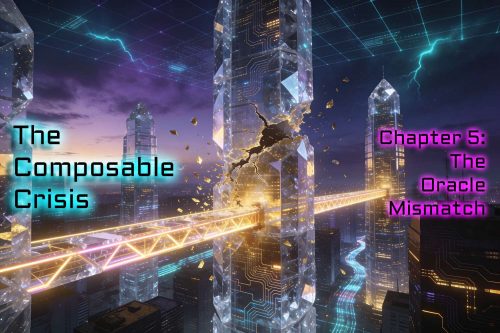
Ravi’s heart sank. He opened his community dashboard and watched in horror as the virtual city of the DeFi District began to crack.
Protocol A’s skyscraper, once a gleaming tower of stability, now flickered with warning lights. Its transparent walls showed the collateral pools inside—and they were shrinking. The liquidation cascade had drained millions of units from the protocol, leaving behind a gaping hole.
“Bad debt warning,” the system announced. “Protocol A’s reserves have fallen below the safety threshold. Please monitor your positions.”
Ravi’s stomach churned. Bad debt meant that Protocol A’s own reserves were insufficient to cover the loans it had issued. It meant that the protocol itself was at risk of insolvency.
“This can’t be happening,” he whispered. “Protocol A is supposed to be safe. It’s one of the biggest protocols in the ecosystem.”
But the numbers didn’t lie. The liquidation cascade had forced Protocol A to sell collateral at a discount, creating losses that its reserves couldn’t absorb. The protocol was hemorrhaging value, and there was no easy way to stop it.
Protocol B’s farm, which had once looked like a lush, productive landscape, now appeared withered and barren. Its yield fields were empty, its tractors idle. Users were withdrawing their funds in a panic, and the protocol’s Total Value Locked—its TVL—was plummeting.
“TVL down 30%,” the system reported. “Please exercise caution when interacting with Protocol B.”
Ravi watched as a stream of red arrows marked the exodus of capital. Users who had once trusted Protocol B were fleeing, taking whatever they could salvage. The stampede was accelerating the collapse.
“This is a bank run,” Ravi muttered. “They’re all running.”
He thought about Talia’s warnings about systemic risk. This was exactly what she’d predicted—a cascade that spread from one protocol to another, feeding on itself until the entire ecosystem was threatened.
At 3:30 PM, Ravi received a message from a user he didn’t recognize.
“You’re Ravi, right? The one who promoted the composable strategy?”
Ravi’s heart sank. He knew what was coming.
“Yes,” he typed.
“I followed your strategy. I lost 70% of my position. I had my life savings in there. What am I supposed to do now?”
Ravi stared at the message, his fingers frozen over the keyboard. He had no advice to offer, no comfort to give. He was as lost as this stranger.
“I don’t know,” he typed finally. “I’m sorry. I don’t know what to do.”
“You should have warned us. You should have known this could happen.”
“You’re right. I should have. I was wrong.”
The user didn’t respond. Ravi didn’t blame them. There was nothing more to say.
At 3:45 PM, Ravi opened his community chat room. The messages were scrolling so fast he could barely read them. Users were shouting, pleading, arguing. Some were calling for the protocols to be shut down. Others were demanding compensation. A few were simply sharing their losses, their stories of financial devastation.
“I lost everything. Everything.”
“My family’s savings. Gone.”
“I trusted this system. I trusted the protocols.”
Ravi read the messages with growing despair. He’d been the one who’d promoted composability, who’d encouraged others to follow his strategy. He’d been the one who’d dismissed Talia’s warnings, who’d insisted the risks were manageable.
And now, dozens—maybe hundreds—of users were suffering because of his overconfidence.
At 4:00 PM, Talia joined the chat room.
“Everyone, please stay calm,” she typed. “The core teams are working on a solution. We’re coordinating with Protocol A and Protocol B to stabilize the situation.”
“Stabilize it?” a user demanded. “Protocol A has bad debt. Protocol B’s TVL is down 30%. There’s nothing to stabilize.”
“We’re activating additional emergency measures,” Talia replied. “Circuit breakers, borrowing restrictions, and reserve injections where possible. It won’t save everything, but it will prevent further collapses.”
“And what about our losses?” another user asked. “What about the people who lost everything?”
Talia paused. Then she typed: “We’re working on that too. But right now, our priority is stopping the bleed. Everything else comes after.”
The chat room fell silent. It wasn’t agreement—it was exhaustion.
Ravi watched the exchange, feeling useless. He wanted to help, to contribute, to do something. But he had nothing to offer. His expertise had led to disaster. His confidence had been a delusion.
At 4:15 PM, Ravi received a private message from Talia.
“Ravi. I need your help.”
Ravi blinked. “My help? After what I did?”
“Yes, your help. You know this ecosystem better than almost anyone. You understand the connections, the dependencies, the leverage points. We need that knowledge right now.”
“But I’m the one who caused this.”
“You caused the trigger,” Talia said. “The cascade was always a possibility. The oracles were always vulnerable. You didn’t create the system’s flaws—you just exposed them.”
Ravi stared at the message. He didn’t feel absolved. He felt complicit.
“What do you need?” he asked.
“I need you to map the dependencies. Every protocol that’s connected to Protocol A or Protocol B. Every position that’s cross-collateralized. Every user who’s exposed to the cascade.”
Ravi nodded slowly. “I can do that.”
“Good. I’ll send you the data. We don’t have much time.”
For the next hour, Ravi worked with a focus he hadn’t felt in days. He pulled up data feeds, analyzed connections, and mapped the ecosystem’s dependencies. His fingers flew across the keyboard, tracing lines of influence that crisscrossed the virtual city.
The network diagram that emerged was a terrifying web. Protocol A and Protocol B were connected to dozens of other protocols—some directly, some through users who’d layered their positions. Each connection was a potential point of failure, a conduit for the cascade to spread.
“This is worse than I thought,” Ravi muttered.
He pulled up Protocol C’s data and felt his blood run cold. Protocol C was a governance token staking platform—it didn’t lend or borrow, but it held positions that were dependent on Protocol A’s collateral values. If Protocol A collapsed, Protocol C would collapse too.
And Protocol C was connected to Protocol D. And Protocol D was connected to Protocol E. And so on, and so on, until the entire ecosystem was entangled in the same web.
“Talia,” Ravi typed. “I have the map. It’s… it’s extensive.”
“Send it to me.”
Ravi transmitted the file. A moment later, Talia responded: “This is exactly what I needed. Thank you.”
“What are you going to do with it?”
“We’re going to prioritize the protocols that are most at risk. Inject reserves where we can. Pause operations where we can’t. And hope that the circuit breakers hold long enough for the panic to subside.”
Ravi nodded. It wasn’t a perfect plan—it wasn’t even a good plan—but it was the only one they had.
At 5:30 PM, Ravi received a message from BlockBuilder99.
“I saw what you did. The dependency map. You’re helping.”
“I’m trying,” Ravi replied. “It’s not much.”
“It’s more than most people are doing. The community is in chaos. At least you’re trying to fix things.”
Ravi felt a small measure of relief. It didn’t erase the guilt, but it reminded him that he could still contribute, still make a difference.
“I should have listened to Talia,” he typed. “She warned me about all of this.”
“We all should have listened to her. But we didn’t. Now we have to deal with the consequences.”
Ravi nodded. “Together?”
“Together.”
At 6:00 PM, the core teams made an announcement.
“Dear community,” the message began. “We are aware of the crisis affecting Protocol A, Protocol B, and connected protocols. The core teams are working around the clock to stabilize the ecosystem. We have activated circuit breakers, restricted borrowing, and are injecting reserves where possible. We ask for your patience and cooperation during this difficult time.”
The announcement was followed by a detailed explanation of the root cause: an oracle mismatch that had triggered a cascade of liquidations. The teams acknowledged that the crisis was a failure of the system’s design—a flaw that had been hidden until now.
“We are committed to learning from this event,” the announcement concluded. “We will implement changes to prevent similar crises in the future. We will rebuild stronger, safer, and more resilient.”
Ravi read the announcement with a mixture of relief and guilt. The core teams were taking responsibility, which was good. But he knew that the crisis wouldn’t have been as severe if he hadn’t been promoting risky strategies.
I helped cause this, he thought. I helped create the conditions for disaster.
He opened his dashboard and looked at his remaining position. Forty-five percent of his capital. It wasn’t nothing, but it was a painful reminder of what he’d lost.
I lost my money. I lost my confidence. I lost the trust of people who followed me.
But I’m still here. I can still rebuild.
At 6:30 PM, Ravi received a message from a user he didn’t recognize.
“Ravi. I just want you to know—you helped me get started in DeFi. I followed your strategies. I made money because of you.”
Ravi stared at the message, confused. “I caused you to lose money too,” he typed back. “Why are you thanking me?”
“Because you taught me how to think about composability. Even if it didn’t work out this time, I learned something valuable. And I know you’ll rebuild. You’re too smart not to.”
Ravi felt tears prick at the corners of his eyes. He’d expected anger, blame, recrimination. Instead, he’d received grace.
“Thank you,” he typed. “I’ll do better next time. I promise.”
“I know you will. Good luck.”
At 7:00 PM, Talia called.
“The circuit breakers are holding,” she said. “The cascade has stopped. We’ve stabilized Protocol A and Protocol B for now.”
“That’s good,” Ravi said. “That’s really good.”
“It’s not over yet. There’s still a lot of work to do. But we’ve bought ourselves some time.”
“What can I do to help?”
“Keep mapping dependencies. Keep tracking the connections. And when we’re ready to rebuild, help us design a system that’s safer.”
Ravi nodded. “I can do that.”
“Ravi,” Talia said, her voice softening. “I know this is hard. I know you’re blaming yourself. But you need to understand—this crisis was inevitable. The system was fragile. You just happened to be the one who found the crack.”
“I should have known better.”
“Maybe. But that’s not the point. The point is that you’re learning. You’re helping. And that’s what matters.”
Ravi was silent for a long moment. Then he said: “Thank you, Talia. For everything.”
“Thank you for helping,” she replied. “We’ll get through this. Together.”
At 8:00 PM, Ravi logged off his computer. His eyes were dry and burning, his body exhausted. He lay back in his chair and stared at the ceiling, processing everything that had happened.
He’d lost a significant portion of his capital. He’d lost the trust of people who’d followed him. He’d lost the confidence that had defined him.
But he’d also gained something. Humility. Perspective. A deeper understanding of the risks and responsibilities of building in a connected world.
“The bricks are still there,” he whispered. “They’re just bricks. It’s how you use them that matters.”
He thought about Talia’s vision: safer composability, risk isolation, circuit breakers. It wasn’t just a technical challenge—it was a philosophical one. How do you build something powerful without making it fragile? How do you encourage innovation while protecting against catastrophe?
“I’ll figure it out,” he murmured. “One brick at a time.”
He closed his eyes and let the exhaustion take him. The crisis wasn’t over, but for now, he could rest. Tomorrow, he would rebuild.
Table of contents:
Introduction
Chapter 1: The Bricks of Finance
Chapter 2: A Borrowing Position
Chapter 3: The Yield Farm
Chapter 4: The Leverage Loop
Chapter 5: The Oracle Mismatch
Chapter 6: The Domino Collapse <<<<<< NEXT
Chapter 7: The Cascading Liquidation
Chapter 8: The Circuit Breaker
Chapter 9: The Decoupled Protocols
Chapter 10: Interconnected, Not Fragile
