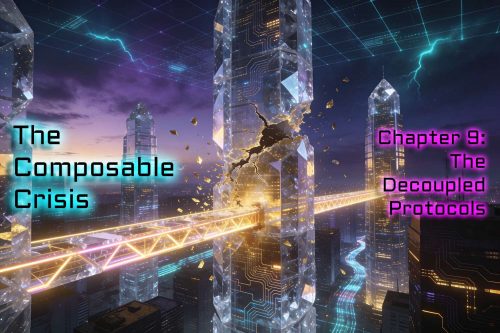
The weeks following the crisis were a blur of meetings, proposals, and endless discussions. The ecosystem was slowly stabilizing, but the wounds were still fresh. Users who had lost everything were struggling to rebuild. Protocols that had nearly collapsed were fighting to regain trust. And at the center of it all, Ravi found himself in an unexpected role: architect of the new system.
He and Talia had been working tirelessly on a proposal they called “Decoupled Protocols.” The idea was simple but revolutionary: instead of building interconnected towers that could collapse together, they would build independent structures that could stand alone.
Ravi stared at the proposal on his screen, his fingers hovering over the keyboard. It was the most important document he’d ever written. If adopted, it would reshape the entire ecosystem. If rejected, the community would remain vulnerable to another crisis.
“Are you ready?” Talia’s voice came through his headset.
Ravi took a deep breath. “Ready.”
“Then let’s do this.”
The community town hall was packed. Hundreds of avatars filled the virtual auditorium, their faces a mix of curiosity, skepticism, and hope. At the front of the room, Ravi and Talia stood behind a holographic podium, their proposal displayed on a massive screen behind them.
Ravi’s heart pounded as he looked out at the crowd. He recognized many of the avatars—users he’d met in the DeFi District, friends who’d followed his strategies, strangers who’d lost money because of his mistakes.
This is my chance to make it right, he thought. This is my chance to build something better.
He stepped forward and began to speak.
“Three weeks ago, our ecosystem nearly collapsed,” Ravi said, his voice steady. “We lost billions of units of value. Thousands of users lost their savings. The protocols we trusted failed us. And we failed each other.”
A murmur rippled through the audience. Ravi paused, letting the words sink in.
“Today, I’m here to propose a solution. It’s not a quick fix. It’s not a bandage. It’s a fundamental redesign of how composability works in our ecosystem.”
He gestured to the screen, which displayed a diagram of the proposed architecture.
“We’re calling it Decoupled Protocols. The idea is simple: each protocol should have independent risk parameters. They shouldn’t rely on the same collateral. They shouldn’t use the same oracles. And they definitely shouldn’t allow cross-collateralization without explicit permission.”
The screen shifted, showing a comparison between the old system and the new one. The old system was a tangled web of connections—protocols linked by shared assets, shared oracles, shared dependencies. The new system was a series of independent structures, connected only by carefully controlled interfaces.
“Right now, if Protocol A fails, Protocol B fails too,” Ravi continued. “And Protocol C. And Protocol D. The entire ecosystem is vulnerable to a single point of failure. Decoupled Protocols changes that. Each protocol stands on its own. If one fails, the others are protected.”
A hand shot up in the audience. Ravi recognized the avatar—a user named YieldMaximizer, who was known for aggressive leverage strategies.
“Your proposal sounds like it’s designed to limit our returns,” YieldMaximizer said, his voice sharp. “If we can’t cross-collateralize, we can’t maximize yield. That’s the whole point of composability.”
Ravi nodded. He’d expected this objection.
“I understand the concern,” he said. “Composability is powerful because it allows us to build on each other’s work. But there’s a difference between building responsibly and building recklessly. What we saw three weeks ago was reckless building.”
“So you’re saying we should be less efficient?”
“I’m saying we should be safer,” Ravi replied. “Efficiency without safety is gambling. And gambling is exactly what caused the crisis.”
YieldMaximizer’s avatar frowned but didn’t respond.
Ravi continued. “Decoupled Protocols isn’t about eliminating composability. It’s about making composability safer. You can still build complex strategies. You just need to do it with explicit permission and clear risk parameters.”
Another hand went up. This time, it was a user named SafetyFirst, who was known for cautious, conservative strategies.
“Your proposal sounds good,” SafetyFirst said. “But how do you enforce these rules? How do you make sure protocols actually follow them?”
Ravi glanced at Talia, who stepped forward.
“That’s where community governance comes in,” Talia said. “We’re proposing a Risk Committee—a group of users who monitor protocol behavior and enforce compliance. The committee would have the authority to pause operations, restrict borrowing, and audit strategies.”
SafetyFirst nodded slowly. “And who’s on this committee?”
“We’re proposing a rotating group of users,” Talia said. “Community members who are elected based on their expertise and their commitment to safety. It’s not perfect, but it’s better than relying on the protocols to police themselves.”
The audience murmured. Some avatars nodded in agreement. Others looked skeptical.
The debate continued for hours. Some users argued that Decoupled Protocols would stifle innovation. Others argued that it was the only way to prevent another crisis. Ravi and Talia answered every question, addressed every concern, and defended every aspect of their proposal.
By the end of the session, the mood in the room had shifted. The skepticism was still there, but it was tempered by a growing sense of possibility. People were starting to believe that a safer ecosystem was possible.
“We’ll be holding a vote on the proposal next week,” the moderator announced. “Please review the materials and make your voice heard.”
The auditorium began to empty. Ravi stood at the podium, watching the avatars depart. His legs were trembling, and his heart was still pounding.
“Did we do it?” he whispered to Talia.
Talia’s avatar smiled. “We made our case. Now it’s up to the community.”
The next few days were a whirlwind of activity. Ravi and Talia worked around the clock, refining their proposal and building support among community members. They hosted small group sessions, answered questions, and addressed concerns.
Ravi found himself in an unexpected role: community organizer. He’d always been a builder, a strategist, someone who worked alone. But now he was connecting with people, listening to their stories, and building consensus.
“You’re good at this,” Talia said one evening, as they reviewed the feedback from the latest session.
“I never thought I’d be,” Ravi admitted. “I always preferred working alone. But this is different. This matters.”
“It does,” Talia said. “And you’re making a difference.”
At 10:00 PM, Ravi received a message from a user he didn’t recognize. The avatar was named NewBuilder, and their profile showed they’d joined the community just a few weeks ago.
“Ravi. I’m new here. I’ve been reading about the crisis, and I’m scared to start building. Everything feels so risky.”
Ravi felt a pang of empathy. He remembered his own early days in the community—the excitement, the fear, the sense of infinite possibility.
“Don’t be scared,” he typed. “Just be careful. Start small. Learn the risks. And never stop asking questions.”
“Your proposal. The Decoupled Protocols. Do you think it’ll pass?”
Ravi paused. “I hope so. I think it’s the right direction. But even if it doesn’t pass, I’ll keep working. I’ll keep pushing for safer systems.”
“Why does it matter so much to you?”
Ravi thought about the question. Why did it matter? Because he’d caused so much harm. Because he’d failed so many people. Because he needed to make it right.
“Because I know what it feels like to lose everything,” he typed. “And I don’t want anyone else to feel that way.”
The vote was scheduled for Friday at noon. Ravi spent the morning in a state of nervous anticipation, unable to focus on anything else. He checked the community dashboard obsessively, watching as the votes rolled in.
The tally was close. For every user who supported Decoupled Protocols, there was another who opposed it. The debate had split the community, and the outcome was uncertain.
At 11:45 AM, Talia called.
“How are you feeling?” she asked.
“Like I’m about to fail,” Ravi admitted. “Like everything I’ve done is going to be rejected.”
“Ravi, even if the proposal doesn’t pass, you’ve already made a difference. You’ve started the conversation. You’ve helped people understand the risks. That matters.”
“I know. But I want it to pass. I want to build something better.”
“Then hope. But even if it doesn’t, don’t give up.”
Ravi nodded. “I won’t.”
At noon, the results were announced.
“The Decoupled Protocols proposal has passed,” the moderator announced. “With 58% of the vote, the community has approved the new framework. Implementation will begin immediately.”
Ravi stared at the announcement, his heart racing. It had passed. The community had chosen safety over efficiency. They’d chosen resilience over yield.
He felt tears well up in his eyes. He’d done it. Together with Talia, he’d done it.
“Ravi?” Talia’s voice came through his headset. “Are you okay?”
“I’m okay,” he said, his voice cracking. “I’m just… I’m really okay.”
The implementation of Decoupled Protocols took months. Ravi worked alongside the core teams, helping to redesign the architecture of the ecosystem. He wrote code, reviewed proposals, and mentored new users.
The changes were gradual, but they were significant. Protocols adopted independent oracles. Risk parameters were isolated. Cross-collateralization became a privilege, not a default.
And slowly, the ecosystem began to heal. Users who had lost everything started to rebuild. New users joined, drawn by the promise of a safer system. Trust, which had been shattered, began to be restored.
Ravi watched it all with a sense of pride. He’d helped build this. He’d helped make it possible.
At 6:00 PM, Ravi received a message from Talia.
“You did good. The new system is everything we hoped it would be.”
Ravi smiled. “We did good. I couldn’t have done it without you.”
“That’s what friends are for.”
Ravi thought about their journey—the warnings, the crisis, the recovery. It had been a long and difficult path, but it had led to something better.
“I’m going to keep building,” he said. “Not just strategies. Systems. Safer systems. Systems that last.”
“That’s the right direction,” Talia said. “And I’ll be right there with you.”
At 8:00 PM, Ravi visited the DeFi District. The virtual city was no longer a shadow of its former self—it was something new. Something better.
Protocol A’s skyscraper had been rebuilt, its foundations stronger than before. Protocol B’s farm had been replanted, its fields greener and more resilient. The bridges connecting the protocols were still there, but they were controlled, monitored, and safe.
Ravi walked through the district, his avatar moving with quiet satisfaction. He passed the monument to the crisis victims, still standing in the center of the city. But now it was surrounded by new construction—the buildings of a new ecosystem.
“This is what we built,” he murmured. “This is what we made possible.”
He thought about the journey—the hubris, the fall, the recovery. It had been painful, but it had been necessary. He’d needed to fail in order to learn. He’d needed to lose in order to build something better.
The bricks are still there, he thought. But now I know how to use them.
He looked at the city one last time, then logged off. The future was bright, and he was ready for it.
Table of contents:
Introduction
Chapter 1: The Bricks of Finance
Chapter 2: A Borrowing Position
Chapter 3: The Yield Farm
Chapter 4: The Leverage Loop
Chapter 5: The Oracle Mismatch
Chapter 6: The Domino Collapse
Chapter 7: The Cascading Liquidation
Chapter 8: The Circuit Breaker
Chapter 9: The Decoupled Protocols
Chapter 10: Interconnected, Not Fragile <<<<<< NEXT
